At t=15msecVin =220sin(100π×15×10−3)=220sin(23π)=−220 V 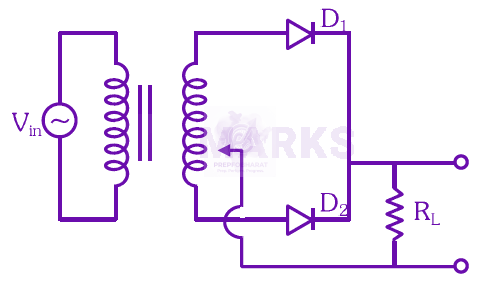
So diode D1 is in reverse bias and D2 is in forward bias
NEET UG 2025 — Physics Modern Physics
A full wave rectifier circuit with diodes (D1) and (D2) is shown in the figure. If input supply voltage Vin =220sin(100πt) volt, then at t=15msec 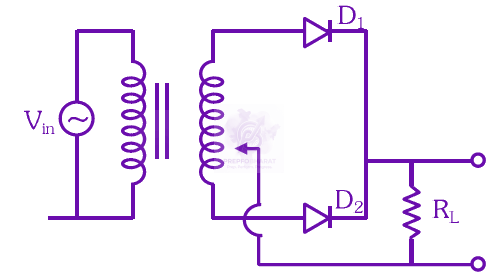
Held on 30 Apr 2025 · Verified 9 Jul 2026.
D1 is forward biased, D2 is reverse biased
D1 is reverse biased, D2 is forward biased
D1 and D2 both are forward biased
D1 and D2 both are reverse biased
Sign in to track your attempts and accuracy.
Sign in to keep a private note on this question. Nothing you write is ever public.
The output $(\mathrm{Y})$ of the given logic implementation is similar to the output of an/a _____ gate. 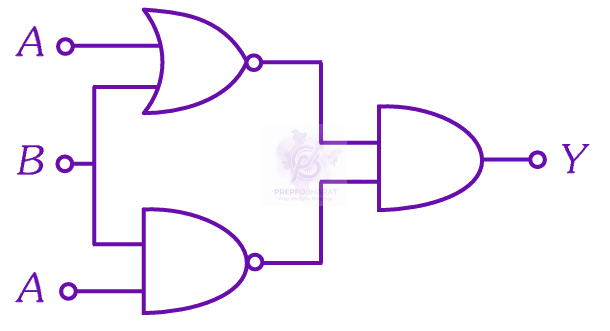
A particle of mass $m$ is moving around the origin with a constant force $F$ pulling it towards the origin. If Bohr model is used to describe its motion, the radius $r$ of the $n^{\text {th }}$ orbit and the particle's speed $v$ in the orbit depend on $n$ as
The maximum kinetic energy of photoelectrons from a surface with work function φ = 2 eV when light of λ = 4000 Å falls on it is (hc = 12400 eV·Å):
A photon and an electron (mass $m$ ) have the same energy $E$. The ratio ( $\lambda_{\text {photon }} / \lambda_{\text {electron }}$ ) of their de Broglie wavelengths is: (c is the speed of light)
De-Broglie wavelength of an electron orbiting in the $n=2$ state of hydrogen atom is close to (Given Bohr radius $=0.052 \mathrm{~nm}$ )
Work through every NEET UG Modern Physics PYQ, year by year.