NEET UG 2016 — Modern Physics
Physics Modern Physics questions from NEET UG 2016.
Other Years
12 Modern Physics Questions from 2016
If an electron in a hydrogen atom jumps from the third orbit to the second orbit, it emits a photon of wavelength $\lambda$. When it jumps from the fourth orbit to the third orbit, the corresponding wavelength of the photon will be
Electrons of mass, $m$ with de-Broglie wavelength, $\lambda$ fall on the target in an X-ray tube. The cutoff wavelength, $({\lambda }_{0})$ of the emitted X-ray is
The given circuit has two ideal diodes connected as shown in the figure below. The current flowing through the resistance ${R}_{1}$ will be 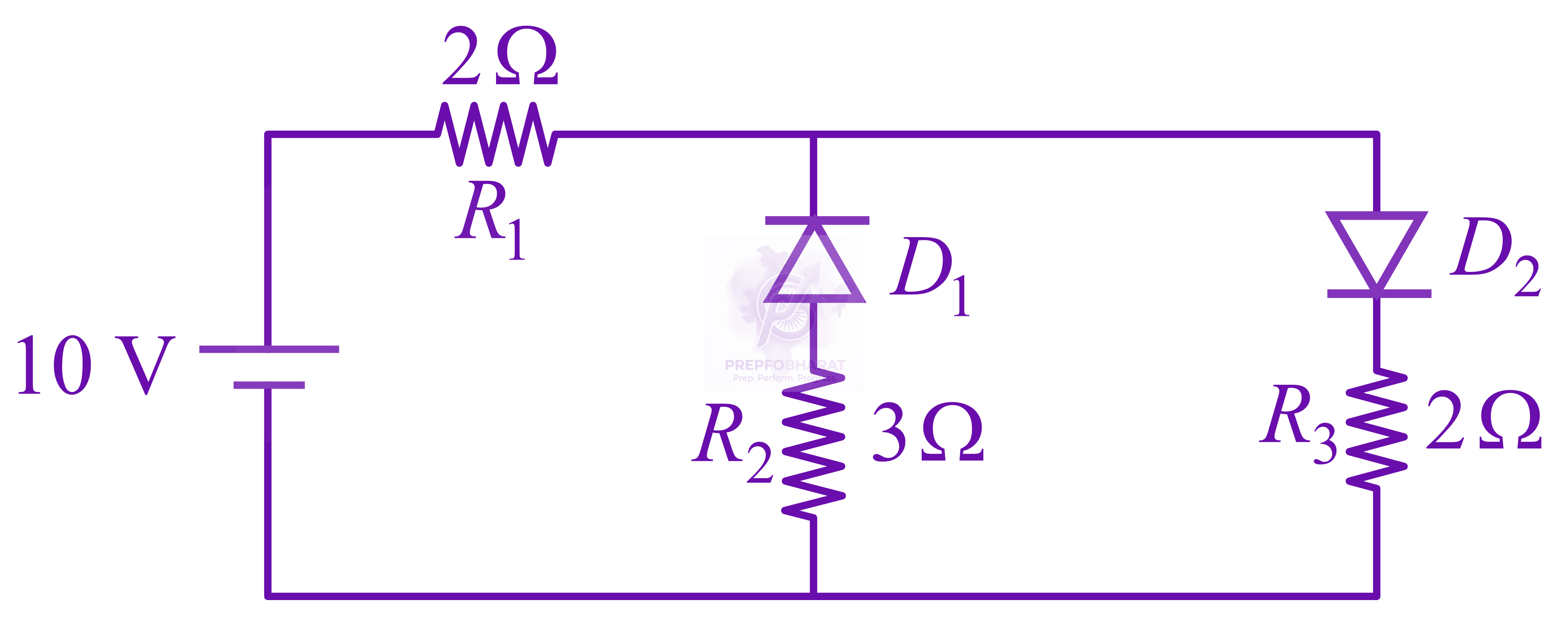
To get output $1$ for the following circuit, the correct choice for the input is: 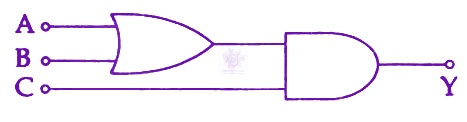
The half-life of a radioactive substance is $30\mathrm{min}$. The time (in minutes) taken between $40%$ decay and $85%$ decay of the same radioactive substance is
Photons with energy of $5\mathrm{eV}$ are incident on a cathode, $C$ in a photoelectric cell. The maximum energy of emitted photoelectrons is $2 eV.$ When photons of energy $6eV$ are incident on $C$, no photoelectrons will reach the anode, $A$, if, the stopping potential of $A$ relative to $C$ is
Given the value of Rydberg constant is ${10}^{7} {m}^{-1}$, the wave number of the last line of the Balmer series in hydrogen spectrum will be:
When an $\alpha$ -particle of mass $m$ moving with a undefined velocity bombards on a heavy nucleus of charge $\mathrm{Ze}$, its distance of the closest approach from the nucleus depends on $m$ as:
What is the output $Y$ in the following circuit, when, all the three inputs $A, B, C$ are first $0$ and then, $1$? 
When a metallic surface is illuminated with radiation of wavelength $\lambda$, the stopping potential is $V$. If the same surface is illuminated with radiation of wavelength $2\lambda$, the stopping potential is $\frac{V}{4}$. The threshold wavelength for the metallic surface is:
An electron of mass m and a photon have same energy $E.$ The ratio of de-Broglie wavelengths associated with them is: ($c$ being velocity of light)
Consider the junction diode as ideal. The value of current flowing through AB is: 