NEET UG 2018 — Modern Physics
Physics Modern Physics questions from NEET UG 2018.
Other Years
7 Modern Physics Questions from 2018
In the circuit shown in the figure, the input voltage ${V}_{i} \text{is} 20 V, {V}_{BE}=0 \text{and} {V}_{CE}=0$. The values of ${I}_{B},{I}_{C} \text{and} \beta$ are given by 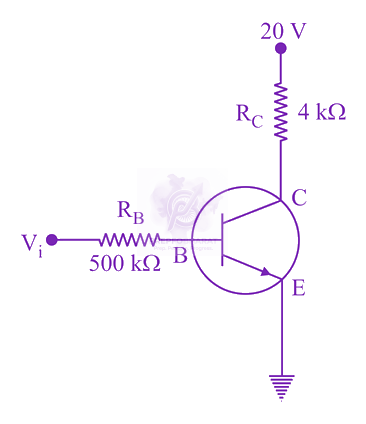
In the combination of the following gates the output $Y$ can be written in terms of inputs $A$ and $B$ as 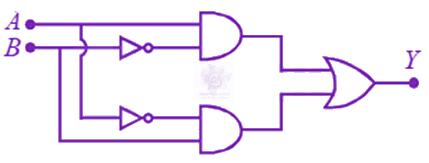
The ratio of kinetic energy to the total energy of an electron in a Bohr orbit of the hydrogen atom is
An electron of mass $m$ with an initial velocity $\vec{V}={V}_{0} \hat{i} ({V}_{0}>0)$ enters in an electric field $\vec{E}={-E}_{0}\hat{i}({E}_{0}>0$ and is a constant$)$ at $t=0$. If ${\lambda }_{0}$ is its de-Broglie wavelength initially, then its de-Broglie wavelength at time $t$ is
When the light of frequency $2{\nu }_{0}$ (where ${\nu }_{0}$ is threshold frequency), is incident on a metal plate, the maximum velocity of electrons emitted is ${v}_{1}$. When the frequency of the incident radiation is increased to $5{\nu }_{0},$ the maximum velocity of electrons emitted from the same plate is ${v}_{2}.$ The ratio of ${v}_{1} to {v}_{2}$ is
In a $p-n$ junction diode, change in temperature due to heating
For a radioactive material, the half-life is $10\mathrm{minutes}$. If initially there are $600$ number of nuclei, the time taken (in $\mathrm{minutes}$) for the disintegration of $450$ nuclei is