NEET UG 2022 — Modern Physics
Physics Modern Physics questions from NEET UG 2022.
Other Years
14 Modern Physics Questions from 2022
The incorrect statement about the property of a Zener diode is:
When two monochromatic lights of frequency, $\nu$ and $\frac{\nu }{2}$ are incident on a photoelectric metal, their stopping potential becomes $\frac{{V}_{S}}{2}$ and ${V}_{s}$ respectively. The threshold frequency for this metal is:
The threshold frequency of a photoelectric metal is $v_0$. If light of frequency $4 v_0$ is incident on this metal, then the maximum kinetic energy of emitted electrons will be:
A nucleus of mass number $189$ splits into two nuclei having mass number $125$ and $64$. The ratio of radius of two daughter nuclei respectively is:
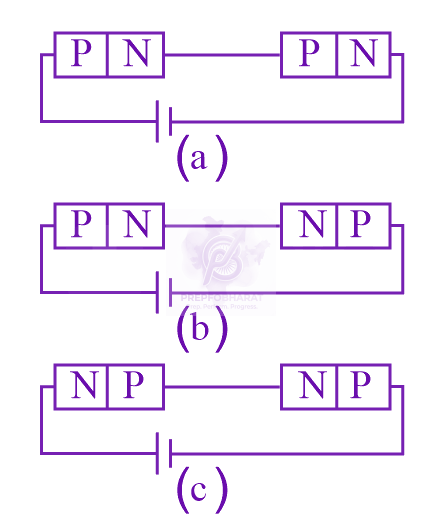 In the given circuits (a), (b) and (c), the potential drop across the two $p-n$ junctions are equal in:
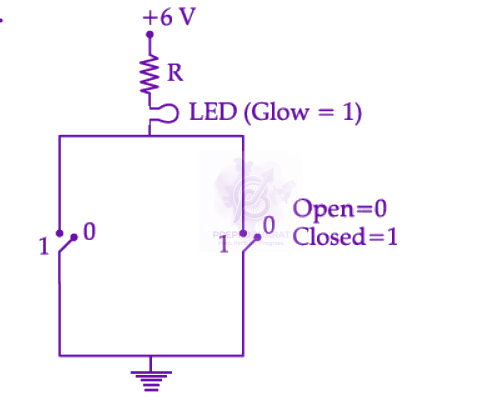 Identify the equivalent logic gate represented by the given circuit:
The light rays having photons of energy $4.2 \mathrm{eV}$ are falling on a metal surface having a work function of $2.2 \mathrm{eV}$. The stopping potential of the surface is:
The graph which shows the variation of the de Broglie wavelength $(\lambda )$ of a particle and its associated momentum $(p)$ is :
At any instant, two elements $X_1$ and $X_2$ have same number of radioactive atoms. If the decay constant of $X_1$ and $X_2$ are $10 \lambda$ and $\lambda$ respectively. Then the time when the ratio of their atoms becomes $\frac{1}{e}$ respectively will be:
Let ${T}_{1}$ and ${T}_{2}$ be the energy of an electron in the first and second excited states of hydrogen atom, respectively. According to the Bohr's model of an atom, the ratio ${T}_{1}:{T}_{2}$ is
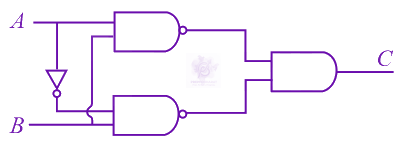 The truth table for the given logic circuit is:
Given below are two statements: Statement I: The law of radioactive decay states that the number of nuclei undergoing the decay per unit time is inversely proportional to the total number of nuclei in the sample. Statement II: The half life of a radionuclide is the sum of the life time of all nuclei, divided by the initial concentration of the nuclei at time $t=0$. In the light of the above statements, choose the most appropriate answer from the options given below:
Let $R_1$ be the radius of the second stationary orbit and $R_2$ be the radius of the fourth stationary orbit of an electron in Bohr's model. The ratio $\frac{R_1}{R_2}$ is:
In the given nuclear reaction, the element $X$ is $\mathrm{Na}1122\rightarrow X+{e}^{+}+v$