NEET UG 2015 — Modern Physics
Physics Modern Physics questions from NEET UG 2015.
Other Years
12 Modern Physics Questions from 2015
In the given figure, a diode $D$ is connected to an external resistance $R=100\Omega$ and an $emf$ of $3.5V$ If the barrier potential developed across the diode is $0.5V$, the current in the circuit will be 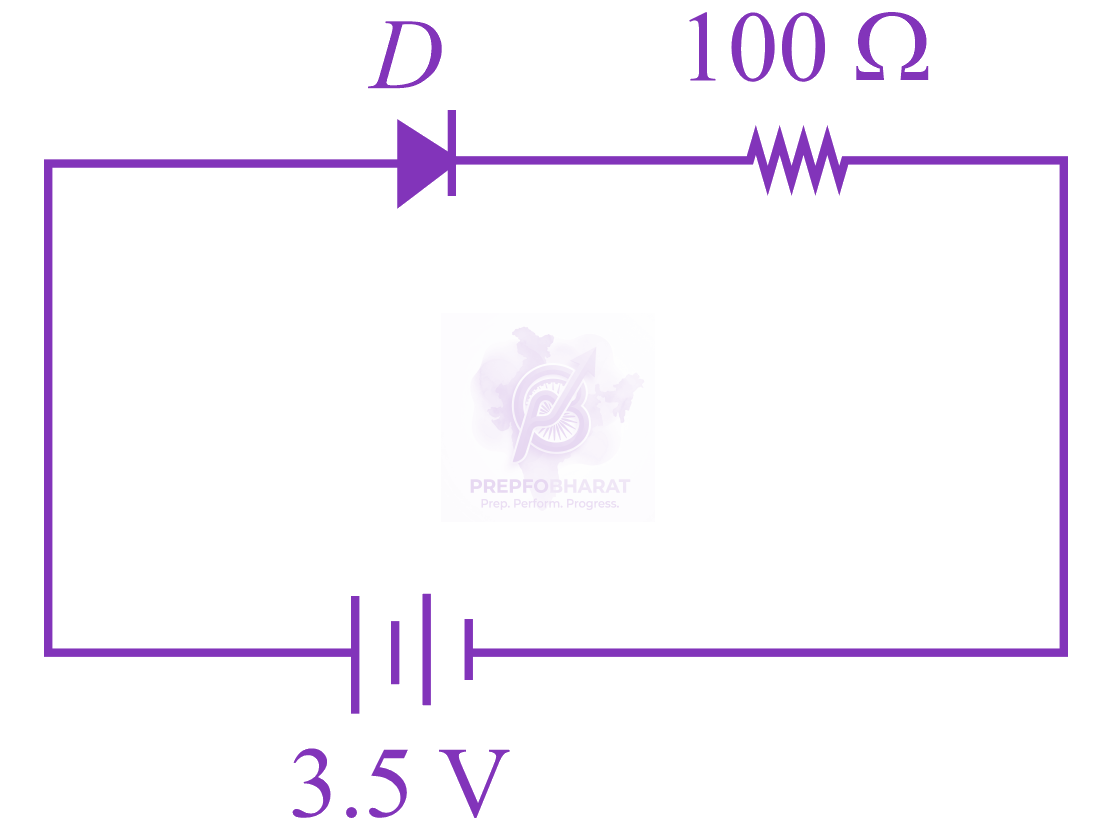
A nucleus of uranium decays at rest into nuclei of thorium and helium. Then:
When a certain metallic surface is illuminated with monochromatic light of wavelength $\lambda ,$ the stopping potential for photoelectric current is $3{V}_{0}$ and when the same surface is illuminated with light of wavelength $2\lambda ,$ the stopping potential is ${V}_{0}.$ The threshold wavelength of this surface for photoelectric effect is
The input signal is given to a CE amplifier having a voltage gain of $150$ is ${V}_{i}=2\mathrm{cos}(15t+\frac{\pi }{3})$. The corresponding output signal will be:
If radius of the $A1327l$ nucleus is taken to be ${R}_{Al}$ then the radius of $Te53125$ nucleus is nearly
If in a p-n junction, a square input signal of $10V$ is applied as shown, then the output across ${R}_{L}$ will be 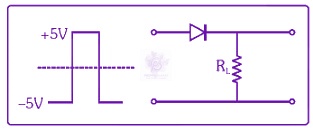
Light of wavelength $500\mathrm{nm}$ is incident on a metal with work function $2.28\mathrm{eV}$. The de Broglie wavelength of the emitted electron is:
A photoelectric surface is illuminated successively by monochromatic light of wavelength $\lambda$ and $\frac{\lambda }{2}$. If the maximum kinetic energy of the emitted photoelectrons in the second case is 3 times that in the first case, the work function of the surface of the material is: ($h$ = Planck's constant, $c$ = speed of light)
Which logic gate is represented by the following combination of logic gates? 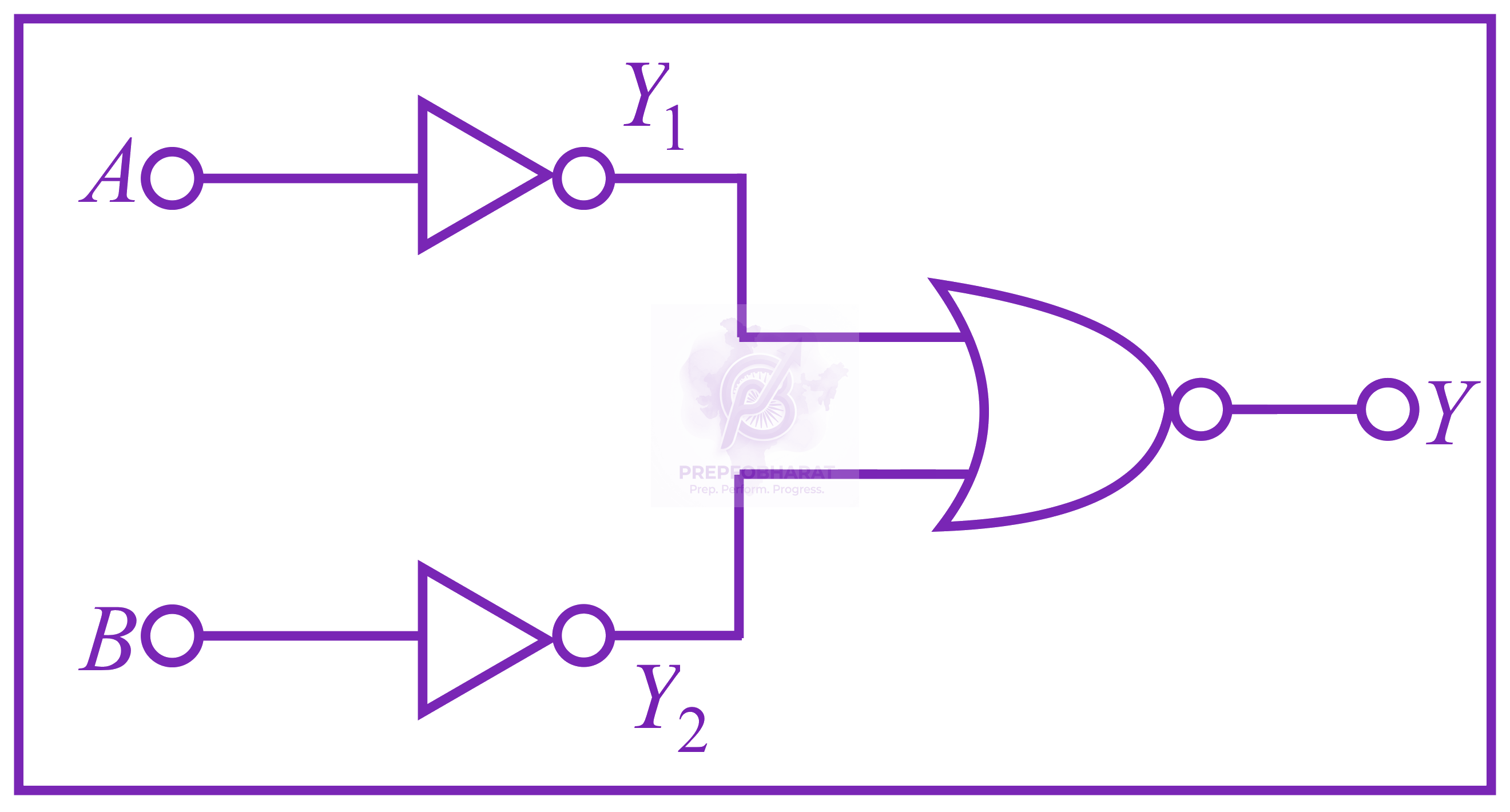
Which of the following figures represent the variation of particle momentum and the associated de-Broglie wavelength?
In the spectrum of hydrogen, the ratio of the longest wavelength in the Lyman series to the longest wavelength in the Balmer series is:
Consider third orbit of ${\mathrm{He}}^{+}$ (helium), using non-relativistic approach, the speed of electron in this orbit will be given constant $K{\text{=9×10}}^{\text{9}}$, $Z=2$ and $h$ (Planck's Constant)$\text{= 6}\text{.6 }\times {\text{ 10}}^{-34}\text{ J s}$