NEET UG 2013 — Modern Physics
Physics Modern Physics questions from NEET UG 2013.
Other Years
14 Modern Physics Questions from 2013
Ratio of longest wavelengths corresponding to Lyman and Balmer series in hydrogen spectrum is
How does the Binding Energy per nucleon vary with the increase in the number of nucleons?
An electron in hydrogen atom makes a transition $n_1 \rightarrow n_2$ where $n_1$ are principle quantum numbers of the two states. Assuming Bohr's model to be valid, the time period of the electron in the initial state is eight times that in the final state. The possible values of $n_1$ and $n_2$ are:
In a $n$-type semiconductor, which of the following statement is true?
The wavelength $\lambda_e$ of an electron and $\lambda_p$ of a photon of same energy $E$ are related by
A certain mass of hydrogen is changed to helium by the process of fusion. The mass defect in fusion reaction is $0.02866 \mathrm{u}$. The energy liberated per $u$ is (given $1 \mathrm{u}=931 \mathrm{MeV}$ )
The de-Broglie wavelength of neutrons in thermal equilibrium at temperature $T$ is:
For photoelectric emission from certain metal the cut-off frequency is $v$. If radiation of frequency $2 \mathrm{v}$ impinges on the metal plate, the maximum possible velocity of the emitted electron will be ( $m$ is the electron mass)
$\alpha$-particle, $\beta$-particle and $\gamma$-rays are all having same energy. Their penetrating power in a given medium in incresing order will be:
In an unbiased $p-n$ junction holes from the p-region to $n$-region because of:
A source of light is placed at a distance of $50 \mathrm{~cm}$ from a photo cells and the stopping potential is found to be $\mathrm{V}_{0^*}$. If the distance between the light source and photo cells is made $25 \mathrm{~cm}$, the new stopping potential will be:
The output from a NAND gate is divided into two in parallel and fed to another NAND gate. The resulting gate is a: 
The output $(X)$ of the logic circuit shown in figure will be 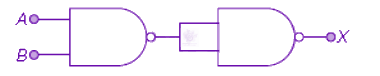
The half-life of a radioactive isotope $X$ is $20 \mathrm{yr}$. It decays to another element $Y$ which is stable. The two elements $X$ and $Y$ were found to be in the ratio $1: 7$ in a sample of a given rock. The age of the rock is estimated to be