NEET UG 2013 — Mechanics
Physics Mechanics questions from NEET UG 2013.
Other Years
26 Mechanics Questions from 2013
Three blocks with masses $m, 2 m$ and $3 m$ are connected by strings, as shown in the figure. After an upward force $F$ is applied on block $m$, the masses move upward at constant speed $v$. What is the net force on the block of mass $2 m ?$ 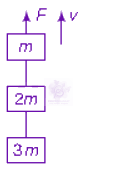
One coolie takes 1 minute to raise a suitcase through a height of $2 \mathrm{~m}$ but the second coolie takes $30 \mathrm{~s}$ to raise the same suitcase to the same height. The power two coolies are in the ratio
The following four wires are made of the same material. Which of these will have the largest extension when the same tension is applied?
A particle with total energy $E$ is moving in a potential energy region $U(x)$. Motion of the particle is restricted to the region when:
In an experiment four quantities $a, b, c$ and $d$ are measured with percentage error $1 \%, 2 \%, 3 \%$ and $4 \%$ respectively. Quantity $P$ is calculated as follows $P=\frac{a^3 b^2}{c d} \%$, Error in $P$ is
A uniform force of $(3 \mathbf{i}+\mathbf{j}) \mathrm{N}$ acts on a particle of mass $2 \mathrm{~kg}$. Hence the particle is displaced from position $(2 \mathbf{i}+\mathbf{k}) \mathrm{m}$ to position $(4 \mathbf{i}+3 \mathbf{j}-\mathbf{k}) \mathrm{m}$. The work done by the force on the particle is
In the ratio of diameters, lengths and Young's modulus of steel and copper wires shown in the figure are $p, q$ and $s$ respectively, then the corresponding ratio of increase in their length would be:
A small object of uniform density rolls up a curved surface with an initial velocity $v^{\prime}$. It reaches up to a maximum height of $\frac{3 v^2}{4 g}$ with respect to the initial position. The object is
The radius of planet is twice the radius of earth. Both have almost equal averge mass densities $V_P$ and $V_E$ are escape velocities of the planet and the earth respectively, then:
A fluid is in streamline flow across a horizontal pipe of variable area of cross section. For this which of the following statements is correct?
A car is moving in a circular horizontal track of radius $10 \mathrm{~m}$ the roof of the car by a light wire of length $1.0 \mathrm{~m}$. The angle made by the wire with the vertical is: 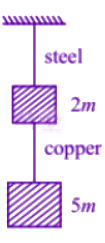
The velocity of a projectile at the initial point $A$ is $(2 \mathbf{i}+3 \mathbf{j}) \mathrm{m} / \mathrm{s}$. Its velocity (in $\mathrm{m} / \mathrm{s}$ ) at point $B$ is 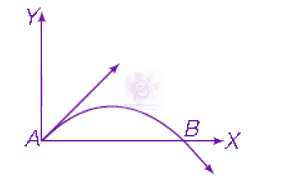
The ratio of radii of gyration of a circular ring and a circular disc, of the same mass and radius about an axis passing through their centres and perpendicular to their planes are:
The discs are rotating about their axes, normal to the discs and passing through the centres of the discs. Disc $D_1$ has $2 \mathrm{~kg}$ mass and $0.2 \mathrm{~m}$ radius and initial angular velocity of $50 \mathrm{rad} \mathrm{s}^{-1}$. Disc $\mathrm{D}_2$ has $4 \mathrm{~kg}$ mass, $0.1 \mathrm{~m}$ radius and initial angular velocity of $200 \mathrm{rad} \mathrm{s}^{-1}$. The two discs are brought in contact face to face, with their axes of rotation coincident. The final angular velocity (in rad $s^{-1}$ ) of the system is:
The wettability of a surface by a liquid depends primarily on
A body of mass $m$ taken from the earth's surface to the height equal to twice the radius $(R)$ of the earth. The change is potential energy of body will be
Vectors $\vec{A}, \vec{B}$, and $\vec{C}$ are such $\vec{A} \cdot \vec{B}=0$ $\vec{A} \cdot \vec{C}=0$. Then the vector parallel is $\vec{A}$ is:
An explosion breaks a rock into three parts in a horizontal plane. Two of them go off at right angles to each other. The first part of mass $1 \mathrm{~kg}$ moves with a speed of $12 \mathrm{~ms}^{-1}$ and the second part of mass $2 \mathrm{~kg}$ moves with $8 \mathrm{~ms}^{-1}$ speed. If the third part flies off with $4 \mathrm{~ms}^{-1}$ speed, then its mass is
A $\operatorname{rod} P Q$ of mass $M$ and length $L$ is hinged at end $P$. The rod is kepts horizontal by a massless string tied to point $Q$ as shown in figure. When string is cut, the initial angular acceleration of the rod is 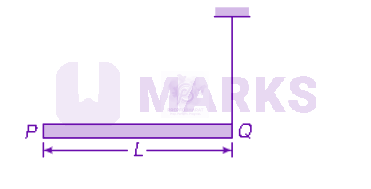
A person holding a rifle (mass of person and rifle together is $100 \mathrm{~kg}$ ) stands on a smooth surface and fires 10 shots horizontally, in $5 \mathrm{~s}$. Each bullet has a mass of $10 \mathrm{~g}$ with a muzzle velocity of $800 \mathrm{~ms}^{-1}$. The final velocity acquired by the person and the average force exerted on the person are:
Infinite number of bodies, each of mass $2 \mathrm{~kg}$ are situated on $x$-axis at distance $1 \mathrm{~m}, 2 \mathrm{~m}, 4 \mathrm{~m}, 8 \mathrm{~m}$, respectively from the origin. The resulting gravitational potential due to this system at the origin will be
The upper half of an inclined plane of inclination $\theta$ is perfectly smooth while lower half is rough. A block starting from rest at the top of the plane will again come to rest at the bottom, if the coefficient of friction between the block and lower half of the plane is given by
The pair of quantities having same dimensions is:
The displacement ' $x$ ' (in meter) of a particle of mass ' $m$ ' (in kg) moving in one dimension under the action of a force, is related to time ' $t$ ' (in sec) by $t=\sqrt{x}+3$. The displacement of the particle when its velocity is zero will be:
A stone falls freely under gravity. It covers distances $h_1, h_2$ and $h_3$ in the first 5 seconds, the next 5 seconds and the next 5 seconds respectively. The relation between $h_1, h_2$ and $h_3$ is
A particle of mass ' $m$ ' is kept at rest at a height $3 R$ from the surface of earth, where ' $R$ ' is radius of earth and ' $M$ ' is mass of earth. The minimum speed with which is should be projected, so that it does not return back, is $(g$ is acceleration due to gravity on the surface of earth)