Loss of energy, ΔE=21Itωi2−21(It+Ib)It2ωi2 =21(It+Ib)IbItωi2
A circular disk of moment of inertia I_t is rotating in a horizontal plane, about its symmetry axis, with a constant angular speed ω_i. Another disk…
NEET UG 2010 — Physics Mechanics
2010mcqmedium
A circular disk of moment of inertia It is rotating in a horizontal plane, about its symmetry axis, with a constant angular speed ωi. Another disk of moment of inertia Ib is dropped coaxially onto the rotating disk. Initially the second disk has zero angular speed. Eventually both the disks rotate with a constant angular speed ωf. The energy lost by the initially rotating disc due to friction is
Official previous-year question
Held on 30 Apr 2010 · Verified 9 Jul 2026.
Options
- A
21(It+Ib)Ib2ωi2
- B
21(It+Ib)It2ωi2
- C
21(It+Ib)Ib−Itωi2
- D
21(Lt+Ib)IbItωi2
Did you get this right?
Sign in to track your attempts and accuracy.
Your note
Sign in to keep a private note on this question. Nothing you write is ever public.
NEET UG Mechanics in other years
More NEET UG Mechanics questions
A bullet of mass 10 g moving with 400 m/s penetrates a wall and comes to rest. The loss in kinetic energy is:
2026easy
A physical quantity $P$ is related to four observations $a, b, c$ and $d$ as follows : $P=a^3 b^2 / c \sqrt{d}$ The percentage errors of measurement in $a, b, c$ and $d$ are $1 \%, 3 \%, 2 \%$ and $4 \%$ respectively. The percentage error in the quantity $P$ is
2025medium
A uniform rod of mass 20 kg and length 5 m leans against a smooth vertical wall making an angle of $60^{\circ}$ with it. The other end rests on a rough horizontal floor. The friction force that the floor exerts on the rod is (take $\mathrm{g}=10 \mathrm{~m} / \mathrm{s}^2$ )
2025medium
The radius of Martian orbit around the Sun is about 4 times the radius of the orbit of Mercury. The Martian year is 687 Earth days. Then which of the following is the length of 1 year on Mercury?
2025medium
Consider a water tank shown in the figure. It has one wall at $x=L$ and can be taken to be very wide in the $z$ direction. When filled with a liquid of surface tension $S$ and density $\rho$, the liquid surface makes angle $\theta_0\left(\theta_0 \ll 1\right)$ with the $x$-axis at $x=L$. If $y(x)$ is the height of the surface then the equation for $y(x)$ is: 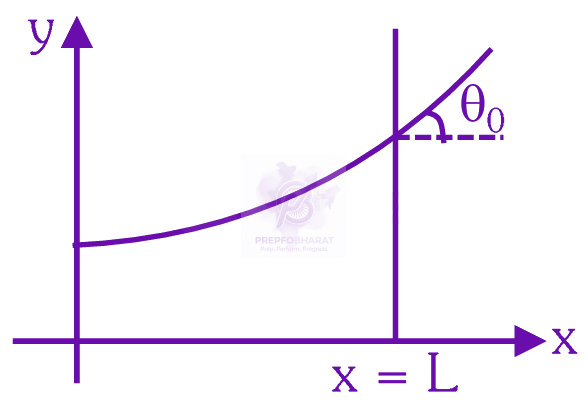 $\left(\operatorname{take} \theta(x)=\sin \theta(x)=\tan \theta(x)=\frac{d y}{d x}, g\right.$ is the acceleration due to gravity)
2025hard
Other Physics topics for NEET UG
Keep practicing Mechanics
Work through every NEET UG Mechanics PYQ, year by year.