Waves & Oscillations PYQ — Page 4
JEE Main Physics — Waves & Oscillations previous year questions with solutions.
All Waves & Oscillations Questions (340)
A simple pendulum is placed at a place where its distance from the earth's surface is equal to the radius of the earth. If the length of the string is $4m$, then the time period of small oscillations will be _________$s$. $[$take $g={\pi }^{2}m{s}^{-2}$]
A tuning fork resonates with a sonometer wire of length $1m$ stretched with a tension of $6N.$ When the tension in the wire is changed to $54N,$ the same tuning fork produces $12$ beats per second with it. The frequency of the tuning fork is _______ $\mathrm{Hz}.$
The displacement of a particle executing SHM is given by $x=10 \sin \left(w t+\frac{\pi}{3}\right) m$. The time period of motion is $3.14 \mathrm{~s}$. The velocity of the particle at $t=0$ is ______$\mathrm{m} / \mathrm{s}$.
A rectangular block of mass $5\mathrm{kg}$ attached to a horizontal spiral spring executes simple harmonic motion of amplitude $1m$ and time period $3.14s$. The maximum force exerted by spring on block is ___ $N$.
A particle executes simple harmonic motion between $x=–A\text{and}x=+A$. If time taken by particle to go from $x=0$ to $\frac{A}{2}$ is $2s$; then time taken by particle in going from $x=\frac{A}{2}$ to $A$ is:
A mass $m$ attached to free end of a spring executes SHM with a period of $1s$. If the mass is increased by $3\mathrm{kg}$ the period of oscillation increases by one second, the value of mass $m$ is ________ $\mathrm{kg}$.
A steel wire with mass per unit length $7.0\times {10}^{–3}\mathrm{kg}{m}^{–1}$ is under tension of $70N$. The speed of transverse waves in the wire will be:
The maximum potential energy of a block executing simple harmonic motion is $25J$. A is amplitude of oscillation. At $\frac{A}{2}$, the kinetic energy of the block is
At a given point of time the value of displacement of a simple harmonic oscillator is given as $y=A\mathrm{cos}(30^{\circ}).$ If amplitude is $40\mathrm{cm}$ and kinetic energy at that time is $200J,$ the value of force constant $1.0\times {10}^{x}N{m}^{–1}$. The value of $x$ is _____.
The ratio of speed of sound in hydrogen gas to the speed of sound in oxygen gas at the same temperature is:
The distance between two consecutive points with phase difference of $60^{\circ}$ in a wave of frequency $500\mathrm{Hz}$ is $6.0m$. The velocity with which wave is travelling is ______ $\mathrm{km}{s}^{-1}$.
A particle executes SHM of amplitude$A$. The distance from the mean position when its kinetic energy becomes equal to its potential energy is:
A particle is executing simple harmonic motion (SHM). The ratio of potential energy and kinetic energy of the particle when its displacement is half of its amplitude will be
Match List I with List II <table class="pyq-table"><tbody><tr><td></td><td>List I</td><td></td><td>List II</td></tr><tr><td>A</td><td>Troposphere</td><td>I</td><td>Approximate $65-75\mathrm{km}$ over Earth’s surface</td></tr><tr><td>B</td><td>E-Part of Stratosphere</td><td>II</td><td>Approximate $300\mathrm{km}$ over Earth’s surface</td></tr><tr><td>C</td><td>${F}_{2}$-Part of Thermosphere</td><td>III</td><td>Approximate $10\mathrm{km}$ over Earth’s surface</td></tr><tr><td>D</td><td>D-Part of Stratosphere</td><td>IV</td><td>Approximate $100\mathrm{km}$ over Earth’s surface</td></tr></tbody></table>Choose the correct answer from the options given below :
Choose the correct length $(L)$ versus square of time period $({T}_{2})$ ) graph for a simple pendulum executing simple harmonic motion.
Two tuning forks A and B produce 4 beats per second. Fork A has frequency 256 Hz. When B is loaded with wax, beats become 6 per second. The frequency of B is:
An organ pipe $40\mathrm{cm}$ long is open at both ends. The speed of sound in air is $360m{s}^{-1}$. The frequency of the second harmonic is _$________\mathrm{Hz}.$
A guitar string of length $90\mathrm{cm}$ vibrates with a fundamental frequency of $120\mathrm{Hz}$. The length of the string producing a fundamental of $180\mathrm{Hz}$ will be _____ $\mathrm{cm}$
A transverse harmonic wave on a string is given by $y(x,t)=5\mathrm{sin}(6t+0.003x)$ where $x$ and $y$ are in $\mathrm{cm}$ and $t$ in $\mathrm{sec}$. The wave velocity is _________ $m{s}^{-1}$.
In the figure given below. a block of mass $M=490g$ placed on a frictionless table is connected with two springs having same spring constant ($K=2N{m}^{-1}$). If the block is horizontally displaced through $X$ $m$ then the number of complete oscillations it will make in $14\pi$ seconds will be ______. 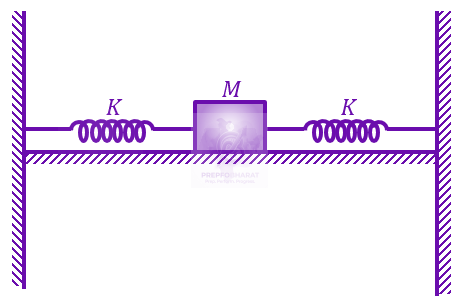
The amplitude of a particle executing SHM is $3\mathrm{cm}$. The displacement at which its kinetic energy will be $25%$ more than the potential energy is: ______ $\mathrm{cm}$.
A block of mass $2\mathrm{kg}$ is attached with two identical springs of spring constant $20N{m}^{-1}$ each. The block is placed on a frictionless surface and the ends of the springs are attached to rigid supports (see figure). When the mass is displaced from its equilibrium position, it executes a simple harmonic motion. The time period of oscillation is $\frac{\pi }{\sqrt{X}}$ in SI unit. The value of $X$ is______. 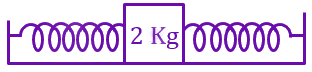
A travelling wave is described by the equation $y(x,t)=[0.05\mathrm{sin}(8x-4t)]m$. The velocity of the wave is: [All the quantities are in SI unit]
Two simple harmonic waves having equal amplitudes of $8\mathrm{cm}$ and equal frequency of $10\mathrm{Hz}$ are moving along the same direction. The resultant amplitude is also $8\mathrm{cm}$. The phase difference between the individual waves is _____ degree.