Waves & Oscillations PYQ — Page 5
JEE Main Physics — Waves & Oscillations previous year questions with solutions.
All Waves & Oscillations Questions (340)
In a linear Simple Harmonic Motion (SHM) (A) Restoring force is directly proportional to the displacement. (B) The acceleration and displacement are opposite in direction. (C) The velocity is maximum at mean position. (D) The acceleration is minimum at extreme points. Choose the correct answer from the options given below:
The variation of kinetic energy (KE) of a particle executing simple harmonic motion with the displacement ($x$) starting from mean position to extreme position ($A$) is given by
The displacement equations of two interfering waves are given by ${y}_{1}=10\mathrm{sin}(\omega t+\frac{\pi }{3})\mathrm{cm}$, ${y}_{2}=5[\mathrm{sin}(\omega t)+\sqrt{3}\mathrm{cos}\omega t]\mathrm{cm}$ respectively. The amplitude of the resultant wave is _____ $\mathrm{cm}$.
A simple pendulum with length $100\mathrm{cm}$ and bob of mass $250g$ is executing S.H.M of amplitude $10\mathrm{cm}$. The maximum tension in the string is found to be $\frac{x}{40}N$. The value of $x$ is _____.
Which graph represents the difference between total energy and potential energy of a particle executing $\mathrm{SHM}$ vs its distance from mean position?
For a periodic motion represented by the equation $y=sin\omega t+cos\omega t$ the amplitude of the motion is
In an experiment with sonometer when a mass of $180g$ is attached to the string, it vibrates with fundamental frequency of $30\mathrm{Hz}$. When a mass $m$ is attached, the string vibrates with fundamental frequency of $50\mathrm{Hz}$. The value of $m$ is ______ $g$.
For a certain organ pipe, the first three resonance frequencies are in the ratio of $1:3:5$ respectively. If the frequency of fifth harmonic is $405\mathrm{Hz}$ and the speed of sound in air is $324m{s}^{–1}$ the length of the organ pipe is _____ $m$.
For particle $P$ revolving round the centre $O$ with radius of circular path $r$ and regular velocity $\omega$, as shown in below figure, the projection of $OP$ on the $x$-axis at time $t$ is 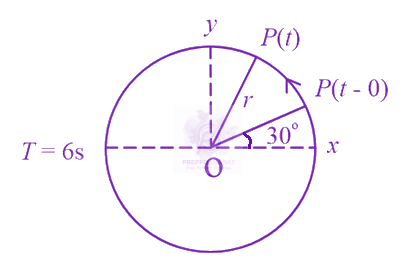
A wire of density $8\times {10}^{3}\mathrm{kg}{m}^{-3}$ is stretched between two clamps $0.5m$ apart. The extension developed in the wire is $3.2\times {10}^{-4}m$. If $Y=8\times {10}^{10}N{m}^{-2}$, the fundamental frequency of vibration in the wire will be _____ $\mathrm{Hz}$
A particle of mass $250g$ executes a simple harmonic motion under a periodic force $F=(–25x)N$. The particle attains a maximum speed of $4m{s}^{-1}$ during its oscillation. The amplitude of the motion is ______$\mathrm{cm}$.
The equation of wave is given by $Y={10}^{-2}\mathrm{sin}2\pi (160t-0.5x+\frac{\pi }{4})$, where $x$ and $Y$ are in $m$ and $t$ in $s$. The speed of the wave is _______ $\mathrm{km}{h}^{-1}$.
The velocity of a particle executing SHM varies with displacement ($x$) as $4{v}^{2}=50–{x}^{2}$. The time period of oscillations is $\frac{x}{7}s$. The value of $x$ is ______. [Take $\pi =\frac{22}{7}$]
For a simple harmonic motion in a mass spring system shown, the surface is frictionless. When the mass of the block is $1\mathrm{kg}$, the angular frequency is ${\omega }_{1}$. When the mass block is $2\mathrm{kg}$ the angular frequency is ${\omega }_{2}$. The ratio $\frac{{\omega }_{2}}{{\omega }_{1}}$ is : 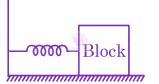
The fundamental frequency of vibration of a string between two rigid support is $50\mathrm{Hz}$. The mass of the string is $18g$ and its linear mass density is $20g{m}^{-1}$. The speed of the transverse waves so produced in the string is _______ $m{s}^{–1}$.
A particle executes S.H.M. of amplitude $A$ along $x$-axis. At $t=0$, the position of the particle is $x=\frac{A}{2}$ and it moves along positive $x$-axis. The displacement of particle in time $t$ is $x=A\mathrm{sin}(\omega t+\delta )$, then the value $\delta$ will be
The general displacement of a simple harmonic oscillator is $x=A\mathrm{sin}\omega t$. Let $T$ be its time period. The slope of its potential energy ($U$) – time ($t$) curve will be maximum when $t=\frac{T}{\beta }$. The value of $\beta$ is ______.
For a solid rod, the Young's modulus of elasticity is $3.2\times {10}^{11}N{m}^{-2}$ and density is $8\times {10}^{3}\mathrm{kg}{m}^{-3}$. The velocity of longitudinal wave in the rod will be
Sound travels in a mixture of two moles of helium and $n$ moles of hydrogen. If rms speed of gas molecules in the mixture is $\sqrt{2}$ times the speed of sound, then the value of $n$ will be
A transverse wave is represented by $y=2\mathrm{sin}(\omega t-kx)\mathrm{cm}$. The value of wavelength (in $\mathrm{cm}$) for which the wave velocity becomes equal to the maximum particle velocity, will be
A particle executes simple harmonic motion. Its amplitude is $8\mathrm{cm}$ and time period is $6s$. The time it will take to travel from its position of maximum displacement to the point corresponding to half of its amplitude, is _____ $s$
In an experiment to determine the velocity of sound in air at room temperature using a resonance tube, the first resonance is observed when the air column has a length of $20.0\mathrm{cm}$ for a tuning fork of frequency $400\mathrm{Hz}$ is used. The velocity of the sound at room temperature is $336{ms}^{-1}$. The third resonance is observed when the air column has a length of _____ $\mathrm{cm}$
A simple pendulum has time period T. If its length is increased by 21% the new time period is:
The speed of sound in air at 0°C is 332 m/s. The speed at 20°C is approximately: