Waves & Oscillations PYQ — Page 3
JEE Main Physics — Waves & Oscillations previous year questions with solutions.
All Waves & Oscillations Questions (340)
Displacement of a wave is expressed as $x(t)=5 \cos \left(628 t+\frac{\pi}{2}\right) m$. The wavelength of the wave when its velocity is $300 \mathrm{~m} / \mathrm{s}$ is :
Two harmonic waves moving in the same direction superimpose to form a wave $\mathrm{x}=\mathrm{a} \cos (1.5 \mathrm{t}) \cos (50.5 \mathrm{t})$ where $t$ is in seconds. Find the period with which they beat (close to nearest integer)
In the resonance experiment, two air columns (closed at one end) of 100 cm and 120 cm long, give 15 beats per second when each one is sounding in the respective fundamental modes. The velocity of sound in the air column is :
In a closed organ pipe, the frequency of fundamental note is $30\mathrm{Hz}$. A certain amount of water is now poured in the organ pipe so that the fundamental frequency is increased to $110\mathrm{Hz}$. If the organ pipe has a cross-sectional area of $2{\mathrm{cm}}^{2}$, the amount of water poured in the organ tube is ________$g$. (Take speed of sound in air is $330m{s}^{-1}$ )
A simple harmonic oscillator has an amplitude $A$ and time period $6\pi$ second. Assuming the oscillation starts from its mean position, the time required by it to travel from$x=A$ to $x=\frac{\sqrt{3}}{2}A$ will be $\frac{\pi }{x}s$, where $x=_______.$
The time period of simple harmonic motion of mass $M$ in the given figure is $\pi \sqrt{\frac{\alpha M}{5K}}$, where the value of $\alpha$ is _______. 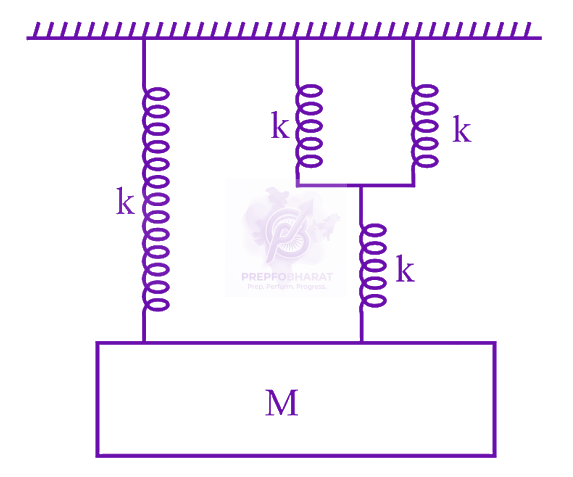
A sonometer wire of resonating length $90 \mathrm{~cm}$ has a fundamental frequency of $400 \mathrm{~Hz}$ when kept under some tension. The resonating length of the wire with fundamental frequency of $600 \mathrm{~Hz}$ under same tension _____$\mathrm{cm}$.
The speed of sound in oxygen at S.T.P. will be approximately: (Given, $R=8.3J{K}^{-1},\gamma =1.4)$
A point source is emitting sound waves of intensity $16\times {10}^{-8}W{m}^{-2}$ at the origin. The difference in intensity (magnitude only) at two points located at a distances of $2m$ and $4m$ from the origin respectively will be ________$\times {10}^{-8}W{m}^{-2}$.
A particle performs simple harmonic motion with amplitude $A$. Its speed is increased to three times at an instant when its displacement is $\frac{2A}{3}$. The new amplitude of motion is $\frac{nA}{3}$. The value of $n$ is _____.
When the displacement of a simple harmonic oscillator is one third of its amplitude, the ratio of total energy to the kinetic energy is $\frac{x}{8}$, where $x=$_________.
An object of mass $0.2 \mathrm{~kg}$ executes simple harmonic motion along $\mathrm{x}$ axis with frequency of $\left(\frac{25}{\pi}\right) \mathrm{Hz}$. At the position $x=0.04 \mathrm{~m}$ the object has kinetic energy $0.5 \mathrm{~J}$ and potential energy $0.4 \mathrm{~J}$. The amplitude of oscillation is _____$\mathrm{cm}$.
The position, velocity and acceleration of a particle executing simple harmonic motion are found to have magnitudes of $4 \mathrm{~m}, 2 \mathrm{~ms}^{-1}$ and $16 \mathrm{~ms}^{-2}$ at a certain instant. The amplitude of the motion is $\sqrt{x}, \mathrm{~m}$ where $x$ is ________
Two open organ pipes of lengths $60 \mathrm{~cm}$ and $90 \mathrm{~cm}$ resonate at $6^{\text {th }}$ and $5^{\text {th }}$ harmonics respectively. The difference of frequencies for the given modes is _______ $\mathrm{Hz}$. (Velocity of sound in air $=333 \mathrm{~m} / \mathrm{s}$ )
A plane progressive wave is given by $y=2 \cos 2 \pi(330 \mathrm{t}-x) \mathrm{m}$. The frequency of the wave is :
The fundamental frequency of a closed organ pipe is equal to the first overtone frequency of an open organ pipe. If length of the open pipe is $60\mathrm{cm}$, the length of the closed pipe will be :
A particle of mass $0.50 \mathrm{~kg}$ executes simple harmonic motion under force $F=-50\left(\mathrm{Nm}^{-1}\right) x$. The time period of oscillation is $\frac{x}{35} \mathrm{~s}$. The value of $x$ is _______ (Given $\pi=\frac{22}{7}$ )
A mass $m$ is suspended from a spring of negligible mass and the system oscillates with a frequency ${f}_{1}.$ The frequency of oscillations if a mass $9m$ is suspended from the same spring is ${f}_{2}.$ The value of $\frac{{f}_{1}}{{f}_{2}}$ is _____ .
A particle executes simple harmonic motion with an amplitude of $4\mathrm{cm}$. At the mean position, velocity of the particle is $10\mathrm{cm}{s}^{-1}$. The distance of the particle from the mean position when its speed becomes $5\mathrm{cm}{s}^{-1}$ is $\sqrt{\alpha }\mathrm{cm}$, where $\alpha =$______.
A closed organ pipe $150\mathrm{cm}$ long gives $7$ beats per second with an open organ pipe of length $350\mathrm{cm}$, both vibrating in fundamental mode. The velocity of sound is ______ $m{s}^{-1}$.
A closed and an open organ pipe have same lengths. If the ratio of frequencies of their seventh overtones is $\left(\frac{a-1}{a}\right)$ then the value of $\mathrm{a}$ is ________
In simple harmonic motion, the total mechanical energy of given system is $E$. If mass of oscillating particle $P$ is doubled then the new energy of the system for same amplitude is: 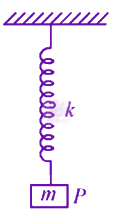
A particle is doing simple harmonic motion of amplitude $0.06 \mathrm{~m}$ and time period $3.14 \mathrm{~s}$. The maximum velocity of the particle is _______ $\mathrm{cm} / \mathrm{s}$.
The equation of a progressive wave is y = 5sin(100πt - 0.4πx). The velocity of the wave is: