Waves & Oscillations PYQ — Page 2
JEE Main Physics — Waves & Oscillations previous year questions with solutions.
All Waves & Oscillations Questions (340)
The fifth harmonic of a closed organ pipe is found to be in unison with the first harmonic of an open pipe. The ratio of lengths of closed pipe to that of the open pipe is $5 / x$. The value of $x$ is $\_\_\_\_$.
The speed of a longitudinal wave in a metallic bar is $400 \mathrm{~m} / \mathrm{s}$. If the density and Young's modulus of the bar material are increased by $0.5 \%$ and $1 \%$, respectively then the speed of the wave is changed approximately to $\_\_\_\_$ $\mathrm{m} / \mathrm{s}$.
The kinetic energy of a simple harmonic oscillator is oscillating with angular frequency of $176 \mathrm{rad} / \mathrm{s}$. The frequency of this simple harmonic oscillator is $\_\_\_\_$ Hz. $\left[\right.$ take $\left.\pi=\frac{22}{7}\right]$
A particle is executing simple harmonic motion with time period 2 s and amplitude 1 cm . If D and d are the total distance and displacement covered by the particle in 12.5 s , then $\frac{\mathrm{D}}{\mathrm{d}}$ is
Two bodies A and B of equal mass are suspended from two massless springs of spring constant $k_1$ and $k_2$, respectively. If the bodies oscillate vertically such that their amplitudes are equal, the ratio of the maximum velocity of $A$ to the maximum velocity of $B$ is
The equation of a transverse wave travelling along a string is $y(x, t)=4.0 \sin \left[20 \times 10^{-3} x+600 t\right] \mathrm{mm}$, where $x$ is in mm and $t$ is in second. The velocity of the wave is :
An organ pipe closed at one end resonates at frequencies 300 Hz and 500 Hz. The fundamental frequency of the pipe is:
The general equation of a progressive wave travelling in the positive x-direction is:
A sinusoidal wave of wavelength 7.5 cm travels a distance of 1.2 cm along the x -direction in 0.3 sec. The crest $P$ is at $x=0$ at $t=0 \mathrm{sec}$ and maximum displacement of the wave is 2 cm. Which equation correctly represents this wave ?
A closed organ and an open organ tube are filled by two different gases having same bulk modulus but different densities $\rho_1$ and $\rho_{2^{\prime}}$, respectively. The frequency of $9^{\text {th }}$ harmonic of closed tube is identical with $4^{\text {th }}$ harmonic of open tube. If the length of the closed tube is 10 cm and the density ratio of the gases is $\rho_1: \rho_2=1: 16$, then the length of the open tube is :
Given below are two statements. One is labelled as Assertion (A) and the other is labelled as Reason (R). Assertion (A) : A simple pendulum is taken to a planet of mass and radius, 4 times and 2 times, respectively, than the Earth. The time period of the pendulum remains same on earth and the planet. Reason (R): The mass of the pendulum remains unchanged at Earth and the other planet. In the light of the above statements, choose the correct answer from the options given below :
Given below are two statements. One is labelled as Assertion (A) and the other is labelled as Reason (R). Assertion (A) : Knowing initial position $x_0$ and initial momentum $p_0$ is enough to determine the position and momentum at any time $t$ for a simple harmonic motion with a given angular frequency $\omega$. Reason (R): The amplitude and phase can be expressed in terms of $x_0$ and $\mathrm{p}_0$. In the light of the above statements, choose the correct answer from the options given below :
A light hollow cube of side length 10 cm and mass 10 g , is floating in water. It is pushed down and released to execute simple harmonic oscillations. The time period of oscillations is $y \pi \times 10^{-2} \mathrm{~s}$, where the value of $y$ is (Acceleration due to gravity, $g=10 \mathrm{~m} / \mathrm{s}^2$, density of water $=10^3 \mathrm{~kg} / \mathrm{m}^3$ )
The equation of a wave travelling on a string is $\mathrm{y}=\sin [20 \pi \mathrm{x}+10 \pi \mathrm{t}]$, where x and t are distance and time in SI units. The minimum distance between two points having the same oscillating speed is :
The amplitude and phase of a wave that is formed by the superposition of two harmonic travelling waves, $\mathrm{y}_1(\mathrm{x}, \mathrm{t})=4 \sin (\mathrm{kx}-\omega \mathrm{t})$ and $\mathrm{y}_2(\mathrm{x}, \mathrm{t})=2 \sin \left(\mathrm{kx}-\omega \mathrm{t}+\frac{2 \pi}{3}\right)$, are $:$ (Take the angular frequency of initial waves same as $\omega$)
Two blocks of masses $m$ and $M,(M \gt m)$, are placed on a frictionless table as shown in figure. A massless spring with spring constant k is attached with the lower block. If the system is slightly displaced and released then ($\mu=$ coefficient of friction between the two blocks) 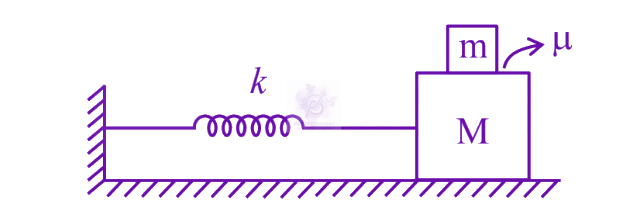 (A) The time period of small oscillation of the two blocks is $\mathrm{T}=2 \pi \sqrt{\frac{(\mathrm{~m}+\mathrm{M})}{\mathrm{k}}}$ (B) The acceleration of the blocks is $\mathrm{a}=\frac{\mathrm{kx}}{\mathrm{M}+\mathrm{m}}$ ($\mathrm{x}=$ displacement of the blocks from the mean position) (C) The magnitude of the frictional force on the upper block is $\frac{m \mu|x|}{M+m}$ (D) The maximum amplitude of the upper block, if it does not slip, is $\frac{\mu(M+m) g}{k}$ (E) Maximum frictional force can be $\mu(\mathrm{M}+\mathrm{m}) \mathrm{g}$. Choose the correct answer from the options given below:
A particle is subjected two simple harmonic motions as : $\mathrm{x}_1=\sqrt{7} \sin 5 \mathrm{tcm}$ and $x_2=2 \sqrt{7} \sin \left(5 t+\frac{\pi}{3}\right) \mathrm{cm}$ where x is displacement and $t$ is time in seconds. The maximum acceleration of the particle is $\mathrm{x} \times 10^{-2} \mathrm{~ms}^{-2}$. The value of x is :
Given below are two statements : one is labelled as Assertion (A) and the other is labelled as Reason (R). Assertion (A) : Time period of a simple pendulum is longer at the top of a mountain than that at the base of the mountain. Reason (R): Time period of a simple pendulum decreases with increasing value of acceleration due to gravity and vice-versa. In the light of the above statements, choose the most appropriate answer from the options given below :
In an experiment with a closed organ pipe, it is filled with water by $\left(\frac{1}{5}\right)$ th of its volume. The frequency of the fundamental note will change by
Two simple pendulums having lengths $l_1$ and $l_2$ with negligible string mass undergo angular displacements $\theta_1$ and $\theta_2$, from their mean positions, respectively. If the angular accelerations of both pendulums are same, then which expression is correct?
A particle oscillates along the $x$-axis according to the law, $x(\mathrm{t})=x_0 \sin ^2\left(\frac{\mathrm{t}}{2}\right)$ where $x_0=1 \mathrm{~m}$. The kinetic energy $(\mathrm{K})$ of the particle as a function of $x$ is correctly represented by the graph
Consider the sound wave travelling in ideal gases of $\mathrm{He}, \mathrm{CH}_4$, and $\mathrm{CO}_2$. All the gases have the same ratio $\frac{P}{\rho}$, where $P$ is the pressure and $\rho$ is the density. The ratio of the speed of sound through the gases $\mathrm{v}_{\mathrm{He}}: \mathrm{v}_{\mathrm{CH}_4}: \mathrm{v}_{\mathrm{CO}_2}$ is given by
Two strings with circular cross section and made of same material, are stretched to have same amount of tension. A transverse wave is then made to pass through both the strings. The velocity of the wave in the first string having the radius of cross section R is $\mathrm{v}_1$, and that in the other string having radius of cross section $R / 2$ is $v_2$. Then $\frac{v_2}{v_1}=$
Given below are two statements: one is labelled as Assertion A and the other is labelled as Reason $\mathbf{R}$ Assertion A: A sound wave has higher speed in solids than gases. Reason R: Gases have higher value of Bulk modulus than solids. In the light of the above statements, choose the correct answer from the options given below