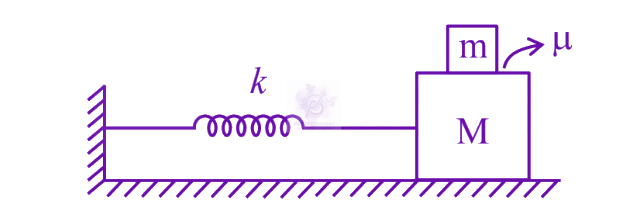
(A) As both blocks moving together so Time period =2π K m; where m=M+m
T=2π KM+m
(B) Let block is displaced by x in (+ve) direction so force on block will be in(-ve) direction
$\begin{aligned}
& \mathrm{F}=-\mathrm{Kx} \
& (\mathrm{M}+\mathrm{m}) \mathrm{a}=-\mathrm{Kx} \
& \mathrm{a}=-\frac{\mathrm{Kx}}{(\mathrm{M}+\mathrm{m})}
\end{aligned}$
(C) As upper block is moving due to friction thus
f=ma=(M+m)mKx
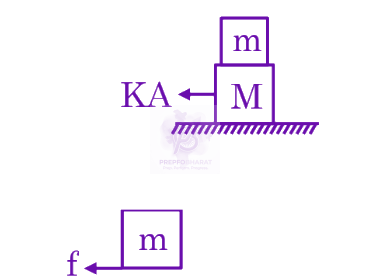
(D) This option is like two block problem in friction for maximum amplitude, force on block is also maximum, for which both blocks are moving together.
$\begin{aligned}
& K A=(M+m) a \
& a=\frac{K A}{(M+m)} \
& f=m a=\frac{m K A}{(M+m)} \
& f_{\max }=f_L=\mu \mathrm{mg} \
& f=\mu m g \
& \frac{m K A}{(M+m)}=\mu m g \
& A=\frac{\mu(M+m) g}{K}
\end{aligned}$
(E) Maximum friction can be μmg as force is acting between blocks & normal force here is mg.