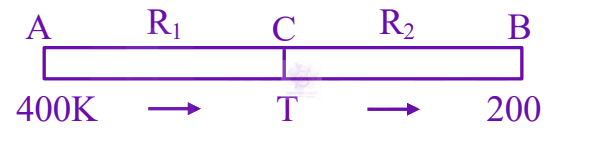
R1= K1 A1ℓ1,R2= K2 A2ℓ2dtdQ=RΔT(dtdQ)1=(μdQ)2R1400−T=R2T−200T−200400−T=R2R1=(ℓ2ℓ1)(r1r2)2× K1K2=21×(21)2×2=(41)T−200400−T=411600−4 T=T−2005 T=1800 T=360 K
JEE Main 2025 — Physics Thermodynamics
Two cylindrical rods A and B made of different materials, are joined in a straight line. The ratio of lengths, radii and thermal conductivities of these rods are :
LBLA=21,rBrA=2 and KBKA=21. The free ends of rods A and B are maintained at 400 K,200 K, respectively. The temperature of rods interface is ________ K, when equilibrium is established.
Held on 7 Apr 2025 · Verified 6 Jul 2026.
Sign in to track your attempts and accuracy.
Sign in to keep a private note on this question. Nothing you write is ever public.
The temperature of a metal strip having coefficient of linear expansion $\alpha$ is increased from $T_1$ to $T_2$ resulting in increase of its length by $\Delta L_1$. The temperature is further increased from $T_2$ to $T_3$ such that the increase in its length is $\Delta L_2$. Given $T_3+T_1=2T_2$ and $T_2-T_1=\Delta T$, the value of $\Delta L_2$ is ______.
The mean free path of a molecule of diameter $5 \times 10^{-10} \mathrm{~m}$ at the temperature $41^{\circ} \mathrm{C}$ and pressure $1.38 \times 10^{5} \mathrm{~Pa}$, is given as $\_\_\_\_$ m. (Given $k_{B}=1.38 \times 10^{-23} \mathrm{~J} / \mathrm{K}$).
Two closed vessels of same volume are joined through a narrow tube and both vessels are filled with air of pressure $90$ kPa and temperature $400$ K. Keeping the temperature of one vessel constant at $400$ K the second vessel temperature is raised to $500$ K. The final pressure in the vessels is _______ kPa.
Heat is supplied to a diatomic gas at constant pressure. Then the ratio of $\Delta Q : \Delta U : \Delta W$ is _______.
An ideal gas undergoes a process maintaining relation between pressure $(P)$ and volume $(V)$ as $P = P_o\left(1 + \left(\dfrac{V_o}{V}\right)^2\right)^{-1}$, where $P_o$ and $V_o$ are constants. If two samples $A$ and $B$ (two moles each) with initial volumes $V_o$ and $3V_o$ respectively undergo above mentioned process and attain same pressure, then the difference at the temperatures of these samples, $T_B - T_A$ is _____. ($R = $ gas constant)
Work through every JEE Main Thermodynamics PYQ, year by year.