Modern Physics PYQ — Page 2
JEE Main Physics — Modern Physics previous year questions with solutions.
All Modern Physics Questions (652)
Given below are two statements: one is labelled as Assertion A and the other is labelled as Reason R Assertion A: A diode under reverse-biased condition provides very small current which is nearly independent of voltage until a critical limit at which the current increases drastically. Reason R: Below the critical voltage limit, only majority charge carriers flow which increases drastically above critical voltage. Choose the correct answer from the options given below
Two electrons are moving in orbits of two hydrogen like atoms with speeds $3 \times 10^{5} \mathrm{~m} / \mathrm{s}$ and $2.5 \times 10^{5} \mathrm{~m} / \mathrm{s}$ respectively. If the radii of these orbits are nearly same then the possible order of energy states are $\_\_\_\_$ respectively.
If an alpha particle with energy 7.7 MeV is bombarded on a thin gold foil, the closest distance from nucleus it can reach is $\_\_\_\_$ m. (Atomic number of gold $=79$ and $\frac{1}{4 \pi \epsilon_{\mathrm{o}}}=9 \times 10^{9}$ in SI units)
Refer to the logic circuit given below. For two inputs $(A=1, B=1)$ and $(A=0, B=1)$, output $(Y)$ will be __________. 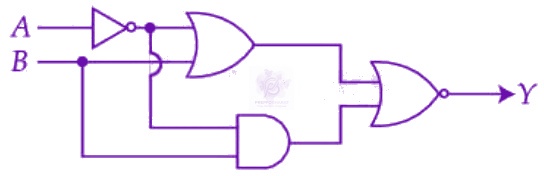
Which of the following pair of nuclei are isobars of the element?
The given circuit works as : 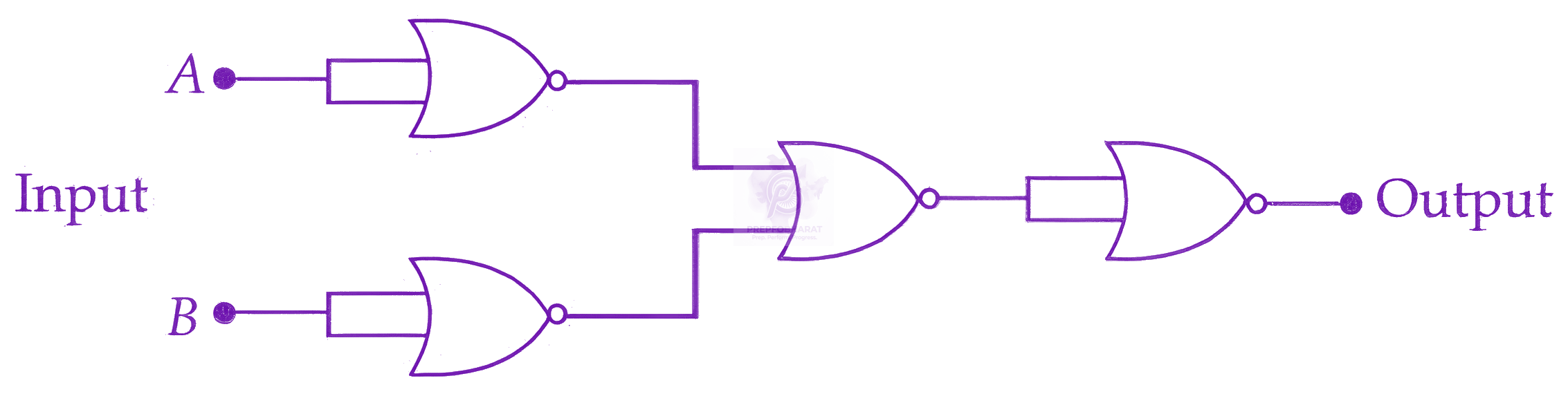
The de Broglie wavelength of an oxygen molecule at $27^{\circ} \mathrm{C}$ is $x \times 10^{-12} \mathrm{~m}$. The value of $x$ is (take Planck's constant $=6.63 \times 10^{-34} \mathrm{~J}. \mathrm{s}$, Boltzmann constant $=1.38 \times 10^{-23} \mathrm{~J} / \mathrm{K}$, mass of oxygen molecule $=5.31 \times 10^{-26} \mathrm{~kg}$)
The energy released when $\dfrac{7}{17.13}$ kg of $^{7}_{3}\text{Li}$ is converted into $^{4}_{2}\text{He}$ by proton bombardment is $\alpha \times 10^{32}$ eV. The value of $\alpha$ is _______. (Nearest integer) (Mass of $^{7}_{3}\text{Li} = 7.0183$ u, mass of $^{4}_{2}\text{He} = 4.004$ u, mass of proton $= 1.008$ u and $1$ u $= 931$ MeV/c$^2$ and Avogadro number $= 6.0 \times 10^{23}$)
The ratio of de Broglie wavelength of a deutron with kinetic energy $E$ to that of an alpha particle with kinetic energy $2 E$, is $n: 1$. The value of $n$ is $\_\_\_\_$. (Assume mass of proton $=$ mass of neutron) :
Two p-n junction diodes $D_{1}$ and $D_{2}$ are connected as shown in figure. $A$ and $B$ are input signals and $C$ is the output. The given circuit will function as a $\_\_\_\_$. 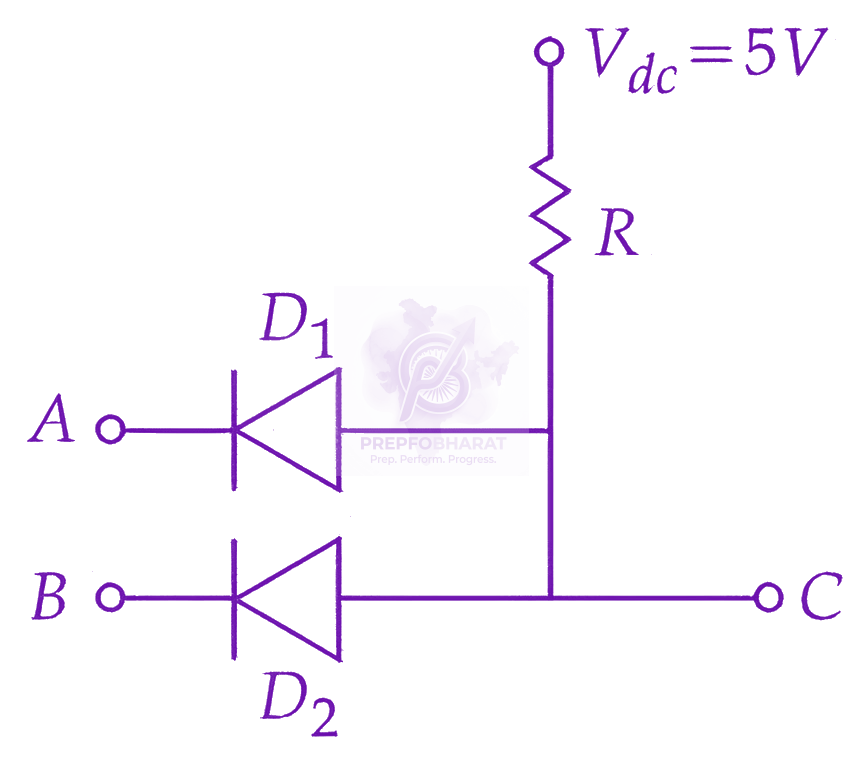
The ratio of momentum of the photons of the $1^{st}$ and $2^{nd}$ line of Balmer series of Hydrogen atoms is $\alpha/\beta$. The possible values of $\alpha$ and $\beta$ are:-
Light source having wavelength $331$ nm is used to generate photo-electrons whose stopping potential is $0.2$ V. The work function of the used metal in the experiment is $\alpha \times 10^{-19}$ J. The value of $\alpha$ is _____. ($h = 6.62 \times 10^{-34}$ J s, $e = 1.6 \times 10^{-19}$ C and $c = 3 \times 10^8$ m/s)
The minimum frequency of photon required to break a particle of mass 15.348 amu into $4 \alpha$ particles is $\_\_\_\_$ kHz. [mass of He nucleus = $4.002 \mathrm{amu}, 1 \mathrm{amu}=1.66 \times 10^{-27} \mathrm{~kg}, \mathrm{~h}=6.6 \times 10^{-34} \mathrm{~J}. \mathrm{s}$ and $\mathrm{c}=3 \times 10^{8} \mathrm{~m} / \mathrm{s}$ ]
$7.9 \mathrm{MeV} \alpha$-particle scatters from a target material of atomic number 79. From the given data the estimated diameter of nuclei of the target material is (approximately) $\_\_\_\_$ m. $\left[\frac{1}{4 \pi \epsilon_{\mathrm{o}}}=9 \times 10^{9} \mathrm{Nm}^{2} / \mathrm{C}^{2}\right.$ and electron charge $\left.=1.6 \times 10^{-19} \mathrm{C}\right]$
Two nuclei of mass number $3$ combine with another nucleus of mass number $4$ to yield a nucleus of mass number $10$. If the binding energy per nucleon for the mass numbers $3$, $4$ and $10$ are $5.6$ MeV, $7.4$ MeV and $6.1$ MeV, respectively, then in the process, $\Delta Mc^2 = $ _____ MeV.
In Rutherford's alpha-particle scattering experiment, only a few alpha particles rebound back because A. The size of gold nucleus is very small as compared to the size of gold atom. B. Alpha particle and gold nucleus have equal charge. C. The impact parameter is minimum for a few alpha particles. D. A few alpha particles have very high kinetic energy. E. Only a few alpha particles undergo head-on collision with the nuclei. Choose the correct answer from the options given below:
For the given logic circuit, which of the following inputs combination will make both LED$-1$ and LED$-2$ to glow? 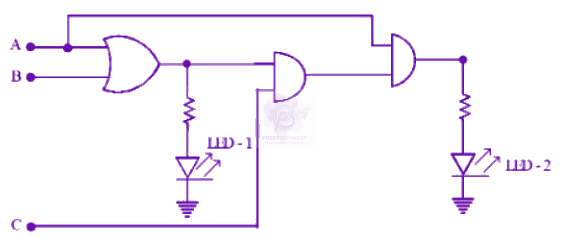
An atom ${ }_{3}^{8} X$ is bombarded by shower of fundamental particles and in 10 s this atom absorbed 10 electrons, 10 protons and 9 neutrons. The percentage growth in the surface area of the nucleons is recorded by:
Number of photons of equal energy emitted per second by a 6 mW laser source operating at 663 nm is $\_\_\_\_$. (Given : $\mathrm{h}=6.63 \times 10^{-34} \mathrm{~J}. \mathrm{s}$ and $\mathrm{c}=3 \times 10^{8} \mathrm{~m} / \mathrm{s}$)
The binding energy for the following nuclear reactions are expressed in MeV. ${ }_{2} \mathrm{He}^{3}+{ }_{0} \mathrm{n}^{1} \rightarrow{ }_{2} \mathrm{He}^{4}+20 \mathrm{MeV}$ ${ }_{2} \mathrm{He}^{4}+{ }_{0} \mathrm{n}^{1} \rightarrow{ }_{2} \mathrm{He}^{5}-0.9 \mathrm{MeV}$ If $\mathrm{X}_{3}, \mathrm{X}_{4}, \mathrm{X}_{5}$ denote the stability of ${ }_{2} \mathrm{He}^{3},{ }_{2} \mathrm{He}^{4}$ and ${ }_{2} \mathrm{He}^{5}$, respectively, then the correct order is :
Angular momentum of an electron in a hydrogen atom is $\dfrac{3h}{\pi}$, then the energy of the electron is _______ eV.
The binding energy per nucleon of $^{209}_{83}Bi$ is _______ MeV. $[\text{Take } m(^{209}_{83}Bi) = 208.980388 \, u, \, m_p = 1.007825 \, u, \, m_n = 1.008665 \, u, \, 1 \, u = 931 \, \text{MeV}/c^2]$
The de Broglie wavelength for an electron accelerated through the potential difference of $V_1$ volt is $\lambda_1$. When the potential difference is changed to $V_2$ volt, the associated de Broglie wavelength is increased by $50\%$. If $(V_1/V_2) = (9/\alpha)$, then the value of $\alpha$ is __________.
The work function of a metal is 4.2 eV. The threshold wavelength for photoelectric emission is approximately: