Modern Physics PYQ — Page 3
JEE Main Physics — Modern Physics previous year questions with solutions.
All Modern Physics Questions (652)
Two radioactive substances A and B of mass numbers $200$ and $212$ respectively, shows spontaneous $\alpha$-decay with same $Q$ value of $1$ MeV. The ratio of energies of $\alpha$-rays produced by A and B is ________.
The average energy released per fission for the nucleus of ${ }_{92}^{235} \mathrm{U}$ is 190 MeV. When all the atoms of 47 g pure ${ }_{92}^{235} \mathrm{U}$ undergo fission process, the energy released is $\alpha \times 10^{23} \mathrm{MeV}$. The value of $\alpha$ is $\_\_\_\_$. (Avogadro Number $=6 \times 10^{23}$ per mole)
In the hydrogen atom, the electron makes a transition from the higher orbit ($i$) to a lower orbit ($f$). The ratio of the radius of the orbits in given by $r_i : r_f = 16 : 4$. The wavelength of photon emitted due to this transition is _____ nm. (Given Rydberg constant $= 1.0973 \times 10^7$ /m)
Assuming the experimental mass of ${}^{12}_{6}C$ as $12\text{ u}$, the mass defect of ${}^{12}_{6}C$ atom is _______ $\text{MeV}/c^2$. (Mass of proton $= 1.00727\text{ u}$, mass of neutron $= 1.00866\text{ u}$, $1\text{ u} = 931.5\text{ MeV}/c^2$ and $c$ is the speed of the light in vacuum).
A light wave described by $E=60\left[\sin \left(3 \times 10^{15}\right) t+\sin \left(12 \times 10^{15}\right) t\right]$ (in SI units) falls on a metal surface of work function 2.8 eV. The maximum kinetic energy of ejected photoelectron is (approximately) $\_\_\_\_$ eV. $\left(h=6.6 \times 10^{-34} \mathrm{~J}\right.$. s. and $\left.e=1.6 \times 10^{-19} \mathrm{C}\right)$
Find the correct combination of $\mathrm{A}, \mathrm{B}, \mathrm{C}$ and D inputs which can cause the LED to glow. 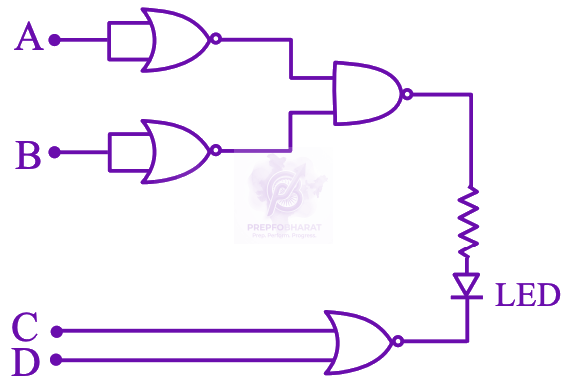
Using Bohr's model, calculate the ratio of the magnetic fields generated due to the motion of the electrons in the $2^{\text{nd}}$ and $4^{\text{th}}$ orbits of hydrogen atom _______.
$K_1$ and $K_2$ be the maximum kinetic energies of photoelectrons emitted from a surface of a given material for the light of wavelength $\lambda_1$ and $\lambda_2$, respectively. If $\lambda_1=2\lambda_2$ then the work function of material is given by:
If $X$ and $Y$ are the inputs, the given circuit works as _______. 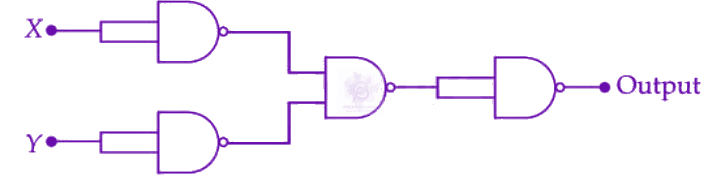
The correct truth table for the given input data of the following logic gate is : Inputs 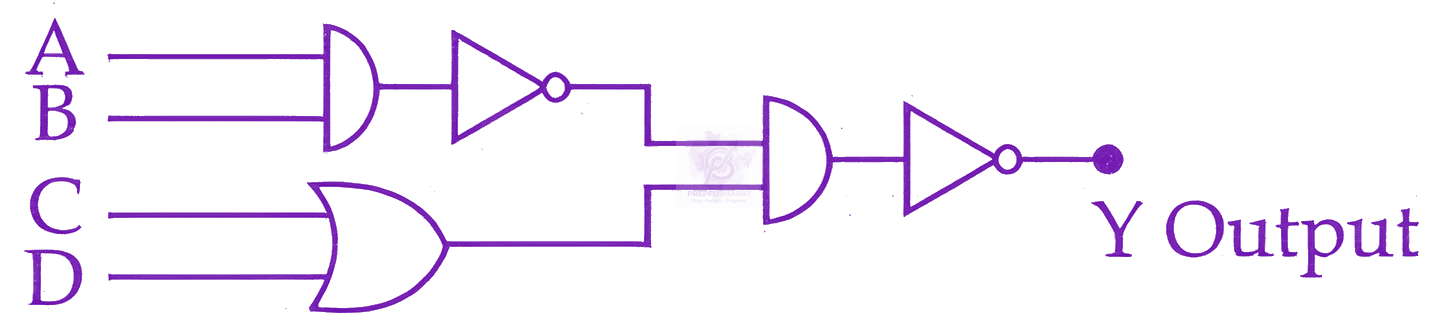
An electron is travelling with a velocity $v$ in free space and when it enters a medium, its velocity is reduced by $20\%$. The de Broglie wavelength of electron in the medium is $\alpha\lambda_0$, where $\lambda_0$ is its de Broglie wavelength in free space. The value of $\alpha$ is _______.
The maximum rated power of the LED is $2$ mW and it is used in the circuit with input voltage of $5$ V as shown in the figure below. The current through resistance $R_S$ is $0.5$ mA. The minimum value of the resistance of $R_S$, to ensure that the LED is not damaged is _______ k$\Omega$. 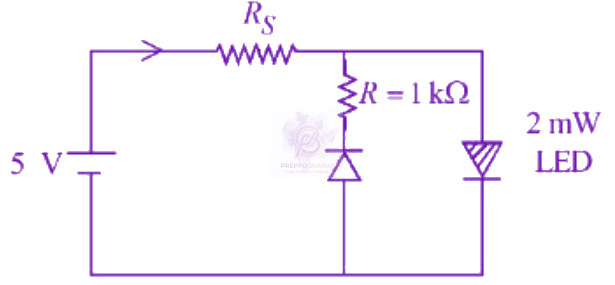
Two $4$ bits binary numbers, $A = 1101$ and $B = 1010$ are given in the inputs of a logic circuit shown in figure below. The output $(Y)$ will be: 
An electron of mass ' m ' with an initial velocity $\overrightarrow{\mathrm{v}}=\mathrm{v}_0 \hat{i}\left(\mathrm{v}_0\gt0\right)$ enters an electric field $\overrightarrow{\mathrm{E}}=-\mathrm{E}_{\mathrm{o}} \hat{\mathrm{k}}$. If the initial de Broglie wavelength is $\lambda_0$, the value after time t would be
Consider a n-type semiconductor in which $\mathrm{n}_{\mathrm{e}}$ and $\mathrm{n}_{\mathrm{h}}$ are number of electrons and holes, respectively. (A) Holes are minority carriers (B) The dopant is a pentavalent atom (C) $\mathrm{n}_{\mathrm{e}} \mathrm{n}_{\mathrm{h}} \neq \mathrm{n}_{\mathrm{i}}^2$ (where $n_i$ is number of electrons or holes in semiconductor when it is intrinsic form) (D) $\mathrm{n}_{\mathrm{e}} \mathrm{n}_{\mathrm{h}} \geq \mathrm{n}_{\mathrm{i}}^2$ (E) The holes are not generated due to the donors Choose the correct answer from the options given below :
A radioactive nucleus $n_2$ has 3 times the decay constant as compared to the decay constant of another radioactive nucleus $n_1$. If initial number of both nuclei are the same, what is the ratio of number of nuclei of $n_2$ to the number of nuclei of $n_1$, after one half-life of $n_1$ ?
The energy $E$ and momentum $p$ of a moving body of mass $m$ are related by some equation. Given that c represents the speed of light, identify the correct equation
The work function of a metal is 4.2 eV. What is the threshold wavelength for photoelectric emission? (hc = 1240 eV·nm)
A monochromatic light is incident on a metallic plate having work function $\phi$. An electron, emitted normally to the plate from a point $A$ with maximum kinetic energy, enters a constant magnetic field, perpendicular to the initial velocity of electron. The electron passes through a curve and hits back the plate at a point $B$. The distance between A and B is : (Given : The magnitude of charge of an electron is e and mass is $\mathrm{m}, \mathrm{h}$ is Planck's constant and c is velocity of light. Take the magnetic field exists throughout the path of electron)
In an experiment with photoelectric effect, the stopping potential,
Considering Bohr's atomic model for hydrogen atom : (A) the energy of H atom in ground state is same as energy of $\mathrm{He}^{+}$ion in its first excited state. (B) the energy of H atom in ground state is same as that for $\mathrm{Li}^{++}$ion in its second excited state. (C) the energy of H atom in its ground state is same as that of $\mathrm{He}^{+}$ion for its ground state. (D) the energy of $\mathrm{He}^{+}$ion in its first excited state is same as that for $\mathrm{Li}^{++}$ion in its ground state Choose the correct answer from the options given below :
In photoelectric effect, the stopping potential $\left(\mathrm{V}_0\right) \mathrm{v} / \mathrm{s}$ frequency $(\nu)$ curve is plotted. ( h is the Planck's constant and $\phi_0$ is work function of metal ) (A) $\mathrm{V}_0 \mathrm{v} / \mathrm{s} \nu$ is linear. (B) The slope of $\mathrm{V}_0 \mathrm{v} / \mathrm{s} \nu$ curve $=\frac{\phi_0}{\mathrm{~h}}$ (C) h constant is related to the slope of $\mathrm{V}_0 \mathrm{v} / \mathrm{s} \nu$ line. (D) The value of electric charge of electron is not required to determine $h$ using the $V_0 \mathrm{v} / \mathrm{s} \nu$ curve. (E) The work function can be estimated without knowing the value of $h$. Choose the correct answer from the options given below :
A small mirror of mass $m$ is suspended by a massless thread of length $l$. Then the small angle through which the thread will be deflected when a short pulse of laser of energy $E$ falls normal on the mirror ( $\mathrm{c}=$ speed of light in vacuum and $\mathrm{g}=$ acceleration due to gravity)
Given below are two statements : one is labelled as Assertion (A) and the other is labelled as Reason (R). Assertion (A) : Emission of electrons in photoelectric effect can be suppressed by applying a sufficiently negative electron potential to the photoemissive substance. Reason (R) : A negative electric potential, which stops the emission of electrons from the surface of a photoemissive substance, varies linearly with frequency of incident radiation. In the light of the above statements, choose the most appropriate answer from the options given below :