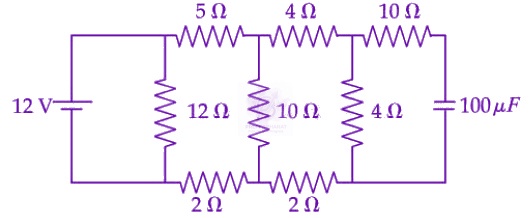
In steady state, the capacitor acts as an open circuit, meaning no current flows through the branch containing the 100 μF capacitor. Consequently, no current flows through the 10 Ω resistor in series with it on the top right.
The voltage across the capacitor will be equal to the voltage across the 4 Ω vertical resistor.
Let's simplify the circuit to find this voltage. The 12 Ω resistor on the left is in parallel with the 12 V battery, so the voltage across the rest of the circuit remains 12 V.
For the rightmost part of the active circuit, the 4 Ω top resistor, the 4 Ω vertical resistor, and the 2 Ω bottom resistor are in series. Their equivalent resistance is:
Rright=4 Ω+4 Ω+2 Ω=10 Ω
This 10 Ω equivalent resistance is in parallel with the 10 Ω vertical resistor in the middle. The equivalent resistance of this parallel combination is:
Rmid=10+1010×10=5 Ω
Now, the total resistance of the main circuit connected to the 12 V source is the sum of the 5 Ω top-left resistor, the 5 Ω equivalent middle resistance, and the 2 Ω bottom-left resistor:
Rtotal=5 Ω+5 Ω+2 Ω=12 Ω
The total current flowing from the 12 V source into this main branch is:
I=12 Ω12 V=1 A
The voltage across the parallel combination (the middle section) is:
Vmid=I×Rmid=1 A×5 Ω=5 V
This 5 V is applied across the right branch which has a total resistance of 10 Ω. The current through this branch is:
Iright=10 Ω5 V=0.5 A
The voltage across the 4 Ω vertical resistor is:
V4Ω=Iright×4 Ω=0.5 A×4 Ω=2 V
Since the capacitor is in parallel with this 4 Ω resistor (with no voltage drop across the 10 Ω resistor in its branch), the voltage across the capacitor is also 2 V.
The stored charge in the capacitor is:
Q=C×V=100 μF×2 V=200 μC
Answer: 200