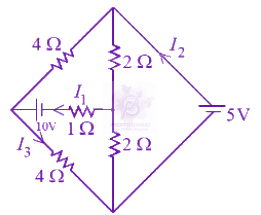
Using the principle of superposition, we analyse the circuit with one source active at a time.
Case 1: Only the 10 V source is active (the 5 V source is replaced by a short circuit).
With the 5 V source shorted, the top and bottom nodes of the bridge are directly connected by a wire, forming a Wheatstone bridge.
Checking for balance:
Left arm ratio: 44=1
Right arm ratio: 22=1
The ratios are equal, so the bridge is balanced. Hence, no current flows through the middle branch connecting the two nodes, and the contribution to I2 from the 10 V source is 0 A.
Equivalent resistance of the balanced bridge:
(4+2)Ω∥(4+2)Ω=6Ω∥6Ω=3Ω
Total resistance including the series 1Ω resistor:
Req=3+1=4Ω
Current drawn from the 10 V source:
I1(10V)=410=2.5 A
This current splits equally between the two 6Ω branches, so the current through the bottom 4Ω resistor is:
I3(10V)=22.5=1.25 A
Case 2: Only the 5 V source is active (the 10 V source is replaced by a short circuit).
Now the 5 V source is applied across the top and bottom nodes, and the 1Ω resistor lies in the middle branch between the left and centre nodes.
For the left branch (4Ω and 4Ω in series), the potential at the midpoint is 25=2.5 V.
For the right branch (2Ω and 2Ω in series), the potential at the midpoint is also 25=2.5 V.
Since both midpoints are at the same potential, no current flows through the 1Ω middle branch. Hence, the contribution to I1 from the 5 V source is 0 A.
Equivalent resistance seen by the 5 V source:
(4+4)Ω∥(2+2)Ω=8Ω∥4Ω=8+48×4=38Ω
Total current supplied by the 5 V source:
I2(5V)=8/35=815=1.875 A
Current through the left branch (which includes the bottom 4Ω resistor):
I3(5V)=85=0.625 A
Applying superposition:
I1=I1(10V)+I1(5V)=2.5+0=2.5 A
I2=I2(10V)+I2(5V)=0+1.875=1.875 A
I3=I3(10V)+I3(5V)=1.25+0.625=1.875 A
Hence, the correct option is (1) I1=2.5 A, I2=1.875 A, I3=1.875 A.