Inside a solenoid, magnetic field B is uniform and parallel to the axis.
Particle moves along the axis, so velocity v is parallel to B.
Magnetic force F=Q(v×B)=0 (since v∥B)
Only gravity acts on the particle.
Acceleration a=g
JEE Main 2026 — Physics Electromagnetism
A current carrying solenoid is placed vertically and a particle of mass m with charge Q is released from rest. The particle moves along the axis of solenoid. If g is acceleration due to gravity then the acceleration (a) of the charged particle will satisfy :
Held on 21 Jan 2026 · Verified 6 Jul 2026.
a>g
0<a<g
a=0
a=g
Sign in to track your attempts and accuracy.
Sign in to keep a private note on this question. Nothing you write is ever public.
$X P Q Y$ is a vertical smooth long loop having a total resistance $R$ where $P X$ is parallel to $Q Y$ and separation between them is $l$. A constant magnetic field $B$ perpendicular to the plane of the loop exists in the entire space. A rod $C D$ of length $L(L>l)$ and mass $m$ is made to slide down from rest under the gravity as shown in figure. The terminal speed acquired by the rod is $\_\_\_\_$ $\mathrm{m} / \mathrm{s}.(\mathrm{g}=$ acceleration due to gravity) 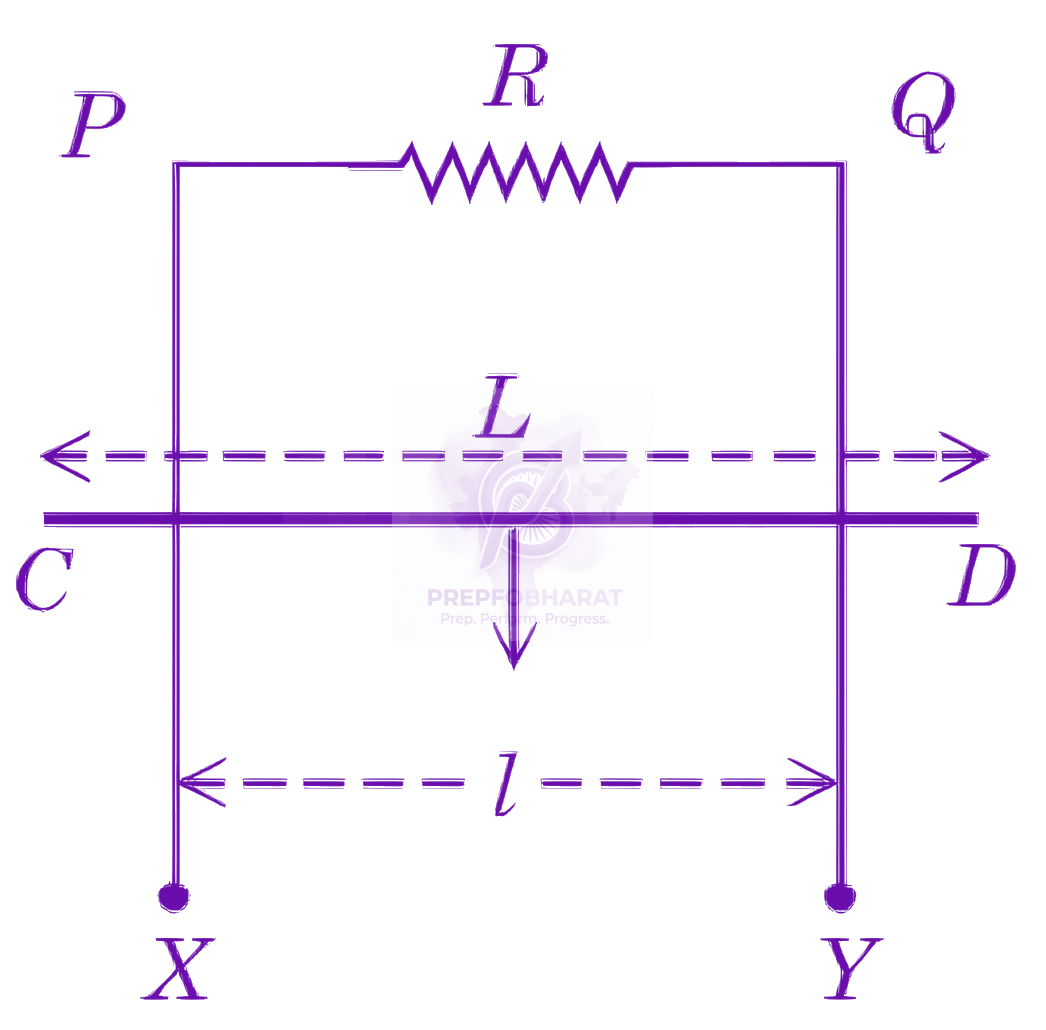
A thin half ring of radius $35$ cm is uniformly charged with a total charge of $Q$ coulomb. If the magnitude of the electric field at centre of the half ring is $100$ V/m, then the value of $Q$ is _______ nC. ($\epsilon_o = 8.85 \times 10^{-12}$ C$^2$/Nm$^2$ and $\pi = 3.14$)
A Wheatstone bridge is initially at room temperature and all arms of the bridge have same value of resistances $\left(R_{1}=R_{2}=R_{3}=R_{4}\right)$. When $R_{3}$ resistance is heated to some temperature, its resistance value has gone up by $10 \%$. The potential difference $\left(V_{a}-V_{b}\right)$ (after $R_{3}$ is heated) is $\_\_\_\_$ V. 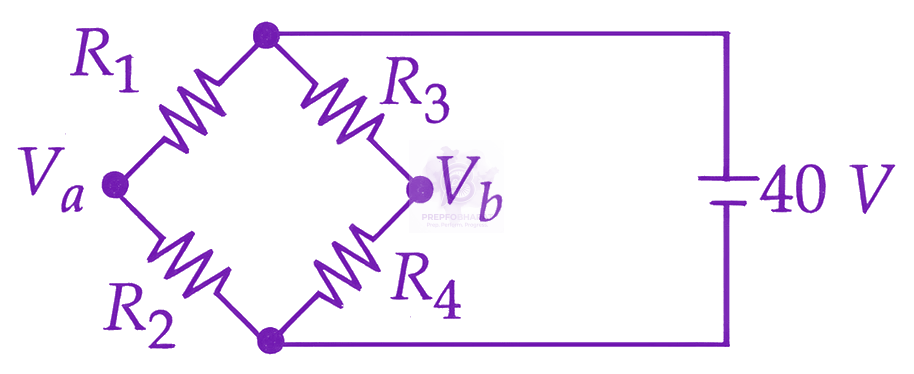
An inductor of inductance $10$ mH having resistance of $100\,\Omega$ is connected to battery of E.M.F. $1.0$ V through a switch as shown in the figure below. After switch is closed, the ratio of instantaneous voltages across the inductor when the current passing through it is $2$ mA and $4$ mA is _______. 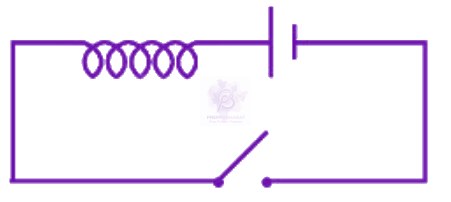
A moving coil of galvanometer when shunted with $2\,\Omega$ resistance gives a full scale deflection for a current of $500$ mA. When a resistance of $470\,\Omega$ is connected in series it gives a full scale deflection for $10$ V potential applied on it. The value of resistance of galvanometer coil is __________ $\Omega$.
Work through every JEE Main Electromagnetism PYQ, year by year.