Coordinate Geometry PYQ — Page 6
JEE Main Mathematics — Coordinate Geometry previous year questions with solutions.
All Coordinate Geometry Questions (615)
Let $\mathrm{E}: \frac{x^2}{\mathrm{a}^2}+\frac{y^2}{\mathrm{~b}^2}=1, \mathrm{a}\gt\mathrm{b}$ and $\mathrm{H}: \frac{x^2}{\mathrm{~A}^2}-\frac{y^2}{\mathrm{~B}^2}=1$. Let the distance between the foci of E and the foci of $H$ be $2 \sqrt{3}$. If $a-A=2$, and the ratio of the eccentricities of $E$ and $H$ is $\frac{1}{3}$, then the sum of the lengths of their latus rectums is equal to:
Let ${ }^{\mathrm{n}} \mathrm{C}_{\mathrm{r}-1}=28,{ }^{\mathrm{n}} \mathrm{C}_{\mathrm{r}}=56$ and ${ }^{\mathrm{n}} \mathrm{C}_{\mathrm{r}+1}=70$. Let $\mathrm{A}(4 \cos t, 4 \sin t), \mathrm{B}(2 \sin t,-2 \cos \mathrm{t})$ and $C\left(3 r-n, r^2-n-1\right)$ be the vertices of a triangle $A B C$, where $t$ is a parameter. If $(3 x-1)^2+(3 y)^2$ $=\alpha$, is the locus of the centroid of triangle ABC , then $\alpha$ equals
Let $\mathrm{H}_1: \frac{x^2}{\mathrm{a}^2}-\frac{y^2}{\mathrm{~b}^2}=1$ and $\mathrm{H}_2:-\frac{x^2}{\mathrm{~A}^2}+\frac{y^2}{\mathrm{~B}^2}=1$ be two hyperbolas having length of latus rectums $15 \sqrt{2}$ and $12 \sqrt{5}$ respectively. Let their ecentricities be $e_1=\sqrt{\frac{5}{2}}$ and $e_2$ respectively. If the product of the lengths of their transverse axes is $100 \sqrt{10}$, then $25 \mathrm{e}_2^2$ is equal to ________.
Let $A(6,8), B(10 \cos \alpha,-10 \sin \alpha)$ and $C(-10 \sin \alpha, 10 \cos \alpha)$, be the vertices of a triangle. If $L(a, 9)$ and $G(h, k)$ be its orthocenter and centroid respectively, then $(5 a-3 h+6 k+100 \sin 2 \alpha)$ is equal to ______ -.
Let $\mathrm{A}(4,-2), \mathrm{B}(1,1)$ and $\mathrm{C}(9,-3)$ be the vertices of a triangle $A B C$. Then the maximum area of the parallelogram AFDE , formed with vertices $\mathrm{D}, \mathrm{E}$ and F on the sides $\mathrm{BC}, \mathrm{CA}$ and AB of the triangle ABC respectively, is ______ .
Let $e_1$ and $e_2$ be the eccentricities of the ellipse $\frac{\mathrm{x}^2}{\mathrm{~b}^2}+\frac{\mathrm{y}^2}{25}=1 \quad$ and the hyperbola $\quad \frac{\mathrm{x}^2}{16}-\frac{\mathrm{y}^2}{\mathrm{~b}^2}=1$, respectively. If $\mathrm{b} \lt 5$ and $\mathrm{e}_1 \mathrm{e}_2=1$, then the eccentricity of the ellipse having its axes along the coordinate axes and passing through all four foci (two of the ellipse and two of the hyperbola) is :
Let ABC be the triangle such that the equations of lines $A B$ and $A C$ be $3 y-x=2$ and $x+y=2$, respectively, and the points B and C lie on x -axis. If $P$ is the orthocentre of the triangle $A B C$, then the area of the triangle PBC is equal to
Let a circle $C$ pass through the points $(4,2)$ and $(0,2)$, and its centre lie on $3 x+2 y+2=0$. Then the length of the chord, of the circle $C$, whose mid-point is $(1,2)$, is :
Let a be the length of a side of a square OABC with $O$ being the origin. Its side OA makes an acute angle $\alpha$ with the positive $x$-axis and the equations of its diagonals are $(\sqrt{3}+1) x+(\sqrt{3}-1) y=0$ and $(\sqrt{3}-1) x-(\sqrt{3}+1) y+8 \sqrt{3}=0$. Then $\mathrm{a}^2$ is equal to
Let \(A B C\) be a triangle formed by the lines \(7 x-6 y+3=0, x+2 y-31=0\) and \(9 x-2 y-19=0\). Let the point \((h, k)\) be the image of the centroid of \(\Delta A B C\) in the line \(3 x+6 y-53=0\). Then \(h^2+k^2+h k\) is equal to:
Let A and B be the two points of intersection of the line $y+5=0$ and the mirror image of the parabola $y^2=4 x$ with respect to the line $x+y+4=0$. If d denotes the distance between A and B , and a denotes the area of $\triangle S A B$, where $S$ is the focus of the parabola $y^2=4 x$, then the value of $(a+d)$ is $\qquad$ -
The distance between two points (x₁,y₁) and (x₂,y₂) in a plane is:
If the orthocentre of the triangle formed by the lines $y=x+1, y=4 x-8$ and $y=m x+c$ is at $(3,-1)$, then $\mathrm{m}-\mathrm{c}$ is :
If the midpoint of a chord of the ellipse $\frac{x^2}{9}+\frac{y^2}{4}=1$ is $(\sqrt{2}, 4 / 3)$, and the length of the chord is $\frac{2 \sqrt{\alpha}}{3}$, then $\alpha$ is :
If the line $3 x-2 y+12=0$ intersects the parabola $4 y=3 x^2$ at the points $A$ and $B$, then at the vertex of the parabola, the line segment $A B$ subtends an angle equal to
If the length of the minor axis of an ellipse is equal to one fourth of the distance between the foci, then the eccentricity of the ellipse is :
If the four distinct points $(4,6),(-1,5),(0,0)$ and $(\mathrm{k}, 3 \mathrm{k})$ lie on a circle of radius r , then $10 \mathrm{k}+\mathrm{r}^2$ is equal to
If the equation of the parabola with vertex $\mathrm{V}\left(\frac{3}{2}, 3\right)$ and the directrix $x+2 y=0$ is $\alpha x^2+\beta y^2-\gamma x y-30 x-60 y+225=0$, then $\alpha+\beta+\gamma$ is equal to :
If the equation of the hyperbola with foci $(4,2)$ and $(8,2)$ is $3 x^2-y^2-\alpha x+\beta y+\gamma=0$, then $\alpha+\beta+\gamma$ is equal to _____. 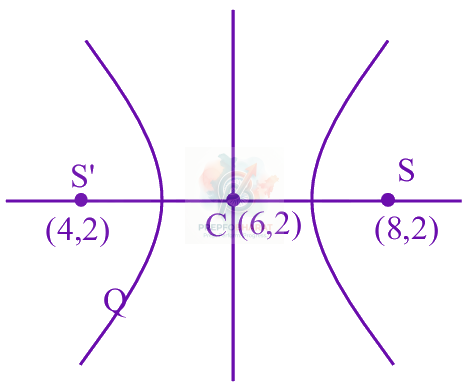
If $\alpha x+\beta y=109$ is the equation of the chord of the ellipse $\frac{x^2}{9}+\frac{y^2}{4}=1$, whose mid point is $\left(\frac{5}{2}, \frac{1}{2}\right)$, then $\alpha+\beta$ is equal to :
If $A$ and $B$ are the points of intersection of the circle $x^2+y^2-8 x=0$ and the hyperbola $\frac{x^2}{9}-\frac{y^2}{4}=1$ and a point P moves on the line $2 x-3 y+4=0$, then the centroid of $\triangle \mathrm{PAB}$ lies on the line :
If $S$ and $S^{\prime}$ are the foci of the ellipse $\frac{x^2}{18}+\frac{y^2}{9}=1$ and P be a point on the ellipse, then $\min \left(S P . S^{\prime} \mathrm{P}\right)+$ $\max \left(\mathrm{SP} . \mathrm{S}^{\prime} \mathrm{P}\right)$ is equal to :
Consider the lines $\mathrm{x}(3 \lambda+1)+\mathrm{y}(7 \lambda+2)=17 \lambda+5$, $\lambda$ being a parameter, all passing through a point P . One of these lines (say L) is farthest from the origin. If the distance of $L$ from the point $(3,6)$ is $d$, then the value of $d^2$ is
Consider the hyperbola $\frac{x^2}{a^2}-\frac{y^2}{b^2}=1$ having one of its focus at $\mathrm{P}(-3,0)$. If the latus ractum through its other focus subtends a right angle at P and $a^2 b^2=\alpha \sqrt{2}-\beta, \alpha, \beta \in \mathbb{N}$.