Physical Chemistry PYQ — Page 6
JEE Main Chemistry — Physical Chemistry previous year questions with solutions.
All Physical Chemistry Questions (1826)
For a first order reaction $A \rightarrow B$ <table class="pyq-table"><tbody><tr><th>$t/\text{min}$</th><th>$[A]/M$</th></tr><tr><td>$0$</td><td>$0.6500$</td></tr><tr><td>$x$</td><td>$0.0650$</td></tr><tr><td>$20$</td><td>$0.00065$</td></tr></tbody></table> $x=$ ______ min. (Nearest integer)
What is the energy (in J atom$^{-1}$) required for the following process? $Li^{2+}(g) \rightarrow Li^{3+}(g) + e^-$ (Take the ionization energy for the H atom in the ground state as $2.18 \times 10^{-18}$ J atom$^{-1}$)
$20$ mL of a solution of acetic acid required $28.4$ mL of $0.1$ M NaOH for its neutralization. A solution (X) was prepared by mixing $20$ mL of the above acetic acid and $14.2$ mL of $0.1$ M NaOH solution. What is the pH of the solution (X)? ($pK_a$ value of acetic acid is $4.75$).
For the thermal decomposition of reactant $\mathrm{AB}(\mathrm{g})$, the following plot is constructed. 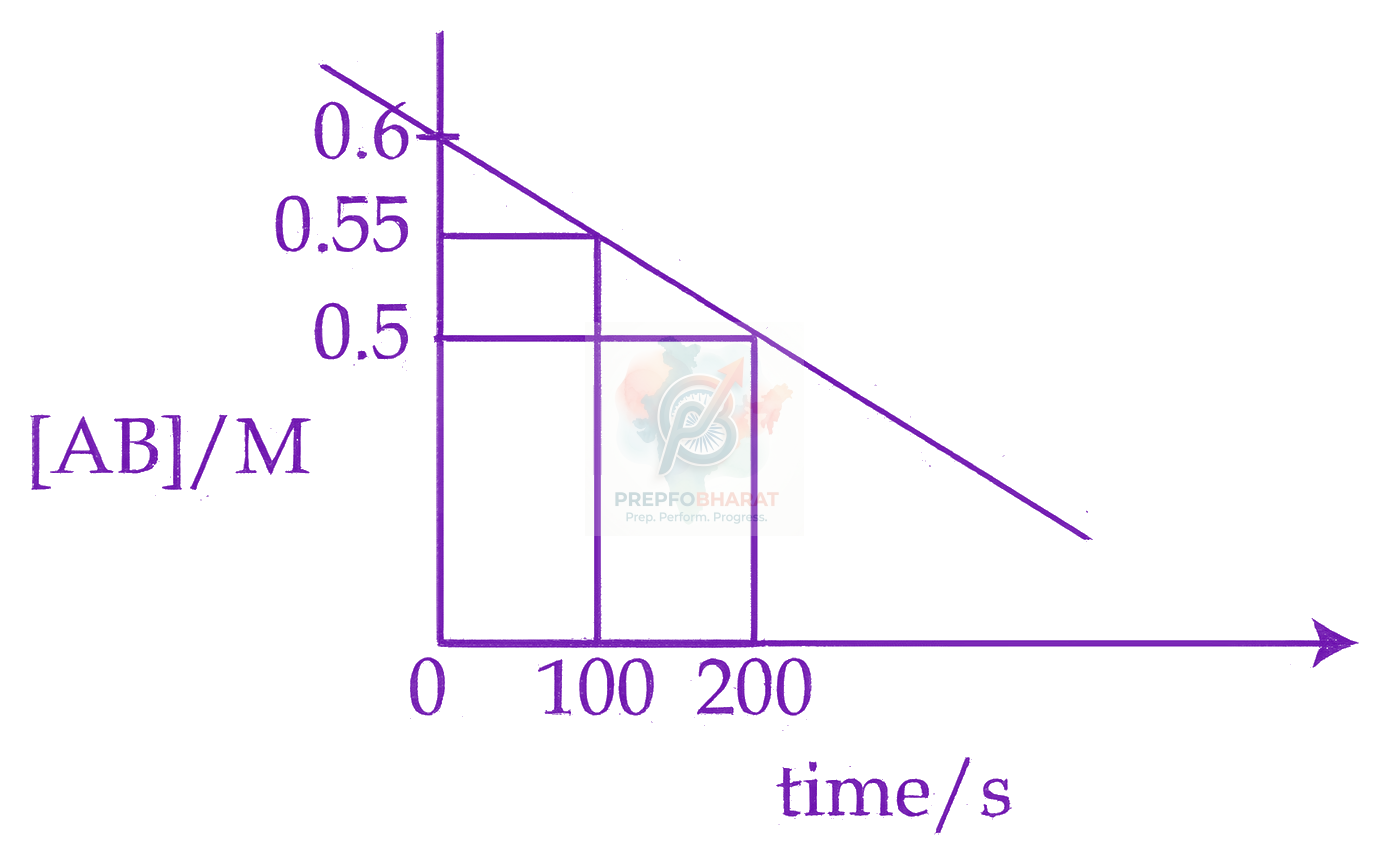 The half life of the reaction is ' $x^{\prime} \min$. $x=$ $\_\_\_\_$ min. (Nearest integer)
Given, (A) $\mathrm{n}=5, \mathrm{~m}_{1}=-1$ (B) $\mathrm{n}=3, \mathrm{l}=2, \mathrm{~m}_{1}=-1, \mathrm{~m}_{\mathrm{s}}=+\frac{1}{2}$ The maximum number of electron(s) in an atom that can have the quantum numbers as given in (A) and (B) respectively are :
Given below are two statements: Statement I: For an ideal gas, heat capacity at constant volume is always greater than the heat capacity at constant pressure. Statement II: In a constant volume process, no work is produced and all the heat withdrawn goes into the chaotic motion and is reflected by a temperature increase of the ideal gas. In the light of the above statements, choose the correct answer from the options given below
The pH of a 0.01 M NaOH solution at 25°C is:
Consider the given graph showing variation of reactant concentration with time. Three different reactions were started with identical initial concentration of reactants. Which of the following statement is correct? 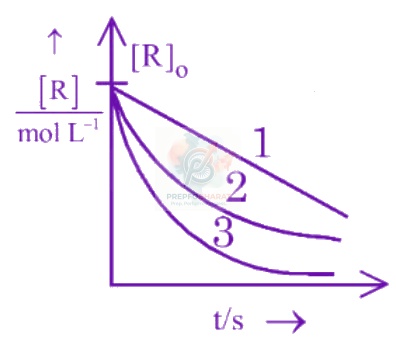
The work functions of two metals $\left(M_{A}\right.$ and $\left.M_{B}\right)$ are in the $1: 2$ ratio. When these metals are exposed to photons of energy 6 eV, the kinetic energy of liberated electrons of $M_{A}: M_{B}$ is in the ratio of $2.642: 1$. The work functions (in eV) of $M_{A}$ and $M_{B}$ are respectively.
The solubility product constants of $Ag_2CrO_4$ and $AgBr$ are $32x$ and $4y$ respectively at $298$ K. The value of $\left(\dfrac{\text{molarity of } Ag_2CrO_4}{\text{molarity of } AgBr}\right)$ can be expressed as :
$20\text{ g}$ hemoglobin in a $1\text{ L}$ aqueous solution (A) at $300\text{ K}$ is separated from pure water by semi permeable membrane. At equilibrium the height of solution in a tube dipped in a solution (A) is found to be $80.0\text{ mm}$ higher than the tube dipped in water. The molar mass of hemoglobin is _______ $\text{kg mol}^{-1}$. (Nearest integer) (Given : $g = 10\text{ m s}^{-2}$, $R = 8.3\text{ kPa dm}^3\text{ K}^{-1}\text{mol}^{-1}$, density of solution $= 1000\text{ kg m}^{-3}$)
In the given electrochemical cell, $\mathrm{Ag}(\mathrm{s})|\mathrm{AgCl}(\mathrm{s})| \mathrm{FeCl}_{2}(\mathrm{aq}), \mathrm{FeCl}_{3}(\mathrm{aq}) \mid \mathrm{Pt}(\mathrm{s})$ at 298 K, the cell potential $\left(\mathrm{E}_{\text {cell }}\right)$ will increase when : A. Concentration of $\mathrm{Fe}^{2+}$ is increased. B. Concentration of $\mathrm{Fe}^{3+}$ is decreased. C. Concentration of $\mathrm{Fe}^{2+}$ is decreased. D. Concentration of $\mathrm{Fe}^{3+}$ is increased. E. Concentration of $\mathrm{Cl}^{-}$is increased. Choose the correct answer from the options given below :
The temperature at which the rate constants of the given below two gaseous reactions become equal is $\_\_\_\_$ K. (Nearest integer) $\mathrm{X} \longrightarrow \mathrm{Y} \quad \mathrm{k}_{1}=10^{6} e^{\frac{-30000}{\mathrm{~T}}}$ $\mathrm{P} \longrightarrow \mathrm{Q} \quad \mathrm{k}_{2}=10^{4} e^{\frac{-24000}{\mathrm{~T}}}$ Given: $\ln 10=2.303$
An electrochemical cell, consist of the following two redox couples, $M^{x+}(aq)/M(s)$ $[E_{red}^\ominus=+0.15\text{ V}]$ and $Fe^{3+}(aq)/Fe(s)$ $[E_{red}^\ominus=-0.036\text{ V}]$. The cell EMF $(E_{cell})$ is recorded to be $0.2057$ V. If the reaction quotient of the electrochemical reaction is found to be $10^{-2}$, then the value of $x$ is ______. (Nearest integer) [Given: M is a p-block metal and $\dfrac{2.303RT}{F}=0.059$ V]
Consider the following data. <table class="pyq-table"><tbody><tr><th>Electrolyte</th><th>$\Lambda^{\circ}_m$ (S cm$^2$ mol$^{-1}$)</th></tr><tr><td>$\text{BaCl}_2$</td><td>$x_1$</td></tr><tr><td>$\text{H}_2\text{SO}_4$</td><td>$x_2$</td></tr><tr><td>HCl</td><td>$x_3$</td></tr></tbody></table> $\text{BaSO}_4$ is sparingly soluble in water. If the conductivity of the saturated $\text{BaSO}_4$ solution is $x$ S cm$^{-1}$ then the solubility product of $\text{BaSO}_4$ can be given as (Here $\Lambda_m = \Lambda^{\circ}_m$)
The half-life of ${ }^{65} \mathrm{Zn}$ is 245 days. After $x$ days, $75 \%$ of original activity remained. The value of $x$ in days is $\_\_\_\_$. (Nearest integer) (Given: $\log 3=0.4771$ and $\log 2=0.3010$)
At $27°$C, $0.1$ M, $1$ L $K_4[Fe(CN)_6]$ aqueous solution and $0.1$ M, $1$ L $FeCl_3$ aqueous solution are placed in a container separated by a semi permeable membrane AB. Assume complete dissociation of both the solutes. Which of the following statement is correct? 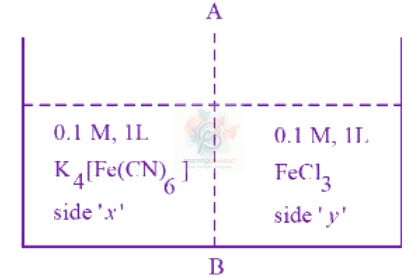
In order to oxidise a mixture of $1$ mole each of $FeC_2O_4$, $Fe_2(C_2O_4)_3$, $FeSO_4$ and $Fe_2(SO_4)_3$ in acidic medium, the number of moles of $KMnO_4$ required is
For strong electrolyte $\Lambda_{\mathrm{m}}$ increases slowly with dilution and can be represented by the equation $\Lambda_{\mathrm{m}}=\Lambda_{\mathrm{m}}^{\circ}-\mathrm{Ac}^{1 / 2}$ Molar conductivity values of the solutions of strong electrolyte AB at $18^{\circ} \mathrm{C}$ are given below : \(\begin{array}{|l|c|c|c|c|} \hline \mathrm{c}\;[\mathrm{mol\,L^{-1}}] & 0.04 & 0.09 & 0.16 & 0.25 \\ \hline \Lambda_{\mathrm{m}}\;[\mathrm{S\,cm^{2}\,mol^{-1}}] & 96.1 & 95.7 & 95.3 & 94.9 \\ \hline \end{array}\) The value of constant A based on the above data $\left[\right.$ in $\left.\mathrm{S} \mathrm{cm}^{2} \mathrm{~mol}^{-1} /(\mathrm{mol} / \mathrm{L})^{1 / 2}\right]$ unit is $\_\_\_\_$.
Molar conductivity of a weak acid HQ of concentration 0.18 M was found to be $1 / 30$ of the molar conductivity of another weak acid HZ with concentration of 0.02 M. If $\lambda^{\circ} \mathrm{Q}^{-}$happened to be equal with $\lambda^{\circ} \mathrm{Z}^{-}$, then the difference of the $\mathrm{pK}_{\mathrm{a}}$ values of the two weak acids $\left(\mathrm{pK}_{\mathrm{a}}(\mathrm{HQ})-\mathrm{pK}_{\mathrm{a}}(\mathrm{HZ})\right)$ is $\_\_\_\_$ (Nearest integer). [Given: degree of dissociation $(\alpha) \ll 1$ for both weak acids, $\lambda^{\circ}$ : limiting molar conductivity of ions]
The heat of atomisation of methane and ethane are ' x ' $\mathrm{kJ} \mathrm{mol}^{-1}$ and ' y ' $\mathrm{kJ} \mathrm{mol}^{-1}$ respectively. The longest wavelength $(\lambda)$ of light capable of breaking the $\mathrm{C}-\mathrm{C}$ bond can be expressed in SI unit as:
The species having identical radii according to the Bohr's theory are: A. $H$ (first orbit) B. $He^+$ (first orbit) C. $He^+$ (Second orbit) D. $Li^{2+}$ (first orbit) E. $Be^{3+}$ (Second orbit) Choose the correct answer from the options given below:
If shortest wavelength of hydrogen atom in Lyman series is $x$, then longest wavelength in Balmer series of $\text{He}^+$ is:
Given below are two statements: Statement I: Sodium dichromate and potassium dichromate are classified as primary standards in titrimetric analysis. Statement II: Phenolphthalein is a weak base, therefore it dissociates in acidic medium. In the light of the above statements, choose the correct answer from the options given below