Physical Chemistry PYQ — Page 5
JEE Main Chemistry — Physical Chemistry previous year questions with solutions.
All Physical Chemistry Questions (1826)
At $\mathrm{T}(\mathrm{K}), 2$ moles of liquid A and 3 moles of liquid B are mixed. The vapour pressure of ideal solution formed is 320 mm Hg. At this stage, one mole of A and one mole of B are added to the solution. The vapour pressure is now measured as 328.6 mm Hg. The vapour pressure (in mm Hg) of A and B are respectively:
What is the mole fraction of water in $10$% by weight (w/w) of aqueous urea solution? [Given: Molar mass of H, O, C and N are $1$, $16$, $12$ and $14$ g mol$^{-1}$ respectively.]
Consider the following reactions in which all the reactants and products are present in gaseous state $2xy \rightleftharpoons x_2 + y_2 \quad K_1 = 2.5\times 10^5$ $xy + \dfrac{1}{2}z_2 \rightleftharpoons xyz \quad K_2 = 5\times 10^{-3}$ The value of $K_3$ for the equilibrium $\dfrac{1}{2}x_2 + \dfrac{1}{2}y_2 + \dfrac{1}{2}z_2 \rightleftharpoons xyz$ is:
One half cell in a voltaic cell is constructed by dipping silver rod in $AgNO_3$ solution of unknown concentration, other half cell is $Zn$ rod dipped in $1$ molar solution of $ZnSO_4$. A voltage of $1.60\text{ V}$ is measured at $298\text{ K}$ for this cell. What is the concentration of $Ag^+$ ions used in terms of $\log x$ ($x = [Ag^+]$) ? $E^\circ_{Zn^{2+}/Zn} = -0.76\text{ V}$, $E^\circ_{Ag^+/Ag} = +0.80\text{ V}$, $\dfrac{2.303 RT}{F} = 0.059\text{ V}$
Consider the following data. (i) $2Al(s) + 6HCl(aq) \rightarrow Al_2Cl_6(aq) + 3H_2(g) + 1200$ kJ/mol (ii) $H_2(g) + Cl_2(g) \rightarrow 2HCl(g) + 164$ kJ/mol (iii) $HCl(g) + aq \rightarrow HCl(aq) + 83$ kJ/mol (iv) $Al_2Cl_6(s) + aq \rightarrow Al_2Cl_6(aq) + 663$ kJ/mol The enthalpy of formation of anhydrous solid $Al_2Cl_6$ is :
Which of the following statements are not correct? A. For water, magnitude of $K_b$ is more than the magnitude of $K_f$. B. The elevation in boiling point of water when a non-volatile solute is added to it is larger in magnitude than its depression in freezing point. C. Osmotic pressure measurement is preferred over any other colligative property to determine molar mass of proteins and polymers. D. The dimerised form of benzoic acid in benzene is $C_6H_5-\underset{O}{\overset{O}{\|}}C-OH \cdots\cdots O=\underset{OH}{\overset{|}{C}}-C_6H_5$ Choose the correct answer from the options given below:
The wavelength of photon ' A ' is 400 nm. The frequency of photon ' B ' is $10^{16} \mathrm{~s}^{-1}$. The wave number of photon ' $C^{\prime}$ is $10^{4} \mathrm{~cm}^{-1}$. The correct order of energy of these photons is :
An oxide of iron contains $69.9\%$ iron, its empirical formula, is: (Given: Molar mass of Fe and O are $56$ and $16$ g mol$^{-1}$ respectively.)
For the given reaction:<br>$\mathrm{CaCO}_{3}+2 \mathrm{HCl} \longrightarrow \mathrm{CaCl}_{2}+\mathrm{H}_{2} \mathrm{O}+\mathrm{CO}_{2}$<br>If $90 \mathrm{~g} \mathrm{CaCO}_{3}$ is added to 300 mL of HCl which contains $38.55 \% \mathrm{HCl}$ by mass and has density $1.13 \mathrm{~g} \mathrm{~mL}^{-1}$, then which of the following option is correct ?<br>Given molar mass of $\mathrm{H}, \mathrm{Cl}, \mathrm{Ca}$ and O are 1, 35.5, 40 and $16 \mathrm{~g} \mathrm{~mol}^{-1}$ respectively.
Consider the following gaseous equilibrium in a closed container of volume ' V ' at $\mathrm{T}(\mathrm{K})$. $\mathrm{P}_{2}(\mathrm{~g})+\mathrm{Q}_{2}(\mathrm{~g}) \rightleftharpoons 2 \mathrm{PQ}(\mathrm{g})$ 2 moles each of $\mathrm{P}_{2}(\mathrm{~g}), \mathrm{Q}_{2}(\mathrm{~g})$ and $\mathrm{PQ}(\mathrm{g})$ are present at equilibrium. Now one mole each of ' $\mathrm{P}_{2}$ ' and ' $\mathrm{Q}_{2}$ ' are added to the equilibrium keeping the temperature at $\mathrm{T}(\mathrm{K})$. The number of moles of $P_{2}, Q_{2}$ and $P Q$ at the new equilibrium, respectively, are
$\mathrm{A}+2 \mathrm{~B} \longrightarrow \mathrm{AB}_{2}$ 36.0 g of 'A' (Molar mass: $60 \mathrm{~g} \mathrm{~mol}^{-1}$) and 56.0 g of ' $\mathrm{B}^{\prime}$ (Molar mass: $80 \mathrm{~g} \mathrm{~mol}^{-1}$) are allowed to react. Which of the following statements are correct ? A. 'A' is the limiting reagent. B. $77.0 \mathrm{~g}$ of $\mathrm{AB}_{2}$ is formed. C. Molar mass of $A B_{2}$ is $140 \mathrm{~g} \mathrm{~mol}^{-1}$. D. $15.0 \mathrm{~g}$ of A is left unreacted after the completion of reaction. Choose the correct answer from the options given below :
What volume of hydrogen gas at STP would be liberated by action of $50\text{ mL}$ of $H_2SO_4$ of $50\%$ purity (density $= 1.3\text{ g mL}^{-1}$) on $20\text{ g}$ of zinc ?<br>Given : Molar mass of H, O, S, Zn are $1, 16, 32, 65\text{ g mol}^{-1}$ respectively.
How many grams of residue is obtained by heating $2.76$ g of silver carbonate? (Given: Molar mass of C, O and Ag are $12$, $16$ and $108$ g mol$^{-1}$ respectively)
For a general redox reaction Anode : $\text{Red}_1 \rightarrow \text{Ox}_1^{n_1^+} + n_1 e^-$ Cathode : $\text{Ox}_2 + n_2 e^- \rightarrow \text{Red}_2^{n_2^-}$ Which of the following statement is incorrect ?
Number of moles and number of molecules in $1.4187$ L of $SO_2$ at STP respectively are:
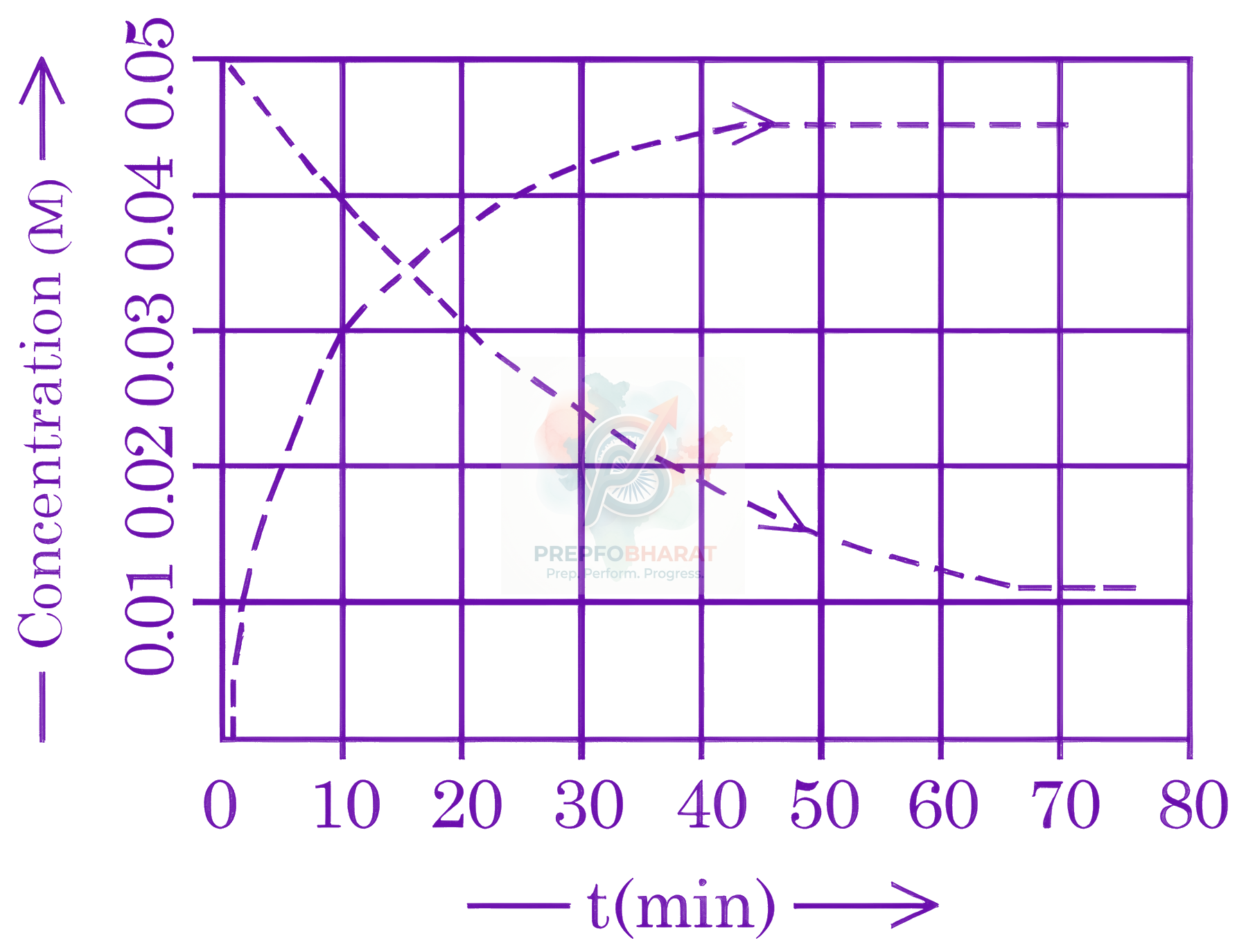 Given above is the concentration vs time plot for a dissociation reaction : $\mathrm{A} \rightarrow \mathrm{nB}$. Based on the data of the initial phase of the reaction (initial 10 min), the value of n is $\_\_\_\_$.
At the transition temperature $T$, $A \rightleftharpoons B$ and $\Delta G^0 = 105 - 35\log T$ where $A$ and $B$ are two states of substance $X$. The transition temperature in $°$C when pressure is $1$ atm is _______. (Nearest integer)
$20.0 \mathrm{dm}^{3}$ of an ideal gas ' X ' at 600 K and 0.5 MPa undergoes isothermal reversible expansion until pressure of the gas is 0.2 MPa. Which of the following option is correct? (Given: $\log 2=0.3010$ and $\log 5=0.6989$)
Consider the following data for the reaction $X_2(g) + Y_2(g) \rightleftharpoons 2XY(g)$ at $600\text{ K}$. The $\Delta_r G^\circ$ (in kJ mol$^{-1}$) for the reaction is : <table class="pyq-table"><tbody><tr><th>Compound</th><th>$\Delta_f H^\circ_{600K}$ (kJ mol$^{-1}$)</th><th>$S^\circ_{600K}$ (J mol$^{-1}$ K$^{-1}$)</th></tr><tr><td>$XY(g)$</td><td>$42$</td><td>$200$</td></tr><tr><td>$X_2(g)$</td><td>$8$</td><td>$140$</td></tr><tr><td>$Y_2(g)$</td><td>$80$</td><td>$250$</td></tr></tbody></table>
Elements P and Q form two types of non-volatile, non-ionizable compounds PQ and $\mathrm{PQ}_{2}$. When 1 g of PQ is dissolved in 50 g of solvent ${ }^{\prime} \mathrm{A}^{\prime}, \Delta \mathrm{T}_{\mathrm{b}}$ was 1.176 K while when 1 g of $\mathrm{PQ}_{2}$ is dissolved in 50 g of solvent ${ }^{\prime} \mathrm{A}^{\prime}, \Delta \mathrm{T}_{\mathrm{b}}$ was 0.689 K. ($\mathrm{K}_{\mathrm{b}}$ of ' $\mathrm{A}^{\prime}=5 \mathrm{~K} \mathrm{~kg} \mathrm{~mol}^{-1}$). The molar masses of elements P and Q (in $\mathrm{g} \mathrm{mol}^{-1}$) respectively, are :
One mole of $\mathrm{Cl}_{2}(\mathrm{~g})$ was passed into 2 L of cold 2 M KOH solution. After the reaction, the concentrations of $\mathrm{Cl}^{-}, \mathrm{ClO}^{-}$and $\mathrm{OH}^{-}$are respectively (assume volume remains constant)
The pH and conductance of a weak acid (HX) was found to be 5 and $4 \times 10^{-5} \mathrm{~S}$, respectively. The conductance was measured under standard condition using a cell where the electrode plates having a surface area of $1 \mathrm{~cm}^{2}$ were at a distance of 15 cm apart. The value of the limiting molar conductivity is $\_\_\_\_$ $\mathrm{S} \mathrm{m}^{2} \mathrm{~mol}^{-1}$. (nearest integer) (Given : degree of dissociation of the weak acid $(\alpha) \ll 1$)
For reaction $A \rightarrow P$, rate constant $k = 1.5 \times 10^3$ s$^{-1}$ at $27°$C. If activation energy for the above reaction is $60$ kJ mol$^{-1}$, then the temperature (in $°$C) at which rate constant, $k = 4.5 \times 10^3$ s$^{-1}$ is _______. (Nearest integer) Given : $\log 2 = 0.30$, $\log 3 = 0.48$, $R = 8.3$ J K$^{-1}$ mol$^{-1}$, $\ln 10 = 2.3$
Consider the following reduction processes : $\mathrm{Al}^{3+}+3 \mathrm{e}^{-} \longrightarrow \mathrm{Al}(\mathrm{s}), \mathrm{E}^{0}=-1.66 \mathrm{~V}$ $\mathrm{Fe}^{3+}+\mathrm{e}^{-} \longrightarrow \mathrm{Fe}^{2+}, \mathrm{E}^{0}=+0.77 \mathrm{~V}$ $\mathrm{Co}^{3+}+\mathrm{e}^{-} \longrightarrow \mathrm{Co}^{2+}, \mathrm{E}^{0}=+1.81 \mathrm{~V}$ $\mathrm{Cr}^{3+}+3 \mathrm{e}^{-} \longrightarrow \mathrm{Cr}(\mathrm{s}), \mathrm{E}^{\circ}=-0.74 \mathrm{~V}$ The tendency to act as reducing agent decreases in the order :