Physical Chemistry PYQ — Page 7
JEE Main Chemistry — Physical Chemistry previous year questions with solutions.
All Physical Chemistry Questions (1826)
Identify the INCORRECT statements from the following: A. Notation ${ }_{12}^{24} \mathrm{Mg}$ represents 24 protons and 12 neutrons. B. Wavelength of a radiation of frequency $4.5 \times 10^{15} \mathrm{~s}^{-1}$ is $6.7 \times 10^{-8} \mathrm{~m}$. C. One radiation has wavelength $=\lambda_{1}(900 \mathrm{~nm})$ and energy $=\mathrm{E}_{1}$. Other radiation has wavelength $=\lambda_{2}(300 \mathrm{~nm})$ and energy $=\mathrm{E}_{2}. \mathrm{E}_{1}: \mathrm{E}_{2}=3: 1$. D. Number of photons of light of wavelength 2000 pm that provides 1 J of energy is $1.006 \times 10^{16}$. Choose the correct answer from the options given below:
The plot of $\log _{10} \mathrm{~K}$ vs $\frac{1}{\mathrm{~T}}$ gives a straight line. The intercept and slope respectively are (where K is equilibrium constant).
$\mathrm{A} \longrightarrow \mathrm{B}$ (first reaction) $\mathrm{C} \longrightarrow \mathrm{D}$ (second reaction) Consider the above two first-order reactions. The rate constant for first reaction at 500 K is double of the same at 300 K. At $500 \mathrm{~K}, 50 \%$ of the reaction becomes complete in 2 hour. The activation energy of the second reaction is half of that of first reaction. If the rate constant at 500 K of the second reaction becomes double of the rate constant of first reaction at the same temperature; then rate constant for the second reaction at 300 K is $\_\_\_\_$ $\times 10^{-1}$ hour $^{-1}$ (nearest integer).
A non-volatile, non-electrolyte solid solute when dissolved in $40$ g of a solvent, the vapour pressure of the solvent decreased from $760$ mm Hg to $750$ mm Hg. If the same solution boils at $320$ K, then the number of moles of the solvent present in the solution is _____. (Nearest integer) [Given: boiling point of the pure solvent $= 319.5$ K, $K_b$ of the solvent $= 0.3$ K kg mol$^{-1}$]
In a closed flask at $600$ K, one mole of X$_2$Y$_4$(g) attains equilibrium as given below : $\text{X}_2\text{Y}_4(g) \rightleftharpoons 2\text{XY}_2(g)$ At equilibrium, $75\%$ X$_2$Y$_4$(g) was dissociated and the total pressure is $1$ atm. The magnitude of $\Delta_r G^{\ominus}$ (in kJ mol$^{-1}$) at this temperature is __________. (Nearest Integer) (Given : R $= 8.3$ J mol$^{-1}$ K$^{-1}$; $\ln 10 = 2.3$, $\log 2 = 0.3$, $\log 3 = 0.48$, $\log 5 = 0.69$, $\log 7 = 0.84$)
At $25°C$, $20.0$ mL of $0.2$ M weak monoprotic acid HX is titrated against $0.2$ M NaOH. The pH of the solution (a) at the start of the titration (when NaOH has not been added) and (b) when $10$ mL of NaOH is added respectively, are: Given: $K_a = 5 \times 10^{-4}$, $pK_a = 3.3$, $\alpha << 1$ <table class="pyq-table"><tbody><tr><th>(a)</th><th>(b)</th></tr></tbody></table>
Consider the first order reaction $R \rightarrow P$. The fraction of molecules decomposed in the given first order reaction can be expressed as
Given below are two statements: Given: Molar mass of C, H, O, Cl are $12, 1, 16$ and $35.5$ g mol$^{-1}$, respectively. Statement I: In $30\%$ (w/w) solution of methanol in CCl$_4$ (at T K), the mole fraction of CCl$_4$ is equal to $0.33$. Statement II: Mixture of methanol and CCl$_4$ shows positive deviation from Raoult's law. In the light of the above statements, choose the correct answer from the options given below:
If the half life of a first order reaction is $6.93$ minutes then the time required for completion of $99$% of the reaction will be _____ minutes. (Given : $\log 2 = 0.3010$)
Consider a solution of $\mathrm{CO}_{2}(\mathrm{~g})$ dissolved in water in a closed container. Which one of the following plots correctly represents variation of log (partial pressure of $\mathrm{CO}_{2}$ in vapour phase above water) $[y$-axis] with $\log$ (mole fraction of $\mathrm{CO}_{2}$ in water) $[x$-axis $]$ at $25^{\circ} \mathrm{C}$ ?
Given is a concentrated solution of a weak electrolyte $A_xB_y$ of concentration 'c' and dissociation constant 'K'. The degree of dissociation is given by :
The correct order of molar heat capacities measured at $298\text{ K}$ and $1\text{ bar}$ is :
$500$ mL of $0.2$ M MnO$_4^-$ solution in basic medium when mixed with $500$ mL of $1.5$ M KI solution, oxidises iodide ions to liberate molecular iodine. This liberated iodine is then titrated with a standard $x$ M thiosulphate solution in presence of starch till the end point. If $300$ mL of thiosulphate was consumed, then the value of $x$ is __________.
Consider $\mathrm{A} \xrightarrow{\mathrm{k}_{1}} \mathrm{~B}$ and $\mathrm{C} \xrightarrow{\mathrm{k}_{2}} \mathrm{D}$ are two reactions. If the rate constant $\left(\mathrm{k}_{1}\right)$ of the $\mathrm{A} \longrightarrow \mathrm{B}$ reaction can be expressed by the following equation $\log _{10} \mathrm{k}=14.34-\frac{1.5 \times 10^{4}}{\mathrm{~T} / \mathrm{K}}$ and activation energy of $C \longrightarrow D$ reaction $\left(E a_{2}\right)$ is $\frac{1}{5}$ th of the $A \longrightarrow B$ reaction $\left(E a_{1}\right)$, then the value of $\left(E a_{2}\right)$ is $\_\_\_\_$ $\mathrm{kJ} \mathrm{mol}^{-1}$. (Nearest Integer)
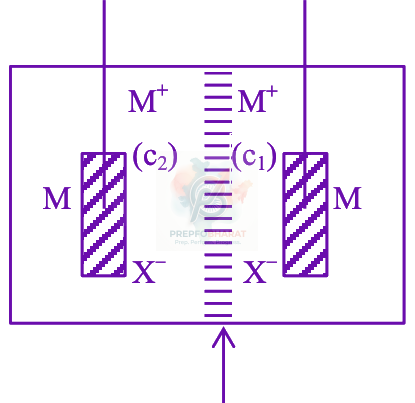 Consider the above electrochemical cell where a metal electrode (M) is undergoing redox reaction by forming $\mathrm{M}^{+}\left(\mathrm{M} \rightarrow \mathrm{M}^{+}+\mathrm{e}^{-}\right)$. The cation $\mathrm{M}^{+}$is present in two different concentrations $c_{1}$ and $c_{2}$ as shown above. Which of the following statement is correct for generating a positive cell potential?
The correct order of total number of atoms present in<br>(A) $2$ moles of cyclohexane<br>(B) $684$ g of sucrose<br>(C) $90.8$ L of dihydrogen at STP<br>is:
A cup of water at $5^{\circ} \mathrm{C}$ (system) is placed in a microwave oven and the oven is turned on for one minute during which the water begins to boil. Which of the following option is true ?
The Bohr radius of a hydrogen like species is $70.53$ pm. The species and the stationary state $(n)$ are respectively (Given : Hydrogen atom Bohr radius is $52.9$ pm)
For the following gas phase equilibrium reaction at constant temperature, $\mathrm{NH}_{3}(\mathrm{~g}) \rightleftharpoons 1 / 2 \mathrm{~N}_{2}(\mathrm{~g})+3 / 2 \mathrm{H}_{2}(\mathrm{~g})$ if the total pressure is $\sqrt{3} \mathrm{~atm}$ and the pressure equilibrium constant $\left(\mathrm{K}_{\mathrm{p}}\right)$ is 9 atm, then the degree of dissociation is given as $\left(x \times 10^{-2}\right)^{-1 / 2}$. The value of $x$ is $\_\_\_\_$. (nearest integer)
Consider the following electrochemical cell : $\mathrm{Pt}\left|\mathrm{O}_{2}(\mathrm{~g})(1 \mathrm{bar})\right| \mathrm{HCl}(\mathrm{aq}) \| \mathrm{M}^{2+}(\mathrm{aq}, 1.0 \mathrm{M}) \mid \mathrm{M}(\mathrm{~s})$ The pH above which, oxygen gas would start to evolve at anode is $\_\_\_\_$ (nearest integer). $\left[\begin{array}{ll}\text { Given: } & \mathrm{E}^{\mathrm{o}}{ }_{\mathrm{M}^{2+} / \mathrm{M}}=0.994 \mathrm{~V} \\ & \mathrm{E}^{\mathrm{o}}{ }_{\mathrm{O}_{2} / \mathrm{H}_{2} \mathrm{O}}=1.23 \mathrm{~V}\end{array}\right\}$ standard reduction potential $]$
Given at $298$ K: $E^{\ominus}_{Fe^{2+}/Fe} = X$ Volt; $E^{\ominus}_{Fe^{3+}/Fe} = Y$ Volt. The $E^{\ominus}_{Fe^{3+}/Fe^{2+}}$ in Volt at $298$ K is given by:
Consider the following data: $\Delta_{f} \mathrm{H}^{\ominus}$ (methane, g$)=-\mathrm{X} \mathrm{kJ} \mathrm{mol}{ }^{-1}$ Enthalpy of sublimation of graphite $=\mathrm{Y} \mathrm{kJ} \mathrm{mol}^{-1}$ Dissociation enthalpy of $\mathrm{H}_{2}=\mathrm{Z} \mathrm{kJ} \mathrm{mol}{ }^{-1}$ The bond enthalpy of $\mathrm{C}-\mathrm{H}$ bond is given by :
$\mathrm{X}_{2}(\mathrm{~g})+\mathrm{Y}_{2}(\mathrm{~g}) \rightleftharpoons 2 \mathrm{Z}(\mathrm{g})$ $\mathrm{X}_{2}(\mathrm{~g})$ and $\mathrm{Y}_{2}(\mathrm{~g})$ are added to a 1 L flask and it is found that the system attains the above equilibrium at $\mathrm{T}(\mathrm{K})$ with the number of moles of $\mathrm{X}_{2}(\mathrm{~g}), \mathrm{Y}_{2}(\mathrm{~g})$ and $\mathrm{Z}(\mathrm{g})$ being 3,3 and 9 mol respectively (equilibrium moles). Under this condition of equilibrium, 10 mol of $\mathrm{Z}(\mathrm{g})$ is added to the flask and the temperature is maintained at $\mathrm{T}(\mathrm{K})$. Then the number of moles of $\mathrm{Z}(\mathrm{g})$ in the flask when the new equilibrium is established is $\_\_\_\_$. (Nearest integer)
The ratio of mass percentage (w/w) of C : H in a hydrocarbon is $12 : 1$. It has two carbon atoms. The weight (in g) of $CO_2(g)$ formed when $3.38$ g of this hydrocarbon is completely burnt in oxygen is : (Given : Molar mass in g mol$^{-1}$ C : 12, H : 1, O : 16)