Physical Chemistry PYQ — Page 8
JEE Main Chemistry — Physical Chemistry previous year questions with solutions.
All Physical Chemistry Questions (1826)
$x \mathrm{mg}$ of pure HCl was used to make an aqueous solution. 25.0 mL of $0.1 \mathrm{M} \mathrm{Ba}(\mathrm{OH})_{2}$ solution is used when the HCl solution was titrated against it. The numerical value of $x$ is $\_\_\_\_$ $\times 10^{-1}$. (Nearest integer) Given : Molar mass of HCl and $\mathrm{Ba}(\mathrm{OH})_{2}$ are 36.5 and $171.0 \mathrm{~g} \mathrm{~mol}^{-1}$ respectively.
Which of the following statements regarding the energy of the stationary state is true in the following one - electron systems ?
$\mathrm{A} \rightarrow \mathrm{D}$ is an endothermic reaction occurring in three steps (elementary). (i) $\mathrm{A} \rightarrow \mathrm{B} \Delta \mathrm{H}_{i}=+\mathrm{ve}$ (ii) $\mathrm{B} \rightarrow \mathrm{C} \Delta \mathrm{H}_{i i}=-\mathrm{ve}$ (iii) $\mathrm{C} \rightarrow \mathrm{D} \Delta \mathrm{H}_{i i i}=-\mathrm{ve}$ Which of the following graphs between potential energy ($y$-axis) vs reaction coordinate (x -axis) correctly represents the reaction profile of $\mathrm{A} \rightarrow \mathrm{D}$ ?
At $298\text{ K}$, the molar conductivity of $x\%$ (w/w) $MX$ solution (aqueous) is $123.5\text{ S cm}^2\text{ mol}^{-1}$. The conductance of same solution is $1.9 \times 10^{-3}\text{ S}$. The value of $x$ is _______ $\times 10^{-2}$. (Given : cell constant $= 1.3\text{ cm}^{-1}$; molar mass of $MX$ is $75\text{ g mol}^{-1}$, density of aqueous solution of $MX$ at $298\text{ K}$ is $1.0\text{ g mL}^{-1}$)
The surface of sodium metal is irradiated with radiation of wavelength $x$ nm. The kinetic energy of ejected electrons is $2.8 \times 10^{-20}$ J. The work function of sodium is $2.3$ eV. The value of $x$ is _____ $\times 10^2$ nm. (Nearest integer) (Given: $h = 6.6 \times 10^{-34}$ J s; $1$ eV $= 1.6 \times 10^{-19}$ J; $c = 3.0 \times 10^8$ m s$^{-1}$)
The wave numbers of three spectral lines of H atom are considered. Identify the set of spectral lines belonging to Balmer series. ($\mathrm{R}=$ Rydberg constant)
What is the ratio of wave number of first line (lowest energy line) of Balmer series of H atomic spectrum to first line of its Brackett series?
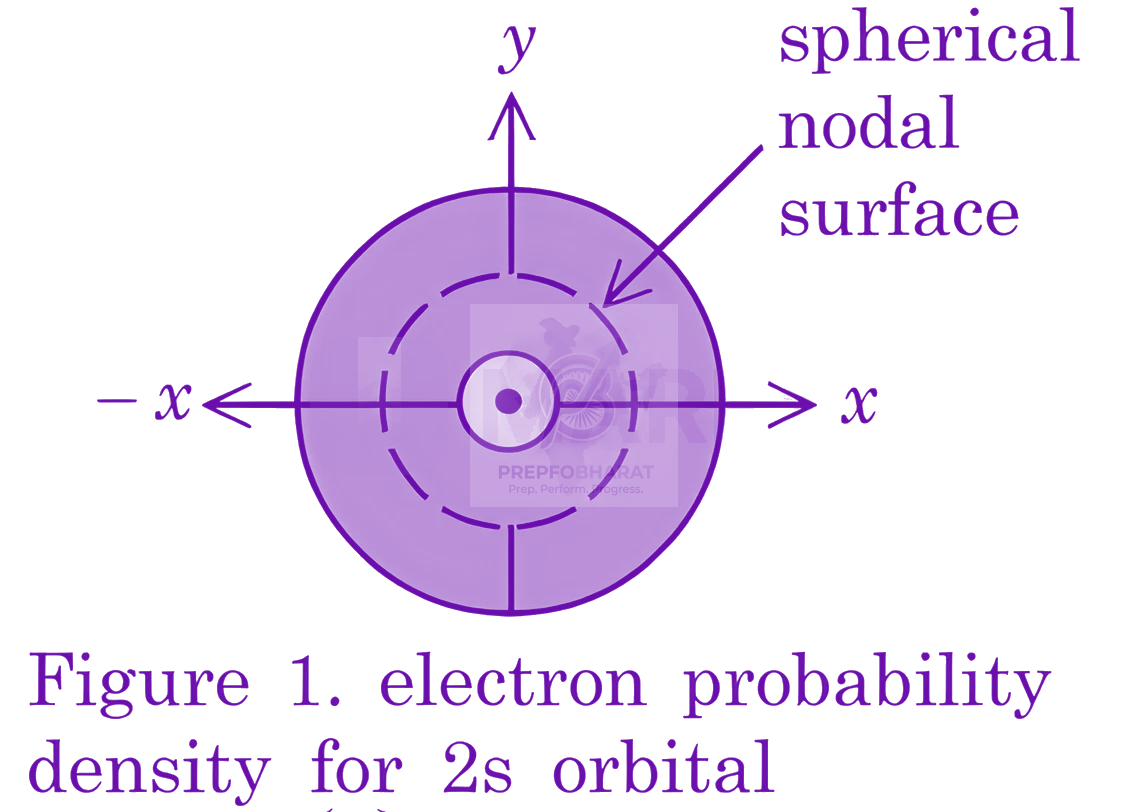 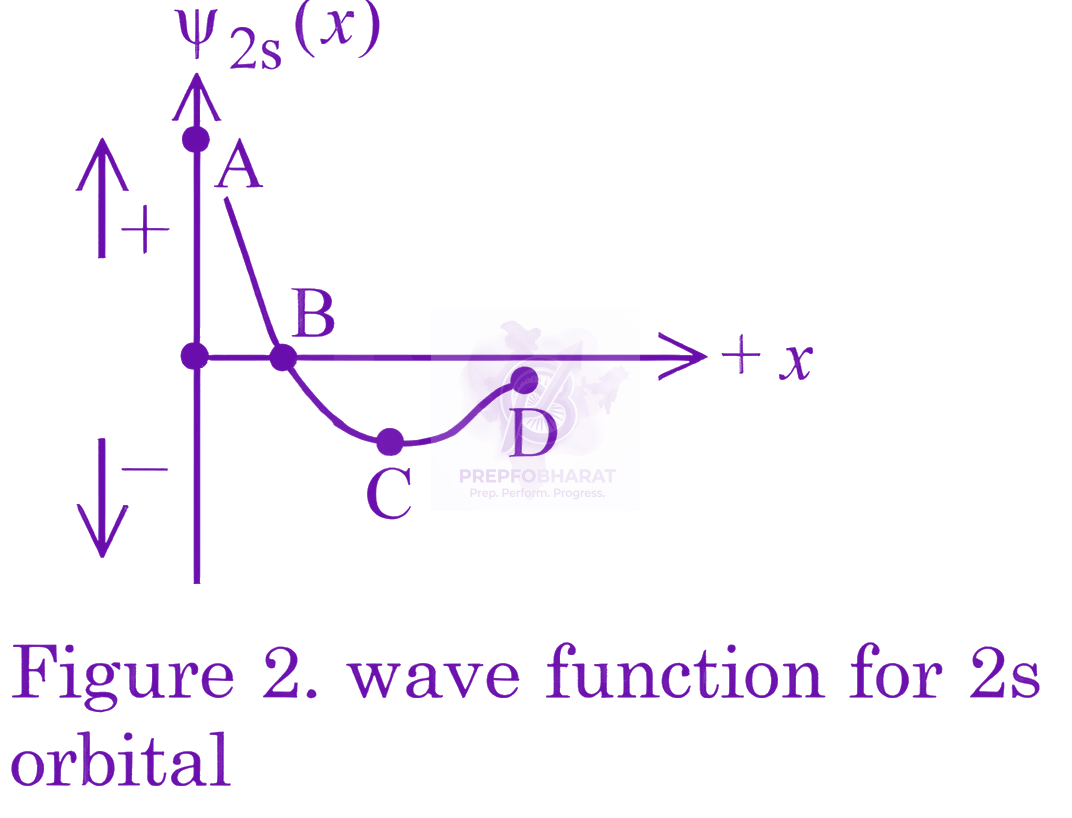 Which of the following point in Figure 2 most accurately represents the nodal surface as shown in Figure 1?
At 298 K, the mole percentage of $\mathrm{N}_{2}(\mathrm{~g})$ in air is $80 \%$. Water is in equilibrium with air at a pressure of 10 atm. What is the mole fraction of $\mathrm{N}_{2}(\mathrm{~g})$ in water at 298 K ? ($\mathrm{K}_{\mathrm{H}}$ for $\mathrm{N}_{2}$ is $6.5 \times 10^{7} \mathrm{~mm} \mathrm{Hg}$)
Electricity is passed through an acidic solution of $\mathrm{Cu}^{2+}$ till all the $\mathrm{Cu}^{2+}$ was exhausted, leading to the deposition of 300 mg of Cu metal. However, a current of 600 mA was continued to pass through the same solution for another 28 minutes by keeping the total volume of the solution fixed at 200 mL. The total volume of oxygen evolved at STP during the entire process is $\_\_\_\_$ mL. (Nearest integer) [Given: $\mathrm{Cu}^{2+}(\mathrm{aq})+2 \mathrm{e}^{-} \rightarrow \mathrm{Cu}(\mathrm{s}) \mathrm{E}_{\text {red }}^{\mathrm{o}}=+0.34 \mathrm{~V}$ $\mathrm{O}_{2}(\mathrm{~g})+4 \mathrm{H}^{+}+4 \mathrm{e}^{-} \rightarrow 2 \mathrm{H}_{2} \mathrm{O} \mathrm{E}_{\text {red }}^{\mathrm{o}}=+1.23 \mathrm{~V}$ Molar mass of $\mathrm{Cu}=63.54 \mathrm{~g} \mathrm{~mol}^{-1}$ Molar mass of $\mathrm{O}_{2}=32 \mathrm{~g} \mathrm{~mol}^{-1}$ Faraday Constant $=96500 \mathrm{C} \mathrm{mol}^{-1}$ Molar volume at $\mathrm{STP}=22.4 \mathrm{~L}$]
Arrange the following resultant mixtures in increasing order of their pH values A. $10$ mL $0.2$ M Ca(OH)$_2$ + $25$ mL $0.1$ M HCl B. $10$ mL $0.01$ M H$_2$SO$_4$ + $10$ mL $0.01$ M Ca(OH)$_2$ C. $10$ mL $0.1$ M H$_2$SO$_4$ + $10$ mL $0.1$ M KOH Choose the correct answer from the options given below:
The hydrogen spectrum consists of several spectral lines in Lyman series ($\mathrm{L}_{1}, \mathrm{~L}_{2}$, $\mathrm{L}_{3} \ldots ; \mathrm{L}_{1}$ has lowest energy among Lyman series). Similarly it consists of several spectral lines in Balmer series $\left(\mathrm{B}_{1}, \mathrm{~B}_{2}, \mathrm{~B}_{3} \ldots ; \mathrm{B}_{1}\right.$ has lowest energy among Balmer lines). The energy of $L_{1}$ is $x$ times the energy of $B_{1}$. The value of $x$ is $\_\_\_\_$ $\times 10^{-1}$ . (Nearest integer)
Consider the reaction $aX \rightarrow bY$, for which the rate constant at $30°C$ is $1 \times 10^{-3}$ mol$^{-1}$ L s$^{-1}$. Which of the following statements are true? A. When concentration of 'X' is increased to four times, the rate of reaction becomes $16$ times. B. The reaction is a second order reaction. C. The half-life period is independent of the concentration of X. D. Decomposition of $N_2 O_5$ is an example of the above reaction. E. $\ln\dfrac{[R_o]}{[R]}$ vs time is valid for the above reaction. Choose the correct answer from the options given below:
A sample of n-octane $(1.14 \mathrm{~g})$ was completely burnt in excess of oxygen in a bomb calorimeter, whose heat capacity is $5 \mathrm{~kJ} \mathrm{~K}^{-1}$. As a result of combustion reaction, the temperature of the calorimeter is increased by 5 K. The magnitude of the heat of combustion of octane at constant volume is ______ $\mathrm{kJ} \mathrm{mol}^{-1}$ (nearest integer).
Compounds that should not be used as primary standards in titrimetric analysis are : A. $\mathrm{Na}_2 \mathrm{Cr}_2 \mathrm{O}_7$ B. Oxalic acid C. NaOH D. $\mathrm{FeSO}_4 \cdot 6 \mathrm{H}_2 \mathrm{O}$ E. Sodium tetraborate Choose the most appropriate answer from the options given below:
Which of the following properties will change when system containing solution 1 will become solution 2? 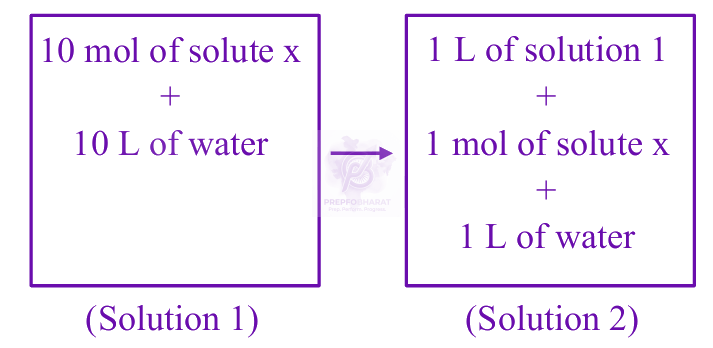
On combustion 0.210 g of an orgainc compound containing $\mathrm{C}, \mathrm{H}$ and O gave $0.127 \mathrm{~g} \mathrm{H}_2 \mathrm{O}$ and 0.307 $\mathrm{g} \mathrm{CO}_2$. The percentages of hydrogen and oxygen in the given organic compound respectively are:
Match List-I with List-II $\begin{array}{|l|l|l|l|}\hline & \text{List-I} & & \text{List-II} \\ \hline \text{(A)} & \begin{array}{l} \text{Solution of} \\ \text{chloroform and} \\ \text{acetone} \end{array} & \text{(I)} & \begin{array}{l} \text{Minimum} \\ \text{boiling} \\ \text{azeotrope} \end{array} \\ \hline \text{(B)} & \begin{array}{l} \text{Solution of ethanol} \\ \text{and water} \end{array} & \text{(II)} & \text{Dimerizes} \\ \hline \text{(C)} & \begin{array}{l} \text{Solution of benzene} \\ \text{and toluene} \end{array} & \text{(III)} & \begin{array}{l} \text{Maximum} \\ \text{boiling} \\ \text{azeotrope} \end{array} \\ \hline \text{(D)} & \begin{array}{l} \text{Solution of acetic} \\ \text{acid in benzene} \end{array} & \text{(IV)} & \Delta \mathrm{V}_{\text {mix }}=0 \\ \hline \end{array}$ Choose the correct answer from the options given below :
What is the freezing point depression constant of a solvent, 50 g of which contain 1 g non volatile solute (molar mass $256 \mathrm{~g} \mathrm{~mol}^{-1}$ ) and the decrease in freezing point is 0.40 K ?
0.01 mole of an organic compound $(X)$ containing $10 \%$ hydrogen, on complete combustion produced $0.9 \mathrm{~g} \mathrm{H}_2 \mathrm{O}$. Molar mass of $(\mathrm{X})$ is _____ $\mathrm{g} \mathrm{mol}^{-1}$.
A solution is made by mixing one mole of volatile liquid \(A\) with 3 moles of volatile liquid \(B\). The vapour pressure of pure A is 200 mm Hg and that of the solution is 500 mm Hg. The vapour pressure of pure \(B\) and the least volatile component of the solution, respectively, are :
For the reaction, $\mathrm{H}_2(\mathrm{~g})+\mathrm{I}_2(\mathrm{~g}) \rightleftharpoons 2 \mathrm{HI}(\mathrm{~g})$ Attainment of equillibrium is predicted correctly by :
Quantitative analysis of an organic compound (X) shows following % composition. C : $14.5 \%$ Cl : 64.46% H: 1.8 % (Empirical formula mass of the compound $(\mathrm{X})$ is __________ $\times 10^{-1}$ (Given molar mass in $\mathrm{g} \mathrm{mol}^{-1}$ of $\mathrm{C}: 12, \mathrm{H}: 1, \mathrm{O}: 16, \mathrm{Cl}: 35.5$)
0.1 mol of the following given antiviral compound \((\mathrm{P})\) will weigh ________ \(\times 10^{-1} \mathrm{~g}\) 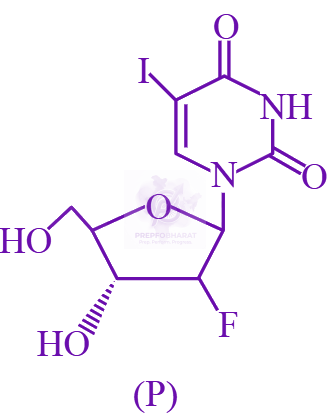 (Given : molar mass in \(\mathrm{g} \mathrm{mol}^{-1} \mathrm{H}: 1, \mathrm{C}: 12, \mathrm{~N}: 14\), \(\mathrm{O}: 16, \mathrm{~F}: 19, \mathrm{I}: 127)\)