Hind II is a type of restriction endonuclease.A restriction enzyme or restriction endonuclease is an enzyme that cleaves DNA into fragments at or near specific recognition sites within the molecule known as restriction sites. Restrictions enzymes are one class of the broader endonuclease group of enzymes. Restriction enzymes are commonly classified into five types, which differ in their structure and whether they cut their DNA substrate at their recognition site, or if the recognition and cleavage sites are separate from one another. To cut DNA, all restriction enzymes make two incisions, once through each sugar-phosphate backbone (i.e. each strand) of the DNA double helix.
Which of the following is a restriction endonuclease?
NEET UG 2016 — Zoology Biotechnology - Principles and Processes
2016mcqmedium
Which of the following is a restriction endonuclease?
Official previous-year question
Held on 30 Apr 2016 · Verified 9 Jul 2026.
Options
- A
Hind II
- B
Protease
- C
DNase I
- D
RNase
Did you get this right?
Sign in to track your attempts and accuracy.
Your note
Sign in to keep a private note on this question. Nothing you write is ever public.
NEET UG Biotechnology - Principles and Processes in other years
Biotechnology - Principles and Processes 2025Biotechnology - Principles and Processes 2024Biotechnology - Principles and Processes 2023Biotechnology - Principles and Processes 2022Biotechnology - Principles and Processes 2021Biotechnology - Principles and Processes 2020Biotechnology - Principles and Processes 2019Biotechnology - Principles and Processes 2018Biotechnology - Principles and Processes 2017Biotechnology - Principles and Processes 2015Biotechnology - Principles and Processes 2014Biotechnology - Principles and Processes 2013
More NEET UG Biotechnology - Principles and Processes questions
Given below are two statements : Statement I: The DNA fragments extracted from gel electrophoresis can be used in construction of recombinant DNA. Statement II : Smaller size DNA fragments are observed near anode while larger fragments are found near the wells in an agarose gel. In the light of the above statements, choose the most appropriate answer from the options given below :
2025medium
Which of the following enzyme(s) are NOT essential for gene cloning? A. Restriction enzymes B. DNA ligase C. DNA mutase D. DNA recombinase E. DNA polymerase Choose the correct answer from the options given below:
2025easy
The blue and white selectable markers have been developed which differentiate recombinant colonies from non-recombinant colonies on the basis of their ability to produce colour in the presence of a chromogenic substrate. Given below are two statements about this method: Statement I : The blue coloured colonies have DNA insert in the plasmid and they are identified as recombinant colonies. Statement II : The colonies without blue colour have DNA insert in the plasmid and are identified as recombinant colonies. In the light of the above statements, choose the most appropriate answer from the options given below:
2025medium
Identify the part of a bio-reactor which is used as a foam braker from the given figure. 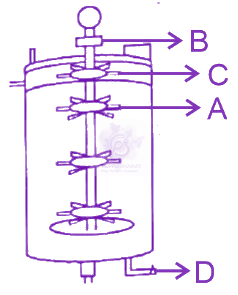
2025easy
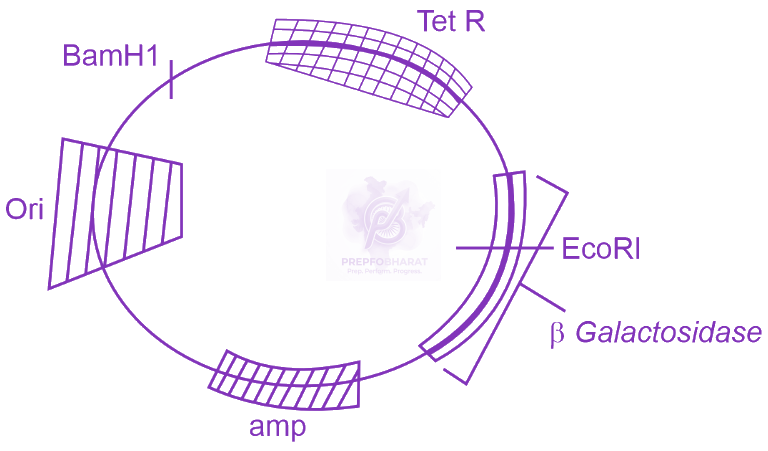 In the above represented plasmid, an alien piece of DNA is inserted at EcoRI site. Which of the following strategies will be chosen to select the recombinant colonies?
2025medium
Other Zoology topics for NEET UG
Keep practicing Biotechnology - Principles and Processes
Work through every NEET UG Biotechnology - Principles and Processes PYQ, year by year.