Evolution PYQ
NEET UG Zoology — Evolution previous year questions with solutions.
Browse by Year
Evolution at a glance
Questions per year
118 across 24 yearsDifficulty mix
118 total- easy58 · 49%
- medium50 · 42%
- hard10 · 8%
All Evolution Questions (118)
Sweet potato and potato represent a certain type of evolution. Select the correct combination of terms to explain the evolution.
What is the correct order (old to recent) of periods in Paleozoic era?
Which evolutionary phenomenon is depicted by the sketch given in figure? 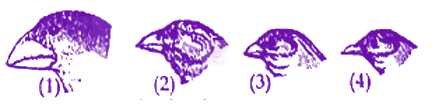
Match List-I with List-II: $\begin{array}{|l|l|l|l|}\hline & \text{List I} & & \text{List II} \\\hline A. & \text{Gene pool} & I. & \text{Stable within a generation} \\\hline B. & \text{Genetic drift} & II. & \text{Change in gene frequency by chance} \\\hline C. & \text{Gene flow} & III. & \text{Transfer of genes into or out of population} \\\hline D & \text{Gene frequency} & IV. & \text{Total number of genes and their alleles} \\\hline \end{array}$ Chose the correct answer from the option given below:
Which one of the following factors will not affect the Hardy-Weinberg equilibrium?
Given below are some stages of human evolution. Arrange them in correct sequence. (Past to Recent) A. Homo habilis B. Homo sapiens C. Homo neanderthalensis D. Homo erectus Choose the correct sequence of human evolution from the options given below:
The flippers of the Penguins and Dolphins are the example of the
Match List-I with List-II with respect to convergent evolution: \begin{array}{|l|l|l|l|}\hline & List-I & & List-II \\\hline A. & Lemur & I. & Flying phalanger \\\hline B. & Bobcat & II. & Numbat \\\hline C. & Anteater & III. & Spotted cuscus \\\hline D. & Flying squirrels & IV. & Tasmanian tiger cat \\\hline\end{array} Choose the correct answer from the options given below:
Match List-I with List-II: \begin{array}{|l|l|l|l|}\hline & List-I & & List-II \\\hline A. & Living Fossil & I. & Elongated canine teeth \\\hline B. & Connecting Link & II. & Vermiform appendix \\\hline C. & Vestigial Organ & III. & Echidna \\\hline D. & Atavism & IV. & Latimeria \\\hline\end{array} Choose the correct answer from the options given below:
Match List I with List II:  Choose the correct answer from the options given below :
Identify the fossil of man who showed the following characteristics. (A) Brain capacity of $1400 \mathrm{cc}$ (B) Used hides to protect their body (C) Buried their dead bodies In the light of above statements, choose the correct answer from the options given below:
Select the correct group/set of Australian Marsupials exhibiting adaptive radiation.
Panspermia, an idea that is still a favourite for some astronomers, means :
Which of the following statements is not true ?
Select the correct statement regarding mutation theory of evolution.
Natural selection where more individuals acquire specific character value other than the mean character value, leads to:
Match List$-I$ with List$-\mathrm{II}$. <table class="pyq-table"><tbody><tr><td colspan="2" rowspan="1">List$-I$</td><td colspan="2" rowspan="1">List$-\mathrm{II}$</td></tr><tr><td>(a)</td><td>Adaptive radiation</td><td>(i)</td><td>Selection of resistant varieties due to excessive use of herbicides and pesticides</td></tr><tr><td>(b)</td><td>Convergent evolution</td><td>(ii)</td><td>Bones of forelimbs in Man and Whale</td></tr><tr><td>(c)</td><td>Divergent evolution</td><td>(iii)</td><td>Wings of Butterfly and Bird</td></tr><tr><td>(d)</td><td>Evolution by anthropogenic action</td><td>(iv)</td><td>Darwin Finches</td></tr></tbody></table>
The factor that leads to Founder effect in population is:
From his experiments, S.L. Miller produced amino acids by mixing the following in a closed flask
Which of the following refer to correct example(s) of organisms which have evolved due to changes in environment brought about by anthropogenic action? (a) Darwin’s Finches of Galapagos islands. (b) Herbicide resistant weeds. (c) Drug resistant eukaryotes. (d) Man-created breeds of domesticated animals like dogs.
After about how many years of formation of earth, life appeared on this planet?
The phenomenon of evolution of different species in a given geographical area starting from a point and spreading to other habitats is called:
Embryological support for evolution was proposed by:
Flippers of Penguins and Dolphins are examples of