Optics PYQ — Page 4
NEET UG Physics — Optics previous year questions with solutions.
All Optics Questions (122)
Two identical glass $({\mu }_{g}=\frac{3}{2})$ equiconvex lenses of focal length, $f$ are kept in contact. The space between the two lenses is filled with water $({\mu }_{w}=\frac{4}{3})$. The focal length of the combination is
For a parallel beam of monochromatic light of wavelength $\lambda$, diffraction is produced by a single slit whose width $\text{a}$ is of the order of the wavelength of the light. If $\text{D}$ is the distance of the screen from the slit, the width of the central maxima will be:
A beam of light consisting of red, green and blue colours is incident on a right-angled prism. The refractive index of the material of the prism for the above red, green and blue wavelengths are $1.39$, $1.44$and $1.47$ respectively. 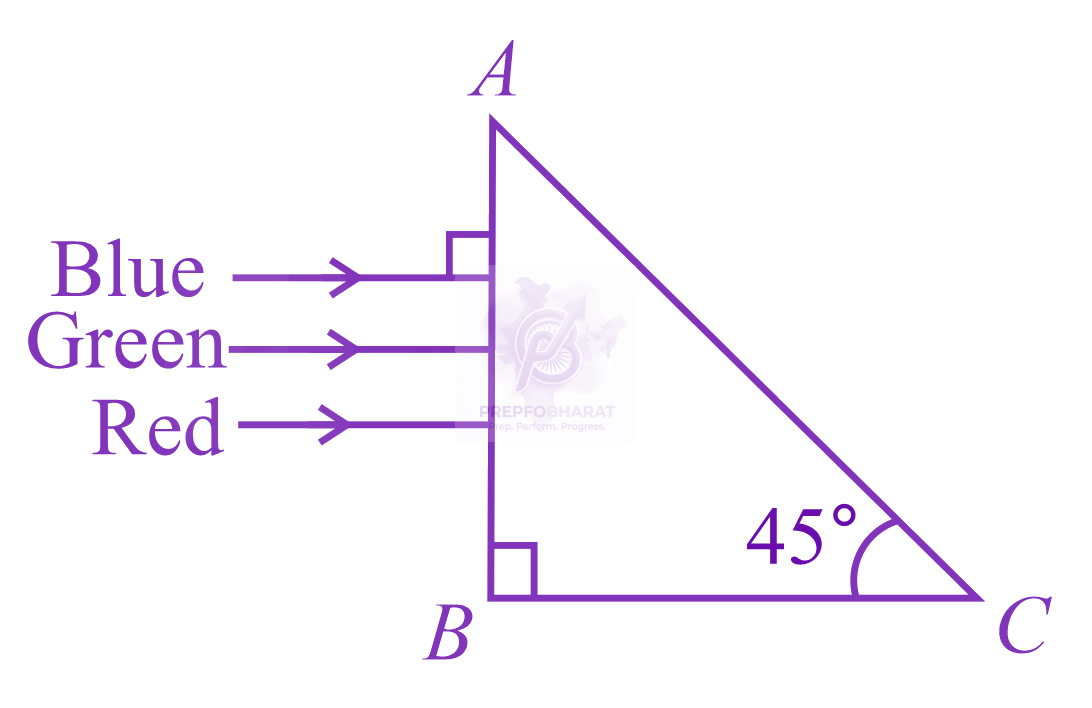 The prism will:
Two slits in Young's experiment have widths in the ratio 1 : 25. The ratio of intensity at the maxima and minima in the interference pattern, $\frac{{I}_{max}}{{I}_{min}}$ is:
In an astronomical telescope in normal adjustment a straight black line of the length $\text{L}$ is drawn on inside part of objective lens. The eye-piece forms a real image of this line. The length of this image is $l$ . The magnification of the telescope is:
Two identical thin Plano-convex glass lenses (refractive index $\text{1}\text{.5}$ ) each having radius of curvature of $\text{20 cm}$ are placed with their convex surfaces in contact at the center. The intervening space is filled with oil of refractive index $\text{1}\text{.7}$ The focal length of the combination is
In a double-slit experiment, the two slits are $1\mathrm{mm}$ apart and the screen is placed $1m$ away. A monochromatic light of wavelength $500\mathrm{nm}$ is used. What will be the width of each slit for obtaining ten maxima of double-slit within the central maxima of a single-slit pattern?
The refracting angle of a prism is $A$ , and refractive index of the material of the prism is $\mathrm{cot}(\frac{A}{2})$. The angle of minimum deviation is
At the first minimum adjacent to the central maximum of a single-slit diffraction pattern, the phase difference between the Huygen's wavelet from the edge of the slit and the wavelet from the midpoint of the slit is:
In the Young’s double slit experiment the intensity of light at a point on the screen where the path difference is $\lambda$ is $K,$ ( $\lambda$ being the wave length of light used). The intensity at a point where the path difference is $\frac{\lambda }{4},$ will be:
A beam of light of $\lambda =600 nm$ from a distant source falls on a single slit $1 mm$ wide and the resulting diffraction pattern is observed on a screen $2 m$ away. The distance between first dark fringes on either side of the central bright fringe is:
The angle of a prism is ‘ $A$ ’. One of its refracting surfaces is silvered. Light rays falling at an angle of incidence $2A$ on the first surface returns back through the same path after suffering reflection at the silvered surface. The refractive index $\mu ,$ of the prism is:
It the focal length of objective lens is increased then magnifying power of:
In Young's double slit experiment the distance between the slits and the screen is doubled. The separation between the slits reduced to half. As a result the fringe width:
A plano-convex lens fits exactly into a plano-concave lens. Their plane surfaces are parallel to each other. If lenses are made of different materials of refractive indices $\mu_1$ and $\mu_2$ and $R$ is the radius of curvature of the curved surface of the lenses, then the focal length of the combination is
A parallel beam of fast moving electrons is incident normally on a narrow slit. A fluorescent screen is placed at a large distance from the slit. If the speed of the electrons is increased, then which of the following statements is correct?
In Young's double slit experiment, the slits are $2 \mathrm{~mm}$ apart and are illuminated by photons of two wavelengths $\lambda_1=12000 Å \quad$ and $\lambda_2=10000 Å$. At what minimum distance from the common central bright fringe on the screen $2 \mathrm{~m}$ from the slit will a bright fringe from one interference pattern coincide with a bright fringe from the other?
The reddish appearance of the sun of sunrise and sunset is due to :
Two plane mirrors are inclined at $70^{\circ}$. A ray incident on one mirror at angle, $\theta$ after reflection falls on second mirror and is reflected from there parallel to first mirror. The value of $\theta$ is:
A parallel beam of light of wavelength $\lambda$ is incident normally on a narrow slit. A diffraction pattern formed on a screen placed perpendicular to the direction of the incident beam. At the second minimum of the diffraction pattern, the phase difference between the rays coming from the two edges of slit is:
A rod of length $10 \mathrm{~cm}$ lies along the principal axis of a concave mirror of focal length $10 \mathrm{~cm}$ in such a way that its end closer to the pole is $20 \mathrm{~cm}$ away from the mirror. The length of the image is
For the angle of minimum deviation of a prism to be equal to its refracting angle, the prism must be made of a material whose refractive index
A ray of light is incident at an angle of incidence, $i$, on one face of a prism of angle $A$ (assumed to be small) and emerges normally from the opposite face. If the refractive index of the prism is $\mu$, the angle of incidence $i$, is nearly equal to
A concave mirror of focal length $f_1$ is placed at a distance of $d$ from a convex lens of focal length $f_2$. A beam of light coming from infinity and falling on this convex lens concave mirror combination returns to infinity. The distance $d$ must be equal