Optics PYQ — Page 5
NEET UG Physics — Optics previous year questions with solutions.
All Optics Questions (122)
When a biconvex lens of glass having refractive index 1.47 is dipped in a liquid, it acts as a plane sheet of glass. This implies that the liquid must have refractive index
The magnifying power of a telescope is 9. When it is adjusted for parallel rays the distance between the objective and eyepiece is $20 \mathrm{~cm}$. The focal length of lenses are
A conversing beam of rays is incident on a diverging lens. Having passed though the lens the rays intersect at a point $15 \mathrm{~cm}$ from the lens on the opposite side. If the lens is removed the point where the rays meets will move $5 \mathrm{~cm}$ closer to the lens. The focal length of the lens is
A biconvex lens has a radius of curvature of magnitude $20 \mathrm{~cm}$. Which one of the following options describe best the image formed of an object of height $2 \mathrm{~cm}$ placed $30 \mathrm{~cm}$ from the lens?
Which of the following is not due to total internal reflection?
A thin prism of angle $15^{\circ}$ made of glass of refractive index $\mu_1=1.5$ is combined with another prism of glass of refractive index $\mu_2=1.75$. The combination of the prism produces dispersion without deviation. The angle of the second prism should be
The speed of light in media $\mathbf{M}_1$ and $\mathrm{M}_2$ is $1.5 \times 10^8 \mathrm{~m} / \mathrm{s}$ and $2.0 \times 10^8 \mathrm{~m} / \mathrm{s}$ respectively. A ray of light enters from medium $\mathrm{M}_1$ to $\mathrm{M}_2$ at an incidence angle $i$. If the ray suffers total internal reflection, the value of $i$ is
A ray of light travelling in a transparent medium of refractive index $\mu$ falls, on a surface separating the medium from air at an angle of incidence of $45^{\circ}$. For which of the following value of $\mu$ the ray can undergo total internal reflection?
A ray of light is incident on a $60^{\circ}$ prism at the minimum deviation position. The angle of refraction at the first face (ie, incident face) of the prism is
A lens having focal length $f$ and aperture of diameter $\mathrm{d}$ forms an image of intensity $I$. Aperture of diameter $\frac{\mathrm{d}}{2}$ in central region of lens is covered by a black paper. Focal length of lens and intensity of image now will be respectively
Two thin lenses of focal lengths $f_1$ and $f_2$ are in contact and coaxial. The power of the combinations is
A boy is trying to start a fire by focusing Sunlight on a piece of paper using an equiconvex lens of focal length $10 \mathrm{~cm}$. The diameter of the Sun is $1.39 \times 10^9 \mathrm{~m}$ and its mean distance from the earth is $1.5 \times 10^{11} \mathrm{~m}$. What is the diameter of the Sun's image on the paper?
A boy is trying to start a fire by focusing sunlight on a piece of paper using an equiconvex lens of focal length $10 \mathrm{~cm}$. The diameter of the sun is $1.39 \times 10^9 \mathrm{~m}$ and its mean distance from the earth is $1.5 \times 10^{11} \mathrm{~m}$. What is the diameter of the sun's image on the paper?
Two thin lenses of focal lengths $f_1$ and $f_2$ are in contact and coaxial. The power of the combination is
A small coin is resting on the bottom of a beaker filled with liquid. A ray of light from the coin travels upto the surface of the liquid and moves along its surface. How fast is the light travelling in the liquid? 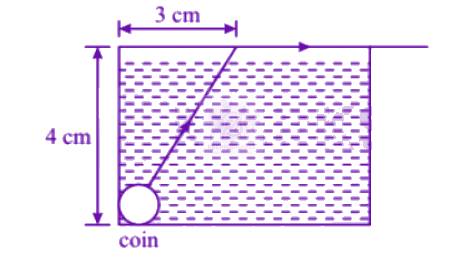
The frequency of a light wave in a material is $2 \times 10^{14} \mathrm{~Hz}$ and wavelength is $5000 Å$. The refractive index of material will be.
A convex lens and a concave lens, each having same focal length of $25 \mathrm{~cm}$, are put in contact to form a combination of lenses. The power in diopters of the combination is:
A microscope is focussed on a mark on a piece of paper and then a slab of glass of thickness $3 \mathrm{~cm}$ and refractive index 1.5 is placed over the mark. How should the microscope be moved to get the mark in focus again ?
The angular resolution of a $10 \mathrm{~cm}$ diameter telescope at a wavelength of $5000 Å$ is of the order of:
A beam of light composed of red and green ray is incident obliquely at a point on the face of rectangular glass slab. When coming out on the opposite parallel face, the red and green ray emerge from:
The refractive index of the material of a prism is $\sqrt{2}$ and its refracting angle is $30^{\circ}$. One of the refracting surface of the prism is made a mirror inward. A beam of monochromatic light entering the prism from the other face will retrace its path after reflection from the mirrored surface if its angle of incidence on the prism is:
A telescope has an objective lens of 10 $\mathrm{cm}$ diameter and is situated at a distance of one kilometers from two objects. The minimum distance between these two objects, which can be resolved by the telescope, when the mean wavelength of light is $5000 Å$, is of the order of:
A convex lens is dipped in a liquid whose refractive index is equal to the refractive index of the lens. Then its focal length will:
An equiconvex lens is cut two halves along (i) XOX' and (ii) YOY' as shown in the figure. Let $f, f^{\prime}, f^{\prime \prime}$ be the focal length of the complete lens, of each half in case (i) and each half in case (ii), respectively. 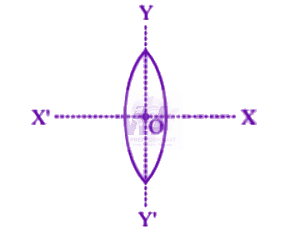 Choose the correct statement from the following: