Bohr’s Postulates are as follows: The electron revolves around the nucleus at stable orbits without radiating energy. The stable orbits are called stationary orbits. These orbits are unique and have different radii. The electron cannot orbit in between two stationary orbits, meaning the orbits are uniquely determined. The stationery orbits are obtained by equating the angular momentum of the electron to an integral multiple of reduced Planck’s constant, mvr=2πnh, where v is the velocity of the electron in the nth orbit and r is the radius of the nth orbit. The orbits have definite energies called the energy shells or energy levels. For hydrogen, En=−n213.6eV.
The total energy of an electron in the n^ th stationary orbit of the hydrogen atom can be obtained by
NEET UG 2020 — Physics Modern Physics
2020mcqeasy
The total energy of an electron in the nth stationary orbit of the hydrogen atom can be obtained by
Official previous-year question
Held on 30 Apr 2020 · Verified 9 Jul 2026.
Options
- A
En=n213.6eV
- B
En=−n213.6eV
- C
En=−n21.36eV
- D
En=−13.6×n2eV
Did you get this right?
Sign in to track your attempts and accuracy.
Your note
Sign in to keep a private note on this question. Nothing you write is ever public.
NEET UG Modern Physics in other years
More NEET UG Modern Physics questions
A photon and an electron (mass $m$ ) have the same energy $E$. The ratio ( $\lambda_{\text {photon }} / \lambda_{\text {electron }}$ ) of their de Broglie wavelengths is: (c is the speed of light)
2025medium
The output $(\mathrm{Y})$ of the given logic implementation is similar to the output of an/a _____ gate. 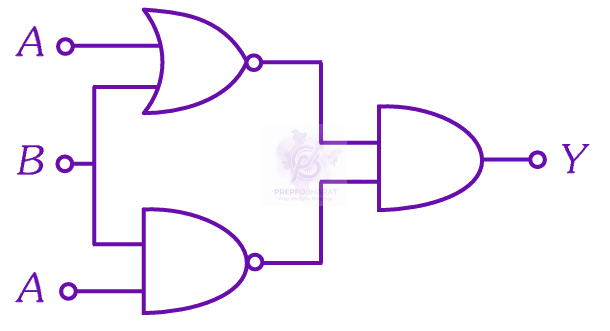
2025medium
The maximum kinetic energy of photoelectrons from a surface with work function φ = 2 eV when light of λ = 4000 Å falls on it is (hc = 12400 eV·Å):
2025easy
A full wave rectifier circuit with diodes $\left(D_1\right)$ and $\left(D_2\right)$ is shown in the figure. If input supply voltage $V_{\text {in }}=220 \sin (100 \pi t)$ volt, then at $t=15 \mathrm{msec}$ 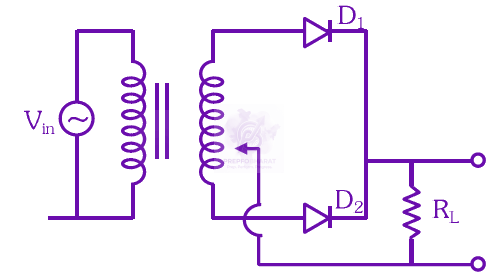
2025medium
A particle of mass $m$ is moving around the origin with a constant force $F$ pulling it towards the origin. If Bohr model is used to describe its motion, the radius $r$ of the $n^{\text {th }}$ orbit and the particle's speed $v$ in the orbit depend on $n$ as
2025medium
Other Physics topics for NEET UG
Keep practicing Modern Physics
Work through every NEET UG Modern Physics PYQ, year by year.