NEET UG 2009 — Mechanics
Physics Mechanics questions from NEET UG 2009.
Other Years
27 Mechanics Questions from 2009
A thin circular ring of mass $\mathrm{M}$ and radius $\mathrm{R}$ is rotating in a horizontal plane about an axis vertical to its plane with a constant angular velocity $\omega$. If two objects each mass $m$ be attached gently to the opposite ends of a diameter of the ring, the ring, will then rotate with an angular velocity:
If the dimensions of a physical quantity are given by $\left[\mathrm{M}^{\mathrm{a}} \mathrm{L}^{\mathrm{b}} \mathrm{T}^{\mathrm{c}}\right]$, then the physical quantity will be :
If the dimensions of a physical quantity are given by $\mathrm{M}^{\mathrm{a}} \mathrm{L}^{\mathrm{b}} \mathrm{T}^c$, then the physical quantity will be
Four identical thin rods each of mass $M$ and length $l$, from a square frame. Moment of inertia of this frame about an axis through the centre of the square and perpendicular to its plane is :
A body of mass $1 \mathrm{~kg}$ of thrown upwards with a velocity $20 \mathrm{~m} / \mathrm{s}$. It momenetarily comes to rest after attaining a height of $18 \mathrm{~m}$. How much energy is lost due to air friction ? $$ \left(\mathrm{g}=10 \mathrm{~m} / \mathrm{s}^2\right) $$
A body, under the action of a force $\overrightarrow{\mathrm{F}}=6 \hat{\mathrm{i}}-8 \hat{\mathrm{j}}+10 \hat{\mathrm{k}}$, acquires an acceleration of 1 $\mathrm{ms}^{-2}$. The mass of this body must be
A bus is moving with a speed of $10 \mathrm{~ms}^{-1}$ on a straight road. A scooterist wishes to overtake the bus in $100 \mathrm{~s}$. If the bus is at a distance of $1 \mathrm{~km}$ from the scooterist, with what speed should the scooterist chase the bus?
Four identical thin rods each of mass $M$ and length $l$, form a square frame. Moment of inertia of this frame about an axis through the centre of the square and perpendicular to its plane is
Two bodies of mass $1 \mathrm{~kg}$ and $3 \mathrm{~kg}$ have position vectors $\hat{i}+2 \hat{j}+\hat{k}$ and $-3 \hat{i}-2 \hat{j}+\hat{k}$, respectively. The centre of mass of this system has a position vector
A particle starts its motion from rest under the action of a constant force. If the distance covered in first 10 seconds is $\mathrm{S}_1$ and that covered in the first 20 seconds is $\mathrm{S}_2$ then :
A block of mass $M$ is attached to the lower end of a vertical spring. The spring is hung from a ceiling and has force constant value $\mathrm{k}$. The mass is released from rest with the spring initially unstretched. The maximum extension produced in the length of the spring will be :
A body of mass $1 \mathrm{~kg}$ is thrown upwards with a velocity $20 \mathrm{~ms}^{-1}$. It momentarily comes to rest after attaining a height of $18 \mathrm{~m}$. How much energy is lost due to air friction ? $\left(\mathrm{g}=10 \mathrm{~ms}^{-2}\right)$
A particle starts its motion from rest under the action of a constant force. If the distance covered in first $10 \mathrm{~s}$ is $\mathrm{s}_1$ and that covered in the first $20 \mathrm{~s}$ is $\mathrm{s}_2$, then
An explosion blows a rock into three parts. Two parts go off at right angles to each other. These two are, $1 \mathrm{~kg}$ first part moving with a velocity of $12 \mathrm{~ms}^{-1}$ and $2 \mathrm{~kg}$ second part moving with a velocity of $8 \mathrm{~ms}^{-1}$. If the third part flies off with a velocity of $4 \mathrm{~ms}^{-1}$, its mass would be
A block of mass $M$ is attached to the lower end of a vertical spring. The spring is hung from a ceiling and has force constant value $k$. The mass is released from rest with the spring initially unstretched. The maximum extension produced in the length of the spring will be
A thin circular ring of mass $M$ and radius $R$ is rotating in a horizontal plane about an axis vertical to its plane with a constant angular velocity $\omega$. If two objects each of mass $m$ be attached gently to the opposite ends of a diameter of the ring, the ring will then rotate with an angular velocity
If $\overrightarrow{\mathrm{F}}$ is the force acting on a particle having position vector $\vec{r}$ and $\vec{\tau}$ be the torque of this force about the origin, then
A bus is moving with a speed of $10 \mathrm{~ms}^{-1}$ on a straight road. A scooterist wishes to overtake the bus in $100 \mathrm{~s}$. If the bus is at a distance of $1 \mathrm{~km}$ from the scooterist, with what speed should the scooterist chase the bus ?
The mass of lift is $2000 \mathrm{~kg}$. When the tension in the supporting cable is $28000 \mathrm{~N}$, then its acceleration is :
The mass of a lift is $2000 \mathrm{~kg}$. When the tension in the supporting cable is $28000 \mathrm{~N}$, then its acceleration is
If $\overrightarrow{\mathrm{F}}$ is the force acting on a particle having position vector $\overrightarrow{\mathrm{r}}$ and $\vec{\tau}$ be the torque of this force about the origin, then :
An explosion blows a rock into three parts Two parts go off at right angles to each other. These two are, $1 \mathrm{~kg}$ first part moving with a velocity of $12 \mathrm{~ms}^{-1}$ and $2 \mathrm{~kg}$ second part moving with a velocity of $8 \mathrm{~ms}^{-1}$. If the thirds part files off with a velocity of $4 \mathrm{~ms}^{-1}$, its mass would be :
An engine pumps water continuously through a hose. Water leaves the hose with a velocity $\mathrm{v}$ and $\mathrm{m}$ is the mass per unit length of the water jet. What is the rate which kinetic energy is imparted to water ?
A body, under the action of a force $\overrightarrow{\mathrm{F}}=6 \hat{\mathrm{i}}-8 \hat{\mathrm{j}}+10 \hat{\mathrm{k}}$, acquires an acceleration of $1 \mathrm{~m} / \mathrm{s}^2$. The mass of this body must be :
Two bodies of mass $1 \mathrm{~kg}$ and $3 \mathrm{~kg}$ have position vectors $\hat{\mathrm{i}}+2 \hat{\mathrm{j}}+\hat{\mathrm{k}}$ and $-3 \hat{\mathrm{i}}-2 \hat{\mathrm{j}}+\hat{\mathrm{k}}$, respectively. The centre of mass of this system has a position vector :
An engine pumps water continuously through a hose. Water leaves the hose with a velocity $y$ and $m$ is the mass per unit length of the water jet. What is the rate at which kinetic energy is imparted to water ?
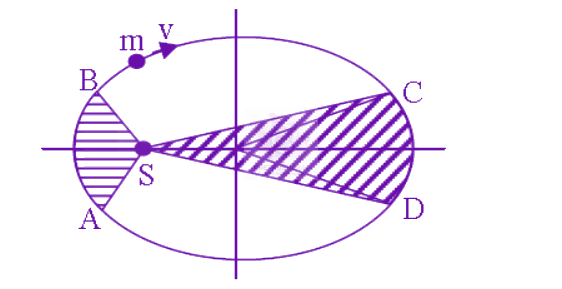
The figure shows elliptical orbit of a planet $m$ about the sun $\mathrm{S}$. The shaded area SCD is twice the shaded are $\mathrm{SAB}$. It $t_1$ is the time for the planet to move from $C$ to $D$ and $t_2$ is the time to move from $A$ to $B$ then