NEET UG 2008 — Mechanics
Physics Mechanics questions from NEET UG 2008.
Other Years
26 Mechanics Questions from 2008
A thin rod of length $L$ and mass $M$ is bent at its midpoint into two halves so that the angle between them is $90^{\circ}$. The moment of inertia of the bent rod about an axis passing through the bending point and perpendicular to the plane defined by the two halves of the rod is
Three forces acting on a body are shown in the figure. To have the resultant force only along the y-direction, the magnitude of the minimum additional force needed is 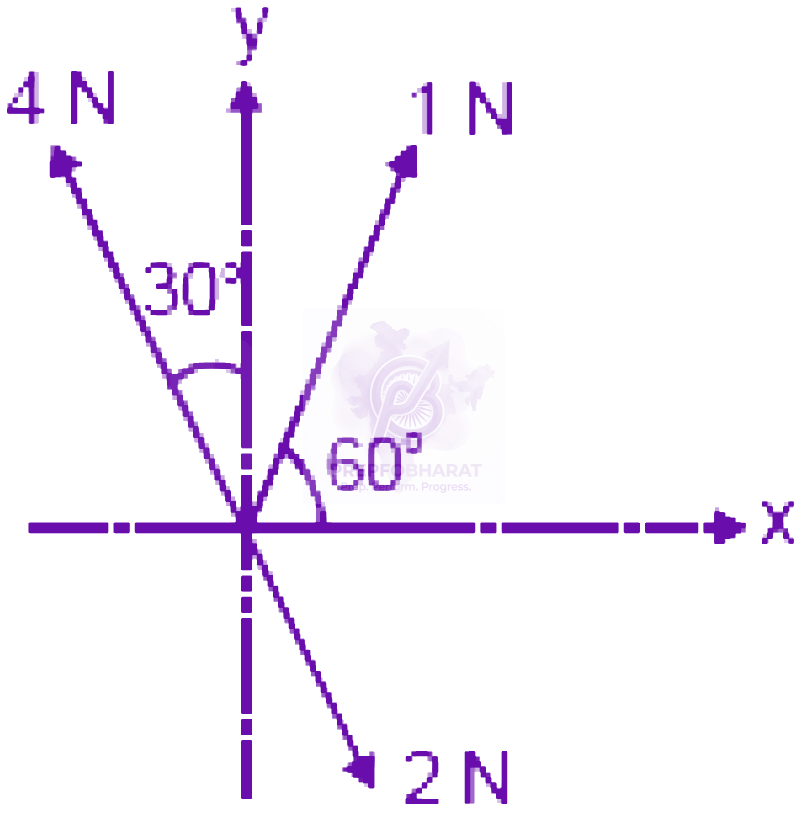
If the error in the measurement of radius of a sphere is $2 \%$, then the error in the determination of volume of the sphere will be
The ratio of the radii of gyration of a circular disc to that of a circular ring, each of same mass and radius, around their respective axes is
A particle moves in a straight line with a constant acceleration. It changes its velocity from $10 \mathrm{~ms}^{-1}$ to $20 \mathrm{~ms}^{-1}$ while passing through a distance $135 \mathrm{~m}$ in t second. The value of $t$ is
If the error in the measurement of radius of a sphere is $2 \%$, then the error in the determination of volume of the sphere will be
A shell of mass $200 \mathrm{~g}$ is ejected from a gun of mass $4 \mathrm{~kg}$ by an explosion that generates $1.05 \mathrm{~kJ}$ of energy. The initial velocity of the shell is
A particle moves in a straight line with a constant acceleration. It changes its velocity from $10 \mathrm{~ms}^{-1}$ to $20 \mathrm{~ms}^{-1}$ while passing through a distance $135 \mathrm{~m}$ in $t$ second. The value of $t$ is
A shell of mass $200 \mathrm{gm}$ is ejected from a gun of mass $4 \mathrm{~kg}$ by an explosion that generates $1.05 \mathrm{~kJ}$ of energy. The initial velocity of the shell is
The distance travelled by a particle starting from rest and moving with an acceleration $\frac{4}{3} \mathrm{~ms}^{-2}$, in the third second is
A roller coaster is designed such that riders experience "weightlessness" as they go round the top of a hill whose radius of curvature is $20 \mathrm{~m}$. The speed of the car at the top of the hill is between
The distance travelled by a particle starting from rest and moving with an acceleration $\frac{4}{3} \mathrm{~ms}^{-2}$, in the third second is
The ratio of the radii of gyration of a circular disc to that of a circular ring, each of same mass and radius, around their respective axes is
A roller coaster is designed such that riders experience "weightlessness" as they go round the top of a hill whose radius of curvature is $20 \mathrm{~m}$. The speed of the car at the top of the hill is between
A particle shows distance-time curve as given in this figure. The maximum instantaneous velocity of the particle is around the point 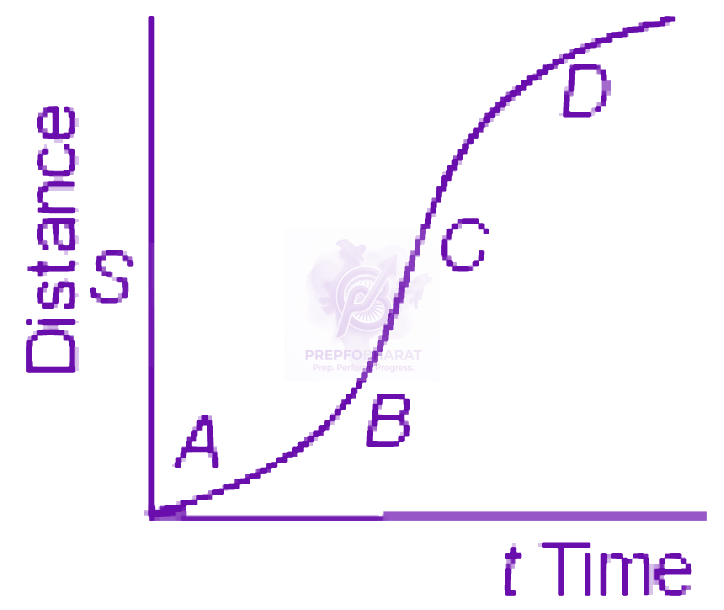
Water falls from a height of $60 \mathrm{~m}$ at the rate of $15 \mathrm{~kg} / \mathrm{s}$ to operate a turbine. The losses due to frictional forces are $10 \%$ of energy. How much power is generated by the turbine? $\left(g=10 \mathrm{~m} / \mathrm{s}^2\right)$
Three forces acting on a body are shown in the figure. To have the resultant force only along the $y$-direction, the magnitude of the minimum additional force needed is 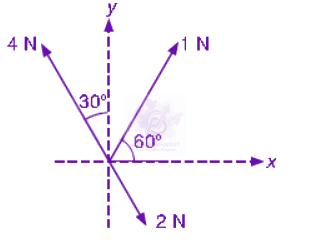
Water falls from a height of $60 \mathrm{~m}$ at the rate of $15 \mathrm{~kg} / \mathrm{s}$ to operate a turbine. The losses due to frictional forces are $10 \%$ of energy. How much power is generated by the turbine? $\left(\mathrm{g}=10 \mathrm{~m} / \mathrm{s}^2\right)$
A particle shows distance-time curve as given in this figure. The maximum instantaneous velocity of the particle is around the point 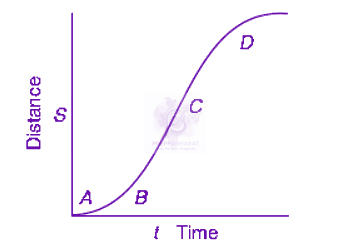
A particle of mass $m$ is projected with velocity $v$ making an angle of $45^{\circ}$ with the horizontal. When the particle lands on the level ground the magnitude of the change in its momentum will be
A thin rod of length $L$ and mass $M$ is bent at its midpoint into two halves so that the angle between them is $90^{\circ}$. The moment of inertia of the bent rod about an axis passing through the bending point and perpendicular to the plane defined by the two halves of the rod is
A particle of mass $m$ is projected with velocity $y$ making an angle of $45^{\circ}$ with the horizontal. When the particle lands on the level ground the magnitude of the change in its momentum will be
Sand is being dropped on a conveyor belt at the rate of $M \mathrm{~kg} / \mathrm{s}$. The force necessary to keep the belt moving with a constant velocity of $v \mathrm{~m} / \mathrm{s}$ will be
Sand is being dropped on a conveyor belt at the rate of $\mathrm{M} \mathrm{kg} / \mathrm{s}$. The force necessary to keep the belt moving with a constant velocity of $v \mathrm{~m} / \mathrm{s}$ will be
Which two of the following five physical parameters have the same dimensions? (a) energy density (b) refractive index (c) dielectric constant (d) Young's modulus (e) magnetic field
Which two of the following five physical parameters have the same dimensions? (1) energy density (2) refractive index (3) dielectric constant (4) Young's modulus (5) magnetic field