As F=−kx
A mass m=1.0 ~kg is put on a flat pan attached to a vertical spring fixed on the ground. The mass of the spring and the pan is negligible. When…
JEE Main 2013 — Physics Waves & Oscillations
2013mcqmedium
A mass m=1.0 kg is put on a flat pan attached to a vertical spring fixed on the ground. The mass of the spring and the pan is negligible. When pressed slightly and released, the mass executes simple harmonic motion. The spring constant is 500 N/m. What is the amplitude A of the motion, so that the mass m tends to get detached from the pan ? (Take g=10 m/s2 ). The spring is stiff enough so that it does not get distorted during the motion. 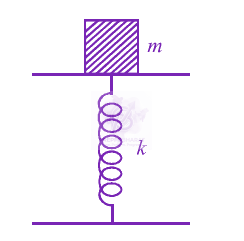
Official previous-year question
Held on 22 Apr 2013 · Verified 6 Jul 2026.
Options
- A
A>2.0 cm
- B
A=2.0 cm
- C
A<2.0 cm
- D
A=1.5 cm
Did you get this right?
Sign in to track your attempts and accuracy.
Your note
Sign in to keep a private note on this question. Nothing you write is ever public.
JEE Main Waves & Oscillations in other years
Waves & Oscillations 2026Waves & Oscillations 2025Waves & Oscillations 2024Waves & Oscillations 2023Waves & Oscillations 2022Waves & Oscillations 2021Waves & Oscillations 2020Waves & Oscillations 2019Waves & Oscillations 2018Waves & Oscillations 2017Waves & Oscillations 2016Waves & Oscillations 2015
More JEE Main Waves & Oscillations questions
The time period of a simple harmonic oscillator is $T=2 \pi \sqrt{\frac{k}{m}}$. Measured value of mass $(m)$ of the object is 10 g with an accuracy of 10 mg and time for 50 oscillations of the spring is found to be 60 s using a watch of 2 s resolution. Percentage error in determination of spring constant $(k)$ is $\_\_\_\_$ \%.
2026medium
Two waves of same frequency and amplitude travel in opposite directions. The resulting pattern is:
2026easy
A spring-mass system oscillates with angular frequency ω. If the mass is doubled and the spring constant is halved, the new angular frequency is:
2026hard
In an open organ pipe $\nu_{3}$ and $\nu_{6}$ are $3^{\text {rd }}$ and $6^{\text {th }}$ harmonic frequencies, respectively. If $\nu_{6}-\nu_{3}=2200 \mathrm{~Hz}$ then length of the pipe is $\_\_\_\_$ mm . (Take velocity of sound in air is $330 \mathrm{~m} / \mathrm{s}$.)
2026easy
A simple pendulum of string length 30 cm performs 20 oscillations in 10 s. The length of the string required for the pendulum to perform 40 oscillations in the same time duration is $\_\_\_\_$ cm. [Assume that the mass of the pendulum remains same.]
2026easy
Other Physics topics for JEE Main
Keep practicing Waves & Oscillations
Work through every JEE Main Waves & Oscillations PYQ, year by year.