JEE Main 2013 — Waves & Oscillations
Physics Waves & Oscillations questions from JEE Main 2013.
Other Years
10 Waves & Oscillations Questions from 2013
Two simple pendulums of length $1 \mathrm{~m}$ and $4 \mathrm{~m}$ respectively are both given small displacement in the same direction at the same instant. They will be again in phase after the shorter pendulum has completed number of oscillations equal to:
In a transverse wave the distance between a crest and neighbouring trough at the same instant is $4.0 \mathrm{~cm}$ and the distance between a crest and trough at the same place is $1.0 \mathrm{~cm}$. The next crest appears at the same place after a time interval of $0.4 \mathrm{~s}$. The maximum speed of the vibrating particles in the medium is:
A uniform cylinder of length $\mathrm{L}$ and mass $M$ having cross-sectional area $\mathrm{A}$ is suspended, with its length vertical, from a fixed point by a massless spring, such that it is half submerged in a liquid of density $\sigma$ at equilibrium position. When the cylinder is given a downward push and released, it starts oscillating vertically with a small amplitude. The time period $\mathrm{T}$ of the oscillations of the cylinder will be :
A sonometer wire of length $114 \mathrm{~cm}$ is fixed at both the ends. Where should the two bridges be placed so as to divide the wire into three segments whose fundamental frequencies are in the ratio $1: 3: 4$ ?
Two charges, each equal to $\text{q}$, are kept at $\text{x} = - \text{a}$ and $\text{x} = \text{a}$ on the x-axis. A particle of mass $\text{m}$ and charge ${\text{q}}_{0}=-\frac{\text{q}}{2}$ is placed at the origin. If charge ${\text{q}}_{0}$ is given a small displacement $\text{(y << a)}$ along the y-axis, the net force acting on the particle is proportional to :
Bob of a simple pendulum of length $l$ is made of iron. The pendulum is oscillating over a horizontal coil carrying direct current. If the time period of the pendulum is $\mathrm{T}$ then :
A sonometer wire of length $1.5m$ is made of steel. The tension in it produces an elastic strain of $\text{1%}$. What is the fundamental frequency of steel if density and elasticity of steel are $7.7\times {10}^{3}\mathrm{kg}{m}^{-3}$ and $2.2\times {10}^{11}N{m}^{-2}$ respectively?
A mass $m=1.0 \mathrm{~kg}$ is put on a flat pan attached to a vertical spring fixed on the ground. The mass of the spring and the pan is negligible. When pressed slightly and released, the mass executes simple harmonic motion. The spring constant is $500 \mathrm{~N} / \mathrm{m}$. What is the amplitude A of the motion, so that the mass $m$ tends to get detached from the pan ? (Take $g=10 \mathrm{~m} / \mathrm{s}^2$ ). The spring is stiff enough so that it does not get distorted during the motion. 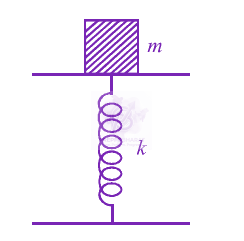
When two sound waves travel in the same direction in a medium, the displacements of a particle located at ' $x$ ' at time ' $t$ ' is given by : $\begin{aligned} & y_1=0.05 \cos (0.50 \pi x-100 \pi t) \\ & y_2=0.05 \cos (0.46 \pi x-92 \pi t) \end{aligned}$ where $y_1, y_2$ and $x$ are in meters and $t$ in seconds. The speed of sound in the medium is :
An ideal gas enclosed in a vertical cylindrical container supports a freely moving piston of mass $\text{M}$. The piston and the cylinder have equal cross-sectional area $\text{A}$. When the piston is in equilibrium, the volume of the gas is ${V}_{0}$ and its pressure is ${M}_{0}$. The piston is slightly displaced from the equilibrium position and released. Assuming that the system is completely isolated from its surrounding, the piston executes a simple harmonic motion with frequency [Assume the system is in space.]