JEE Main Physics — Mechanics previous year questions with solutions.
A particle of mass $\mathrm{m}$ is moving in a straight line with momentum p. Starting at time $t=0,$ a force $F=k$ t acts in the same direction on the moving particle during time interval T so that its momentum changes from $\mathrm{p}$ to $3 \mathrm{p}$. Here $k$ is a constant. The value of $\mathrm{T}$ is
A particle of mass $m$ is moving along a trajectory given by $x={x}_{0}+a cos{\omega }_{1}t$ $y={y}_{0}+b sin{\omega }_{2}t$ The torque, acting on the particle about the origin, at $t=0$ is:
A particle moves in one dimension from rest under the influence of a force that varies with the distance traveled by the particle as shown in the figure. The kinetic energy of the particle after it has traveled $3 m$ is: 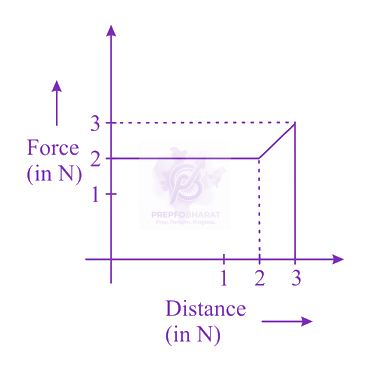
A particle moves from the point $(2.0 \hat{i}+4.0 \hat{j}) \mathrm{m},$ at $\mathrm{t}=0$, with an initial velocity $(5.0 \hat{i}+4.0 \hat{j}) \mathrm{ms}^{-1} .$ It is acted upon by a constant force which produces a constant acceleration $(4.0 \hat{i}+4.0 \hat{j}) \mathrm{ms}^{-2} .$ What is the distance of the particle from the origin at time $2 \mathrm{~s} ?$
A particle moves from the point $(2.0 \hat{i}+4.0 \hat{j}) \mathrm{m},$ at $\mathrm{t}=0$, with an initial velocity $(5.0 \hat{i}+4.0 \hat{j}) \mathrm{ms}^{-1} .$ It is acted upon by a constant force which produces a constant acceleration $(4.0 \hat{i}+4.0 \hat{j}) \mathrm{ms}^{-2} .$ What is the distance of the particle from the origin at time $2 \mathrm{~s} ?$
A particle is moving with speed $v=b\sqrt{x}$ along positive $x-$ axis. Calculate the speed of the particle at time $t=\tau$ (assume that the particle is at origin at $t=0$ )
A particle is moving with a velocity $\vec{v}=K(y\hat{i}+x\hat{j}),$ where $K$ is a constant. The general equation for its path is:
A particle is moving with a velocity $\vec{v}=K(y\hat{i}+x\hat{j}),$ where $K$ is a constant.<br>The general equation for its path is:
A particle is moving along a circular path with a constant speed of $10 \mathrm{~ms}^{-1}$. What is the magnitude of the change in velocity of the particle, when it moves through an angle of $60^{\circ}$ around the centre of the circle?
A metal coin of mass $5 g$ and radius $1 cm$ is fixed to a thin stick $AB$ of negligible mass as shown in the figure. The system is initially at rest. The constant torque, that will make the system rotate about $AB$ at $25$ rotations per second in $5 s$ , is close to: 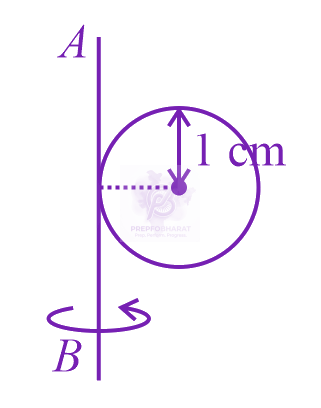
A mass of $10 \mathrm{kg}$ is suspended vertically by a rope from the roof. When a horizontal force is applied on the rope at some point, the rope deviated at an angle of $45^{\circ}$ at the roof point. If the suspended mass is at equilibrium, the magnitude of the force applied is $(g=10 m{s}^{-2})$
A man (mass $=50 kg$ ) and his son (mass $=20 kg$ ) are standing on a frictionless surface facing each other. The man pushes his son so that he starts moving at a speed of $0.70 m {s}^{-1}$ with respect to the man. The speed of the man with respect to the surface is:
A long cylindrical vessel is half filled with a liquid. When the vessel is rotated about its own vertical axis, the liquid rises up near the wall. If the radius of vessel is $5 cm$ and its rotational speed is $2$ rotations per second, then the difference in the heights between the center and the sides, in $cm,$ will be:
A load of mass $M kg$ is suspended from a steel wire of length $2m$ and radius $1.0 mm$ in Searle's apparatus experiment. The increase in length produced in the wire is $4.0 mm.$ Now the load is fully immersed in a liquid of relative density $2.$ The relative density of the material of load is $8.$ The new value of increase in length of the steel wire is:
A liquid of density $\rho$ is coming out of a hose pipe of radius a with horizontal speed $v$ and hits a mesh. $50 \%$ of the liquid passes through the mesh unaffected. $25 \%$ looses all of its momentum and $25 \%$ comes back with the same speed. The resultant pressure on the mesh will be:
A homogeneous solid cylindrical roller of radius $R$ and mass $M$ is pulled on a cricket pitch by a horizontal force. Assuming rolling without slipping, angular acceleration of the cylinder is:
A heavy ball of mass $M$ is suspended from the ceiling of a car by a light string of mass $m (m\ll M).$ When the car is at rest, the speed of transverse waves in the string is $60 {\mathrm{ms}}^{-1}.$ When the car has acceleration $a,$ the wave-speed increases to $60.5 {\mathrm{ms}}^{-1}.$ The value of $a,$ in terms of gravitational acceleration $g,$ is closed to
A force acts on a $2 \mathrm{kg}$ object so that its position is given as a function of time as $x=3{t}^{2}+5.$ What is the work done by this force in first $5$ seconds?
A cubical block of side $0.5 m$ floats on water with $30%$ of its volume under water. What is the maximum weight that can be put on the block without fully submerging it under water? [Take, density of water $={10}^{3} kg/{m}^{3}$ ]
A copper wire is stretched to make it $0.5%$ longer. The percentage change in its electrical resistance if its volume remains unchanged is:
A copper wire is stretched to make it $0.5%$ longer. The percentage change in its electrical resistance if its volume remains unchanged is:
A circular disc of radius $b$ has a hole of radius $a$ at its centre(see figure). If the mass per unit area of the disc varies as $(\frac{{\sigma }_{0}}{r})$ then, the radius of gyration of the disc about its axis passing through the center is 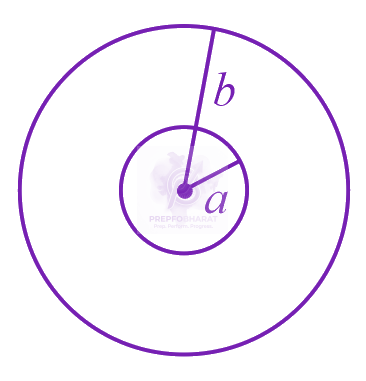
A circular disc $D_{1}$ of mass $M$ and radius $R$ has two identical $\operatorname{discs} D_{2}$ and $D_{3}$ of the same mass $M$ and radius R attached rigidly at its opposite ends (see figure). The moment of inertia of the system about the axis OO', passing through the centre of $D_{1}$, as shown in the figure, will be 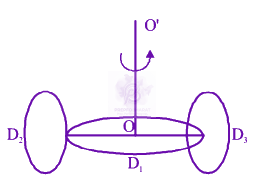
A bullet of mass $20 g$ has an initial speed of $1 m {s}^{-1}$, just before it starts penetrating a mud wall of thickness $20 cm$. If the wall offers a mean resistance of $2.5\times {10}^{-2} N,$ the speed of the bullet after emerging from the other side of the wall is close to: