JEE Main Physics — Mechanics previous year questions with solutions.
A boy’s catapult is made of rubber cord which is $42 cm$ long, with $6 mm$ diameter of cross-section and of negligible mass. The boy keeps a stone weighing $0.02 kg$ on it and stretches the cord by $20 cm$ by applying a constant force. When released, the stone flies off with a velocity of $20 m{s}^{-1}$ . Neglect the change in the area of cross-section of the cord while stretched. The Young’s modulus of rubber is closest to:
A body of mass ${m}_{1}$ moving with an unknown velocity of ${v}_{1} \hat{i},$ undergoes a collinear collision with a body of mass ${m}_{2}$ moving with a velocity ${v}_{2} \hat{i}.$ After the collision, ${m}_{1}$ and ${m}_{2}$ move with velocities of ${v}_{3} \hat{i}$ and ${v}_{4} \hat{i},$ respectively. If ${m}_{2}=0.5 {m}_{1}$ and ${v}_{3}=0.5 {v}_{1},$ then ${v}_{1}$ is:
A body of mass $2 kg$ makes an elastic collision with a second body at rest and continues to move in the original direction but with one fourth of its original speed. What is the mass of the second body?
A body of mass $1 \mathrm{~kg}$ falls freely from a height of $100 \mathrm{~m}$, on a platform of mass $3 \mathrm{~kg}$ which is mounted on a spring having spring constant $\mathrm{k}=1.25 \times 10^{6} \mathrm{~N} / \mathrm{m}$. The bodysticks to the platform and the spring's maximum compression is found to be $x$. Given that $g=10 \mathrm{~ms}^{-2},$ the value of $\mathrm{x}$ will be close to :
A body is projected at $t=0$ with a velocity $10 \mathrm{~ms}^{-1}$ at an angle of $60^{\circ}$ with the horizontal. The radius of curvature of its trajectory at $t=1$ s is $R$. Neglecting air resistance and taking acceleration due to gravity $\mathrm{g}=10 \mathrm{~ms}^{-2}$, the value of $R$ is:
A block of mass $m,$ lying on a smooth horizontal surface, is attached to a spring (of negligible mass) of spring constant $k.$ The other end of the spring is fixed, as shown in the figure. The block is initially at rest in its equilibrium position. If now the block is pulled with a constant force $F,$ the maximum speed of the block is: 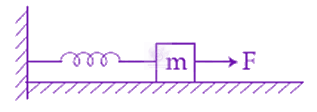
A block of mass $10 kg$ is kept on a rough inclined plane as shown in the figure. A force of $3 N$ is applied on the block. The coefficient of static friction between the plane and the block is $0.6.$ What should be the minimum value of force $P,$ such that the block does not move downward? (take $g=10 m{s}^{-2}$ ) 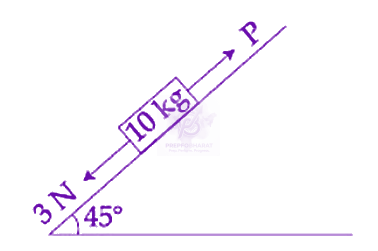
A block of mass $m$ is kept on a platform which starts from rest with a constant acceleration $g/2$ upwards, as shown in the figure. Work done by normal reaction on block in time $t$ is 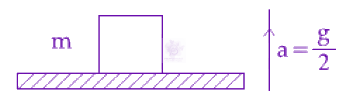
A block of mass $5 kg$ is (i) pushed in case $(A)$ and (ii) pulled in case $(B),$ by a force $F=20 N,$ making an angle of ${30}^{o}$ with the horizontal, as shown in the figures. The coefficient of friction between the block and floor is $\mu =0.2.$ The difference between the accelerations of the block, in case $(B)$ and case $(A)$ will be: $(g=10 m {s}^{-2})$ 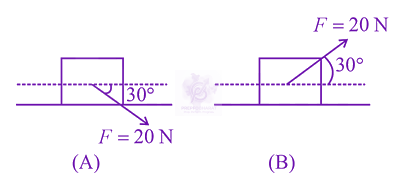
A block kept on a rough inclined plane, as shown in the figure, remains at rest upto a maximum force $2N$ down the inclined plane. The maximum external force up the inclined plane that does not move the block is $10N.$ The coefficient of static friction between the block and the plane is: [Take $g=10 m/{s}^{2}$ ] 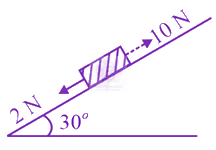
A ball is thrown vertically up (taken as $+z-axis$ ) from the ground. The correct momentum-height $(p-h)$ diagram is:
A ball is thrown upward with an initial velocity ${V}_{0}$ from the surface of the earth. The motion of the ball is affected by a drag force equal to $m\gamma {v}^{2}$ (where $m$ is mass of the ball, $v$ is its instantaneous velocity and $\gamma$ is a constant). Time taken by the ball to rise to its zenith is:
When an air bubble of radius $r$ rises from the bottom to the surface of a lake, its radius becomes $\frac{5 \mathrm{r}}{4}$. Taking the atmospheric pressure to be equal to $10 \mathrm{~m}$ height of water column, the depth of the lake would approximately be (ignore the surface tension and the effect of temperature):
Two particles of the same mass $m$ are moving in circular orbits because of force, given by $F (r)=-\frac{16}{r}-{r}^{3}$. The first particle is at a distance $r=1$, and the second, at $r=4$. The best estimate for the ratio of kinetic energies of the first and the second particle is closest to
Two masses ${m}_{1}=5 \mathrm{kg}$ and ${m}_{2}=10 \mathrm{kg}$, connected by an inextensible string over a frictionless pulley, are moving as shown in the figure. The coefficient of friction of horizontal surface is $0.15$. The minimum weight m that should be put on top of ${m}_{2}$ to stop the motion is: 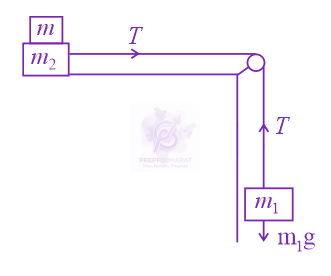
The velocity time graphs of a car and a scooter are shown in the figure. (i) The difference between the distance travelled by the car and the scooter in 15 s and (ii) the time at which the car will catch up with the scooter are, respectively. 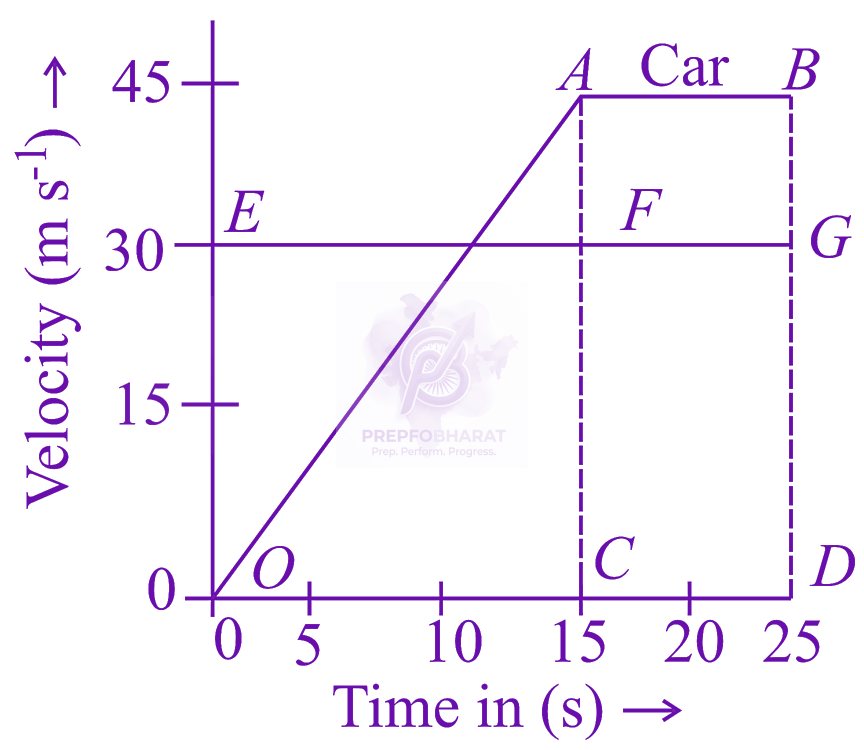
The velocity-time graphs of a car and a scooter are shown in the figure. (i) the difference between the distance travelled by the car and the scooter in $15 \mathrm{~s}$ and (ii) the time at which the car will catch up with the scooter are, respectively 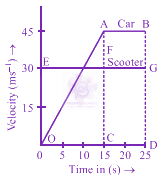
The relative uncertainty in the period of a satellite orbiting around the earth is ${10}^{-2}$ . If the relative uncertainty in the radius of the orbit is negligible, the relative uncertainty in the mass of the earth is:
The relative error in the determination of the surface area of a sphere is $\alpha$. Then the relative error in the determination of its volume is
The relative error in the determination of the surface area of a sphere is $\alpha$. The relative error in the determination of its volume is
The percentage errors in quantities $P$, $Q$, $R$ and $S$ are $0.5%$, $1%$, $3%$ and $1.5%$ respectively in the measurement of a physical quantity $A= \frac{ {P}^{3} {Q}^{2} }{ \sqrt{ R } S }$. The maximum percentage error in the value of $A$ will be:
The mass of a hydrogen molecule is $3.32\times {10}^{-27 }\mathrm{kg}.$ If ${10}^{23}$ hydrogen molecules strike, per second, a fixed wall of the area $2 {\mathrm{cm}}^{2}$ at an angle of ${45}^{o}$ to the normal, and rebound elastically with a speed of ${10}^{3}m{s}^{-1},$ then the pressure on the wall is nearly:
The density of a material, in the shape of a cube, is determined by measuring three sides of the cube and its mass. If the relative errors in measuring the mass and length are $1.5%$ and $1%$, respectively, the maximum error in determining the density is:
The characteristic distance at which quantum gravitational effects are significant, the Planck length, can be determined from a suitable combination of the fundamental physical constants $\mathrm{G}, \mathrm{h}$ and $\mathrm{c}$. Which of the following correctly gives the Planck length?