JEE Main Physics — Mechanics previous year questions with solutions.
Two masses $m$ and $\frac{m}{2}$ are connected at the two ends of a massless rigid rod of length $l.$ The rod is suspended by a thin wire of torsional constant $k$ at the centre of mass of the rod-mass system (see figure). Because of torsional constant $k,$ the restoring torque is $\tau =k\theta$ for angular displacement $\theta .$ If the rod is rotated by ${\theta }_{0}$ and released, the tension in it when it passes through its mean position will be: 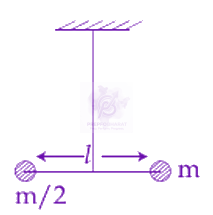
A piece of wood of mass $0.03 kg$ is dropped from the top of a $100 m$ height building. At the same time, a bullet of mass $0.02 kg$ is fired vertically upward, with a velocity $100 m{s}^{-1},$ from the ground. The bullet gets embedded in the wood. Then the maximum height to which the combined system reaches above the top of the building before falling below is: $(g=10 m{s}^{-2})$
A rod, of length $L$ at room temperature and uniform area of cross section $A,$ is made of a metal having coefficient of linear expansion $\alpha /^{\circ}C$ It is observed that an external compressive force $F$ is applied on each of its ends, prevents any change in the length of the rod when its temperature rises by $\Delta TK$ Young's modulus, $Y$ for this metal is:
A spring whose unstrentches length is $l$ has a force constant $k.$ The spring is cut into two pieces of unstretches lengths ${l}_{1}$ and ${l}_{2}$ where, ${l}_{1}=n{l}_{2}$ and $n$ is an integer. The ratio ${k}_{1}/{k}_{2}$ of the corresponding force constants, ${k}_{1}$ and ${k}_{2}$ will be:
In $SI$ units, the dimensions of $\sqrt{\frac{{\epsilon }_{0}}{{\mu }_{0}}}$ is:
Four identical particles of mass $M$ are located at the corners of a square of side $‘a’$ . What should be their speed if each of them revolves under the influence of other’s gravitational field in a circular orbit circumscribing the square? 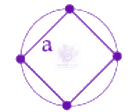
A rocket has to be launched from earth in such a way that it never returns. If $E$ is the minimum energy delivered by the rocket launcher, what should be the minimum energy that the launcher should have, if the same rocket is to be launched from the surface of the moon? Assume that the density of the earth and the moon are equal and that the earth's volume is $64$ times the volume of the moon.
Two coaxial discs, having moments of inertia ${I}_{1}$ and $\frac{{I}_{1}}{2}$ , are rotating with respective angular velocities ${\omega }_{1}$ and $\frac{{\omega }_{1}}{2}$ , about their common axis. They are brought in contact with each other and thereafter they rotate with a common angular velocity. If ${E}_{f}$ and ${E}_{i}$ are the final and initial total energies, then $({E}_{f}-{E}_{i})$ is:
The position co-ordinates of a particle moving in a $3D$ coordinate system is given by<br>$x=a\mathrm{cos}\omega t$<br>$y=a\mathrm{sin}\omega t$<br>and $z=a\omega t$<br>The speed of the particle is:
A particle moves from the point $(2.0 \hat{i}+4.0 \hat{j}) \mathrm{m},$ at $\mathrm{t}=0$, with an initial velocity $(5.0 \hat{i}+4.0 \hat{j}) \mathrm{ms}^{-1} .$ It is acted upon by a constant force which produces a constant acceleration $(4.0 \hat{i}+4.0 \hat{j}) \mathrm{ms}^{-2} .$ What is the distance of the particle from the origin at time $2 \mathrm{~s} ?$
An equilateral triangle $\mathrm{ABC}$ is cut from a thin solid sheet of wood. (See figure) $\mathrm{D}, \mathrm{E}$ and $\mathrm{F}$ are the mid-points of its sides as shown and $\mathrm{G}$ is the centre of the triangle. The moment of inertia of the triangle about an axis passing through $\mathrm{G}$ and perpendicular to the plane of the triangle is $\mathrm{I}_{0}$. If the smaller triangle $\mathrm{DEF}$ is removed from $\mathrm{ABC}$, the moment of inertia of the remaining figure about the same axis is $I$. Then 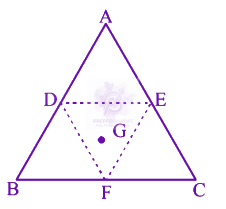
A satellite is revolving in a circular orbit at a height h from the carth surface, such that $\mathrm{h}< < \mathrm{R}$ where $\mathrm{R}$ is the radius of the earth. Assuming that the effect of earth"s atmosphere can be neglected the minimum increase in the speed required so that the satellite could escape from the gravitational field of earth is
In the density measurement of a cube, the mass and edge length are measured as $(10.00\pm 0.10) kg$ and $(0.10\pm 0.01) m,$ respectively. The error in the measurement of density is:
The resistance of the meter bridge AB in given figure is $4 \Omega$. With a cell of emf $\varepsilon=0.5 \mathrm{~V}$ and rheostat resistance $\mathrm{R}_{\mathrm{h}}=2 \Omega$ the null point is obtained at some point J. When the cell is replaced by another one of emf $\varepsilon=\varepsilon_{2}$ the same null point $\mathrm{J}$ is found for $\mathrm{R}_{\mathrm{h}}=6 \Omega$. The $\operatorname{emf} \varepsilon_{2}$ is: 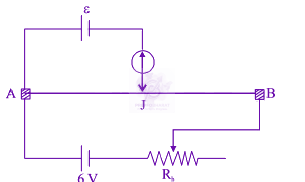
A particle is moving with a velocity $\vec{v}=K(y\hat{i}+x\hat{j}),$ where $K$ is a constant.<br>The general equation for its path is:
Young's moduli of two wires $A$ and $B$ are in the ratio $7:4$ . Wire $A$ is $2 m$ long and has radius $R.$ Wire $B$ is $1.5 m$ long and has radius $2 mm.$ If the two wires stretch by the same length for a given load, the value of $R$ is close to:
A boy’s catapult is made of rubber cord which is $42 cm$ long, with $6 mm$ diameter of cross-section and of negligible mass. The boy keeps a stone weighing $0.02 kg$ on it and stretches the cord by $20 cm$ by applying a constant force. When released, the stone flies off with a velocity of $20 m{s}^{-1}$ . Neglect the change in the area of cross-section of the cord while stretched. The Young’s modulus of rubber is closest to:
A tunning fork of frequency $480 Hz$ is used in an experiment for measuring speed of sound $(v)$ in air by resonance tube method. Resonance is observed to occur at two successive lengths of the air column, ${l}_{1}=30 cm$ and ${l}_{2}=70 cm.$ Then, $\nu$ is equal to:
A solid sphere of mass $M$ and radius $a$ is surrounded by a uniform concentric spherical shell of thickness $2a$ and mass $2M.$ The gravitational field at distance $3a$ from the centre will be:
Let $|\vec{{A}_{1}}|=3, |\vec{{A}_{2}}|=5$ and $|\vec{{A}_{1}}+\vec{{A}_{2}}|=5.$ The value of $(2\vec{{A}_{1}}+3\vec{{A}_{2}})\cdot (3\vec{{A}_{1}}-2\vec{{A}_{2}})$ is:
Two forces $P$ and $Q$, of magnitude $2F$ and $3F$, respectively, are at an angle $\theta$ with each other. If the force $Q$ is doubled, then their resultant also gets doubled. Then, the angle $\theta$ is:
To mop-clean a floor, a cleaning machine presses a circular mop of radius $R$ vertically down with a total force $F$ and rotates it with a constant angular speed about its axis. If the force $F$ is distributed uniformly over the mop and if coefficient of friction between the mop and the floor is $\mu ,$ the torque, applied by the machine on the mop is:
The area of a square is $5.29 c{m}^{2}.$ The area of $7$ such squares taking into account the significant figures is:
Ship $A$ is sailing towards north-east with velocity) $\vec{v}=30\hat{i}+50\hat{j}\mathrm{km}{h}^{-1}$ where $\hat{i}$ points east and $\hat{j},$ north. The ship $B$ is at a distance of $80 km$ east and $150 km$ north of Ship $A$ and is sailing towards the west at $10km{h}^{-1}.$ $A$ will be at the minimum distance from $B$ in: