JEE Main Physics — Mechanics previous year questions with solutions.
In an experiment, brass and steel wires of length $1 m$ each with areas of cross section $1 m{m}^{2}$ are used. The wires are connected in series and one end of the combined wire is connected to a rigid support and other end is subjected to elongation. The stress required to produce a net elongation of $0.2 mm$ is, [Given, the Young's Modulus for steel and brass are, respectively, $120\times {10}^{9} N/{m}^{2}$ and $60\times {10}^{9} N/{m}^{2}$ ]
A circular disc $D_{1}$ of mass $M$ and radius $R$ has two identical $\operatorname{discs} D_{2}$ and $D_{3}$ of the same mass $M$ and radius R attached rigidly at its opposite ends (see figure). The moment of inertia of the system about the axis OO', passing through the centre of $D_{1}$, as shown in the figure, will be 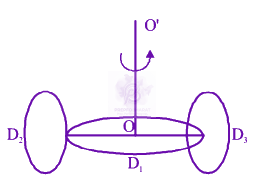
In a simple pendulum experiment for determination of acceleration due to gravity $(g)$, time taken for $20$ oscillations is measures by using a watch of $1$ second least count. The mean value of time taken comes out to be $30 s$. The length of the pendulum is measured by using a meter scale of least count $1 mm$ and the value obtained is $55.0 cm$. The percentage error in the determination of $g$ is close to
A submarine experiences a pressure of $5.05\times {10}^{6} Pa$ at a depth of ${d}_{1}$ in a sea. When it goes further to a depth of ${d}_{2}$ , it experiences a pressure of $8.08\times {10}^{6} Pa$ . Then ${d}_{2}-{d}_{1}$ is approximately (density of water $={10}^{3} kg/{m}^{3}$ and acceleration due to gravity $=10 m{s}^{-2}$ ):
A wooden block floating in a bucket of water has $\frac{4}{5}$ of its volume submerged. When certain amount of an oil is poured into the bucket, it is found that the block is just under the oil surface with half of its volume under water and half in oil. The density of oil relative to that of water is:
A liquid of density $\rho$ is coming out of a hose pipe of radius a with horizontal speed $v$ and hits a mesh. $50 \%$ of the liquid passes through the mesh unaffected. $25 \%$ looses all of its momentum and $25 \%$ comes back with the same speed. The resultant pressure on the mesh will be:
In the density measurement of a cube, the mass and edge length are measured as $(10.00\pm 0.10) kg$ and $(0.10\pm 0.01) m,$ respectively. The error in the measurement of density is:
A body of mass $1 \mathrm{~kg}$ falls freely from a height of $100 \mathrm{~m}$, on a platform of mass $3 \mathrm{~kg}$ which is mounted on a spring having spring constant $\mathrm{k}=1.25 \times 10^{6} \mathrm{~N} / \mathrm{m}$. The bodysticks to the platform and the spring's maximum compression is found to be $x$. Given that $g=10 \mathrm{~ms}^{-2},$ the value of $\mathrm{x}$ will be close to :
The magnitude of torque on a particle of mass $1 \mathrm{~kg}$ is 2.5 Nm about the origin. If the force acting on it is $1 \mathrm{~N},$ and the distance of the particle from the origin is $5 \mathrm{~m},$ the angle between the force and the position vector is (in radians):
A solid sphere of mass $M$ and radius $R$ is divided into two unequal parts. The first part has a mass of $\frac{7M}{8}$ and is converted into uniform disc of radius $2R$ . The second part is converted into a uniform solid sphere. Let ${I}_{1}$ be the moment of inertia of the disc about its axis and ${I}_{2}$ be the moment of inertia of the new sphere about its axis. The ratio ${I}_{1}/{I}_{2}$ is given by:
A heavy ball of mass $M$ is suspended from the ceiling of a car by a light string of mass $m (m\ll M).$ When the car is at rest, the speed of transverse waves in the string is $60 {\mathrm{ms}}^{-1}.$ When the car has acceleration $a,$ the wave-speed increases to $60.5 {\mathrm{ms}}^{-1}.$ The value of $a,$ in terms of gravitational acceleration $g,$ is closed to
A bullet of mass $20 g$ has an initial speed of $1 m {s}^{-1}$, just before it starts penetrating a mud wall of thickness $20 cm$. If the wall offers a mean resistance of $2.5\times {10}^{-2} N,$ the speed of the bullet after emerging from the other side of the wall is close to:
A block kept on a rough inclined plane, as shown in the figure, remains at rest upto a maximum force $2N$ down the inclined plane. The maximum external force up the inclined plane that does not move the block is $10N.$ The coefficient of static friction between the block and the plane is: [Take $g=10 m/{s}^{2}$ ] 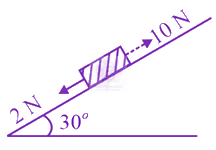
In a meter bridge, the wire of length $1 m$ has a non-uniform cross-section such that, the variation $\frac{dR}{dl}$ of its resistance $R$ with length $l$ is $\frac{dR}{dl}\propto \frac{1}{\sqrt{l}}.$ Two equal resistances are connected as shown in the figure. The galvanometer has zero deflection when the jockey is at point $P.$ What is the length $AP?$ 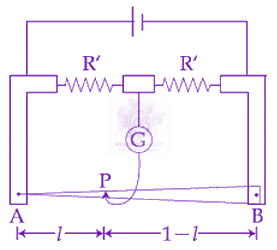
A rectangular solid box of length $0.3 m$ is held horizontally, with one of its sides on the edge of a platform of height $5 m$ . When released, it slips off the table in a very short time $\tau =0.01 s$ , remaining essentially horizontal. The angle by which it would rotate when it hits the ground will be (in radians) close to: 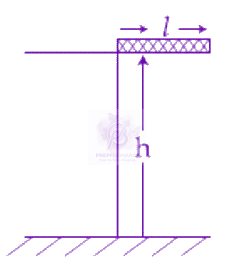
In a car race on straight road, car $A$ takes a time $t$ less than car $B$ at the finish and passes finishing point with a speed $v$ more than that of car $B.$ Both the cars start from rest and travel with constant acceleration ${a}_{1}$ and ${a}_{2}$ respectively. Then $v$ is equal to:
A plane is inclined at an angle $\alpha =30^{\circ}$ with respect to the horizontal. A particle is projected with a speed $u=2 m {s}^{-1}$ , from the base of the plane, making an angle $\theta =15^{\circ}$ with respect to the plane as shown in the figure. The distance from the base, at which the particle hits the plane is close to: (Take $g=10 m {s}^{-2}$ ) 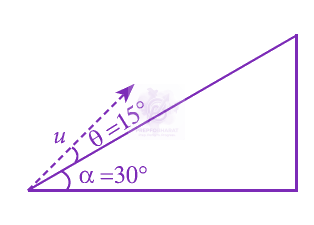
A long cylindrical vessel is half filled with a liquid. When the vessel is rotated about its own vertical axis, the liquid rises up near the wall. If the radius of vessel is $5 cm$ and its rotational speed is $2$ rotations per second, then the difference in the heights between the center and the sides, in $cm,$ will be:
A solid sphere, of radius R acquires a terminal velocity ${v}_{1}$ when falling (due to gravity) through a viscous fluid having a coefficient of viscosity $\eta .$ The sphere is broken into 27 identical solid spheres. If each of these spheres acquires a terminal velocity, ${v}_{2},$ when falling through the same fluid, the ratio $(\frac{{v}_{1}}{{v}_{2}})$ equals:
Let $L, R, C$ and $V$ represent inductance, resistance, capacitance and voltage, respectively. The dimension of $\frac{L}{RCV}$ in $SI$ units will be:
A particle moves in one dimension from rest under the influence of a force that varies with the distance traveled by the particle as shown in the figure. The kinetic energy of the particle after it has traveled $3 m$ is: 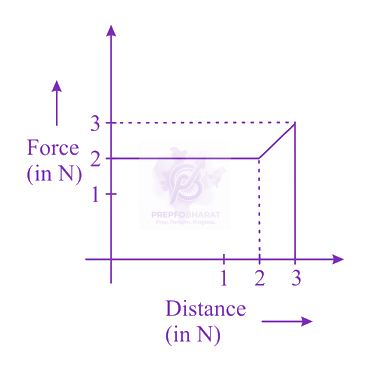
Ship $A$ is sailing towards north-east with velocity) $\vec{v}=30\hat{i}+50\hat{j}\mathrm{km}{h}^{-1}$ where $\hat{i}$ points east and $\hat{j},$ north. The ship $B$ is at a distance of $80 km$ east and $150 km$ north of Ship $A$ and is sailing towards the west at $10km{h}^{-1}.$ $A$ will be at the minimum distance from $B$ in:
A stationary horizontal disc is free to rotate about its axis. When a torque is applied on it, its kinetic energy as a function of $\theta$, where $\theta$ is the angle by which it has rotated, is given as $k{\theta }^{2}$. If its moment of inertia is $I$ then the angular acceleration of the disc is:
A ball is thrown vertically up (taken as $+z-axis$ ) from the ground. The correct momentum-height $(p-h)$ diagram is: