JEE Main Physics — Mechanics previous year questions with solutions.
A rod of length $50 cm$ is pivoted at one end. It is raised such that it makes an angle of ${30}^{o}$ from the horizontal as shown and released from rest. Its angular speed when it passes through the horizontal (in $rad {s}^{-1}$ ) will be $(g=10 m{s}^{-2})$ 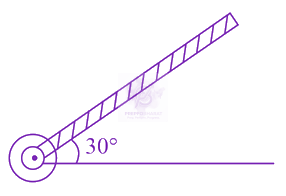
A uniform rod of length $l$ is being rotated in a horizontal plane with a constant angular speed about an axis passing through one of its ends. If the tension generated in the rod due to rotation is $T(x)$ at a distance $x$ from the axis, then which of the following graphs depicts it most closely?
A body of mass ${m}_{1}$ moving with an unknown velocity of ${v}_{1} \hat{i},$ undergoes a collinear collision with a body of mass ${m}_{2}$ moving with a velocity ${v}_{2} \hat{i}.$ After the collision, ${m}_{1}$ and ${m}_{2}$ move with velocities of ${v}_{3} \hat{i}$ and ${v}_{4} \hat{i},$ respectively. If ${m}_{2}=0.5 {m}_{1}$ and ${v}_{3}=0.5 {v}_{1},$ then ${v}_{1}$ is:
The top of a water tank is open to air and its water level is maintained. It is giving out $0.74 {m}^{3}$ water per minute through a circular opening of $2 \mathrm{cm}$ radius in its wall. The depth of the centre of the opening from the level of water in the tank is close to:
The following bodies are made to roll up (without slipping) the same inclined plane from a horizontal plane: (i) a ring of radius $R,$ (ii) a solid cylinder of radius $\frac{R}{2}$ and (iii) a solid sphere of radius $\frac{R}{4}.$ If, in each case, the speed of the center of mass at the bottom of the incline is same, the ratio of the maximum heights they climb is:
A solid sphere and solid cylinder of identical radii approach an incline with the same linear velocity (see figure). Both roll without slipping all throughout. The two climb maximum heights ${h}_{sph}$ and ${h}_{cyl}$ on the inline. The ratio $\frac{{h}_{sph}}{{h}_{cyl}}$ is given by: 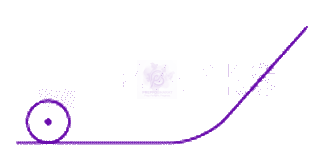
A spaceship orbits around a planet at a height of $20 km$ from its surface. Assuming that only gravitational field of the planet acts on the spaceship, what will be the number of complete revolutions made by the spaceship in $24$ hours around the planet? [Given: Mass of planet $=8\times {10}^{22} kg$ , Radius of planet $=2\times {10}^{6} m,$ Gravitational constant $G=6.67\times {10}^{-11} N{m}^{2}/k{g}^{2}$ ]
Two satellites, $A$ and $B$, have masses $m$ and $2m$ respectively. $A$ is in a circular orbit of radius $R$ and $B$ is in a circular orbit of radius $2R$ around the earth. The ratio of their kinetic energies, $\frac{{K}_{A}}{{K}_{B}}$ is:
A straight rod of length $L$ extends from $x=a$ to $x=L+a.$ The gravitational force it exerts on a point mass 'm' at $x=0,$ if the mass per unit length of the rod is $A+B{x}^{2},$ is given by:
In the cube of side 'a' shown in the figure, the vector from the central point of the face $ABOD$ to the central point of the face $BEFO$ will be:<br><img src="https://prepforbharat.s3.ap-south-1.amazonaws.com/exam/615f0e999476412f48314daf/Physics/images/Mathematics_in_Physics/648b5a66417cc3fb48d666a3/question_1__q_648b5a66417cc3fb48d666a3__cdn-question-pool.getmarks.app__dfipwtyfqphmgqfmxreyumzdpvpggtkgoliwasbawcukbzmeqq__6f74dad4ca_final_ppt_sync.png" alt="JEE Main 2019 Physics, Mathematics in Physics — question figure">
The position vector of a particle changes with time according to the relation $\vec{r}(t)=15{t}^{2}\hat{i}+(4-20{t}^{2})\hat{j}.$ What is the magnitude of the acceleration at $t=1?$
Moment of inertia of a body about a given axis is $1.5 kg {m}^{2}.$ Initially the body is at rest. In order to produce a rotational kinetic energy of $1200 J,$ the angular acceleration of $20 rad/{s}^{2}$ must be applied about the axis for a duration of:
A particle of mass $m$ is moving along a trajectory given by $x={x}_{0}+a cos{\omega }_{1}t$ $y={y}_{0}+b sin{\omega }_{2}t$ The torque, acting on the particle about the origin, at $t=0$ is:
Two particles are projected from the same point with the same speed u such that they have the same range R, but different maximum heights, ${h}_{1}$ and ${h}_{2}.$ Which of the following is correct?
Water from a tap emerges vertically downwards with an initial speed of $1.0 m{s}^{-1}$ . The cross $-$ sectional area of the tap is ${ 10}^{-4} {m}^{2}$ . Assume that the pressure is constant throughout the stream of water and that the flow is streamlined. The cross $-$ sectional area of the stream, $0.15 m$ below the tap would be: (Take $g=10 m{s}^{-2}$ )
A person standing on an open ground hears the sound of a jet aeroplane, coming from north at an angle ${60}^{o}$ with ground level, but he finds the aeroplane right vertically above his position. If $v$ is the speed of sound, speed of the plane is:
The diameter and height of a cylinder are measured by a meter scale to be $12.6\pm 0.1 cm$ and $34.2\pm 0.1 cm$ , respectively. What will be the value of its volume in appropriate significant figures?
A particle moves from the point $(2.0 \hat{i}+4.0 \hat{j}) \mathrm{m},$ at $\mathrm{t}=0$, with an initial velocity $(5.0 \hat{i}+4.0 \hat{j}) \mathrm{ms}^{-1} .$ It is acted upon by a constant force which produces a constant acceleration $(4.0 \hat{i}+4.0 \hat{j}) \mathrm{ms}^{-2} .$ What is the distance of the particle from the origin at time $2 \mathrm{~s} ?$
A circular disc of radius $b$ has a hole of radius $a$ at its centre(see figure). If the mass per unit area of the disc varies as $(\frac{{\sigma }_{0}}{r})$ then, the radius of gyration of the disc about its axis passing through the center is 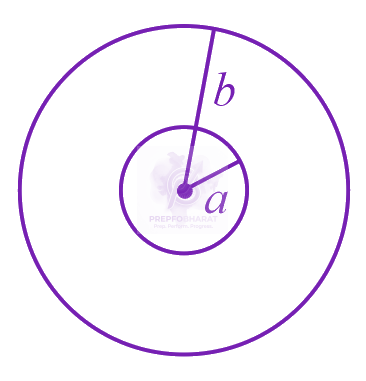
The diameter and height of a cylinder are measured by a meter scale to be $12.6\pm 0.1 cm$ and $34.2\pm 0.1 cm$ , respectively. What will be the value of its volume in appropriate significant figures?
A uniform cable of mass $M$ and length $L$ is placed on a horizontal surface such that its ${(\frac{1}{n})}^{th}$ part is hanging below the edge of the surface. To lift the hanging part of the cable upto the surface, the work done should be:
In the cube of side 'a' shown in the figure, the vector from the central point of the face $ABOD$ to the central point of the face $BEFO$ will be: 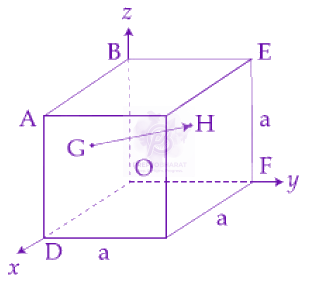
A particle is moving with a velocity $\vec{v}=K(y\hat{i}+x\hat{j}),$ where $K$ is a constant. The general equation for its path is:
The area of a square is $5.29 c{m}^{2}.$ The area of $7$ such squares taking into account the significant figures is: