JEE Main Physics — Mechanics previous year questions with solutions.
The value of acceleration due to gravity at Earth's surface is $9.8 m {s}^{-2}$ . The altitude above its surface at which the acceleration due to gravity decreases to $4.9 m {s}^{-2}$, is close to: (Radius of earth $=6.4\times {10}^{6} m$ )
The position vector of the center of mass ${\vec{r}}_{\mathrm{cm}}$ of an asymmetric uniform bar of negligible area of cross-section as shown in figure is: 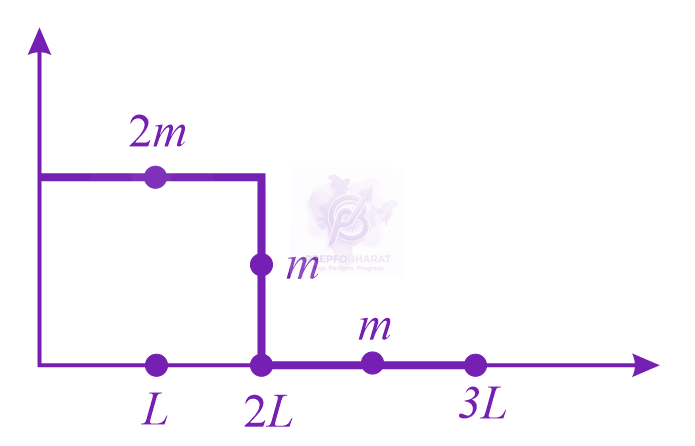
The pitch and the number of divisions, on the circular scale, for a given screw gauge are $0.5\mathrm{mm}$ and $100$ respectively. When the screw gauge is fully tightened without any object, the zero of its circular scale lies $3$ divisions below the mean line. The readings of the main scale and the circular scale, for a thin sheet, are $5.5\mathrm{mm}$ and $48$ respectively, the thickness of this sheet is:
Two stars of masses $3\times {10}^{31}\mathrm{kg}$ each, and at distance $2\times {10}^{11}m$ rotate in a plane about their common centre of mass $O.$ A meteorite passes through $O$ moving perpendicular to the stars,s rotation plane. In order to escape from the gravitational field of this double star, the minimum speed that meteorite should have at $O$ is ( Take Gravitational constant $G=6.67\times {10}^{-11}N{m}^{2}{\mathrm{kg}}^{-2}$)
An $L$ -shaped object, made of thin rods of uniform mass density, is suspended with a string as shown in figure. If $AB=BC,$ and the angle made by $AB$ with downward vertical is $\theta ,$ then: 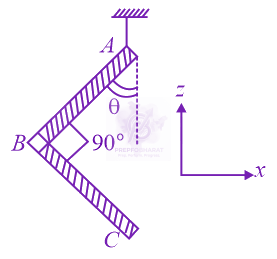
A block of mass $m$ is kept on a platform which starts from rest with a constant acceleration $g/2$ upwards, as shown in the figure. Work done by normal reaction on block in time $t$ is 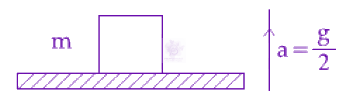
A person standing on an open ground hears the sound of a jet aeroplane, coming from north at an angle ${60}^{o}$ with ground level, but he finds the aeroplane right vertically above his position. If $v$ is the speed of sound, speed of the plane is:
The position co-ordinates of a particle moving in a $3D$ coordinate system is given by $x=a\mathrm{cos}\omega t$ $y=a\mathrm{sin}\omega t$ and $z=a\omega t$ The speed of the particle is:
If Surface tension$(S)$, Moment of Inertia $(I)$ and Planck's constant $(h),$ were to be taken as the fundamental units, the dimensional formula for linear momentum would be:
The force of interaction between two atoms is given by $F=\alpha \beta \exp \left(-\frac{x^{2}}{\alpha k T}\right) ;$ where $x$ is the distance, $\mathrm{k}$ is the Boltzmann constant and T is temperature and $\alpha$ and $\beta$ are two constants. The dimensions of $\beta$ is:
The trajectory of a projectile near the surface of the earth is given as $y=2x-9{x}^{2}.$ If it were launched at an angle ${\theta }_{0}$ with speed ${v}_{0}$ then $(g=10 {m s}^{-2}):$
Two particles $A, B$ are moving on two concentric circles of radii ${R}_{1}$ and ${R}_{2}$ with equal angular speed $\omega .$ At $t=0,$ their positions and direction of motion are shown in the figure: 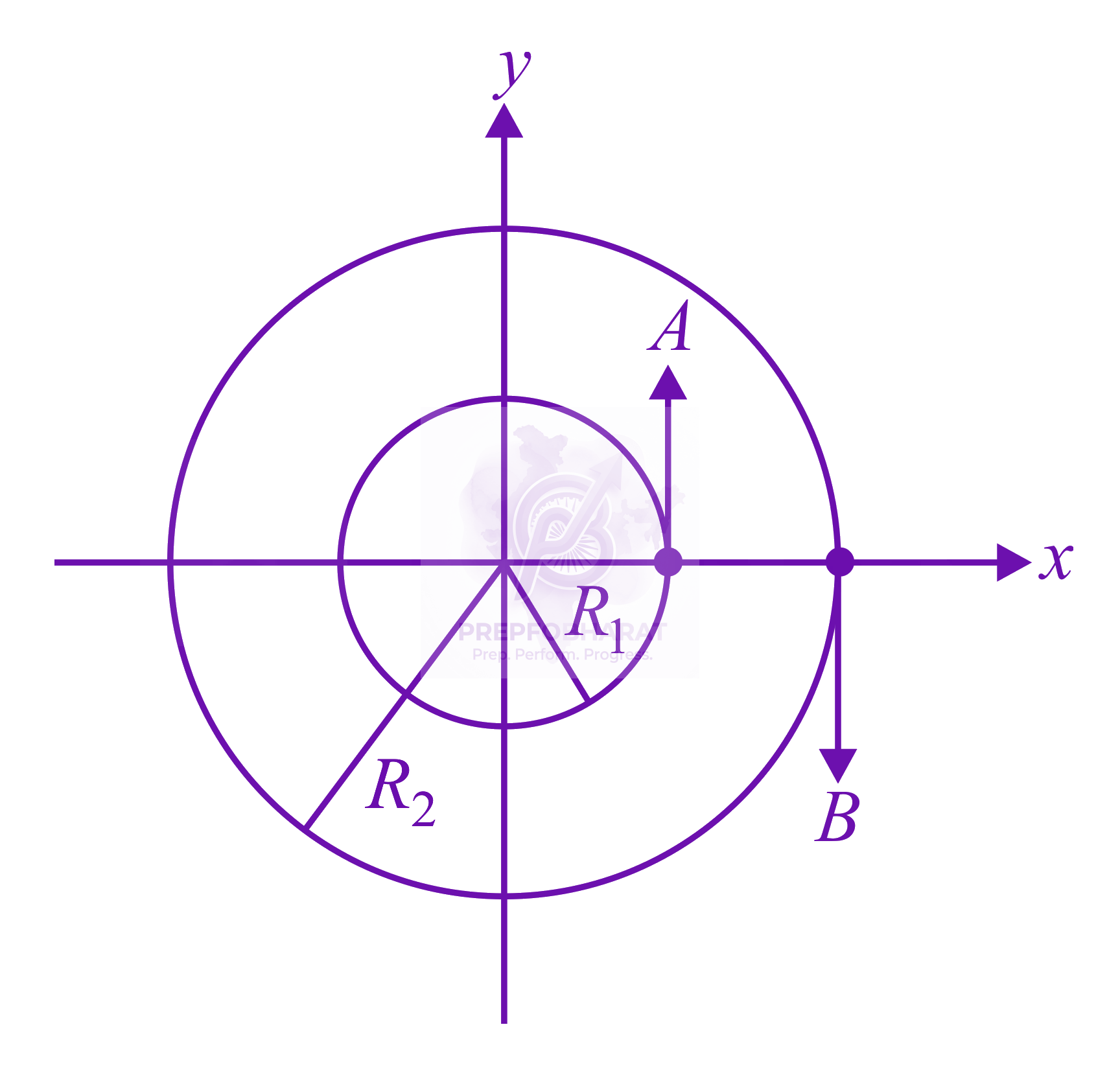 The relative velocity $\vec{{V}_{A}}-\vec{{V}_{B}}$ at $t=\frac{\pi }{2\omega }$ is given by:
A body is projected at $t=0$ with a velocity $10 \mathrm{~ms}^{-1}$ at an angle of $60^{\circ}$ with the horizontal. The radius of curvature of its trajectory at $t=1$ s is $R$. Neglecting air resistance and taking acceleration due to gravity $\mathrm{g}=10 \mathrm{~ms}^{-2}$, the value of $R$ is:
The time dependence of the position of a particle of mass $m=2$ is given by $\vec{r }(t)=2t \hat{i}-3{t}^{2}\hat{j}$ . Its angular momentum, with respect to the origin, at time $t=2$ is:
A smooth wire of length $2\pi r$ is bent into a circle and kept in a vertical plane. A bead can slide smoothly on the wire. When the circle is rotating with angular speed $\omega$ about the vertical diameter $AB,$ as shown in figure, the bead is at rest with respect to the circular ring at position $P$ as shown. Then the value of ${\omega }^{2}$ is equal to: 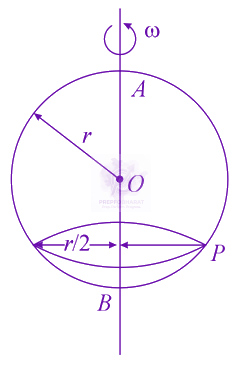
The elastic limit of brass is $379 MPa$. The minimum diameter of a brass rod if it is to support a $400 N$ load without exceeding its elastic limit will be
The mass and the diameter of a planet are three times the respective values for the Earth. The period of oscillation of a simple pendulum on the Earth is $2 \mathrm{~s}$. The period of oscillation of the same pendulum on the planet would be:
A satellite of mass $M$ is in a circular orbit of radius $R$ about the center of the earth. A meteorite of the same mass, falling towards the earth, collides with the satellite completely inelastic. The speeds of the satellite and the meteorite are the same, just before the collision. The subsequent motion of the combined body will be:
A block of mass $10 kg$ is kept on a rough inclined plane as shown in the figure. A force of $3 N$ is applied on the block. The coefficient of static friction between the plane and the block is $0.6.$ What should be the minimum value of force $P,$ such that the block does not move downward? (take $g=10 m{s}^{-2}$ ) 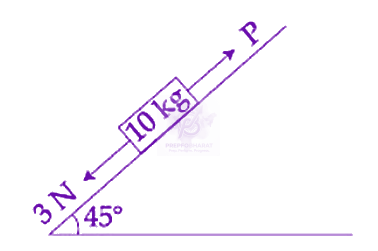
A particle of mass $20 g$ is released with an initial velocity $5 m{s}^{-1}$ along the curve from the point $A,$ as shown in the figure. The point $A$ is at height $h$ from point $B.$ The particle slides along the frictionless surface. When the particle reaches point $B,$ its angular momentum about $O$ will be: (Take $g=10 m{s}^{-2}$) 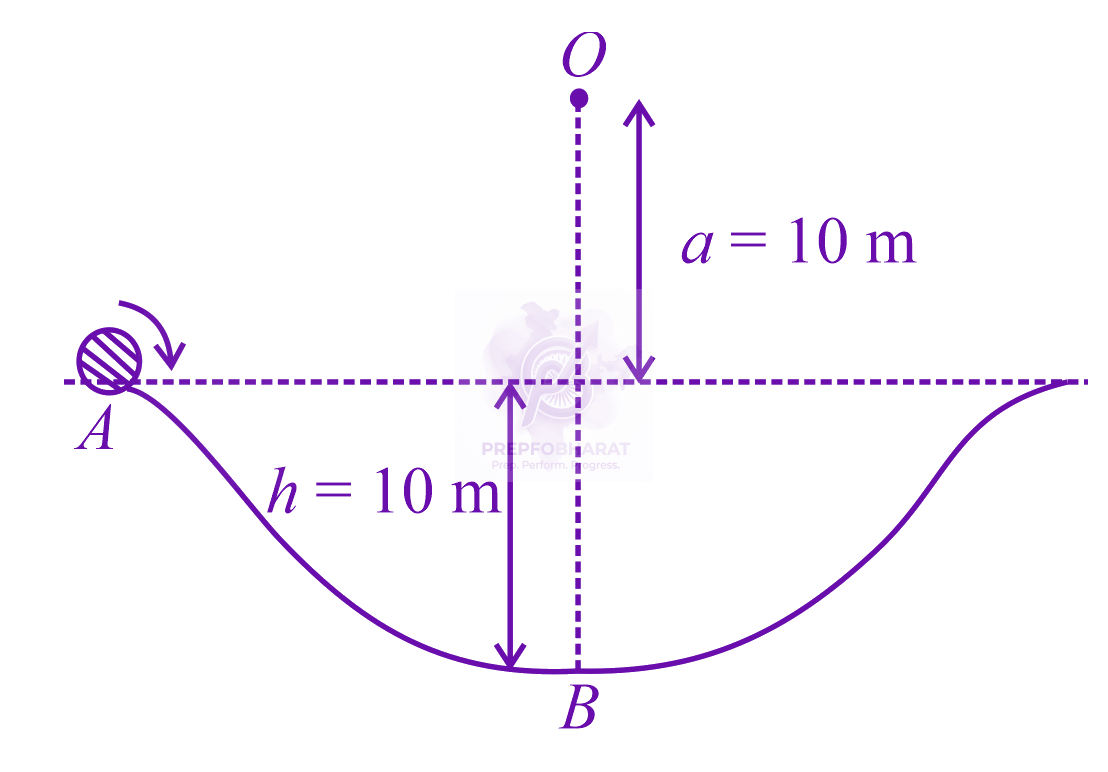
A load of mass $M kg$ is suspended from a steel wire of length $2m$ and radius $1.0 mm$ in Searle's apparatus experiment. The increase in length produced in the wire is $4.0 mm.$ Now the load is fully immersed in a liquid of relative density $2.$ The relative density of the material of load is $8.$ The new value of increase in length of the steel wire is:
In a simple pendulum experiment for determination of acceleration due to gravity $(g)$, time taken for $20$ oscillations is measures by using a watch of $1$ second least count. The mean value of time taken comes out to be $30 s$. The length of the pendulum is measured by using a meter scale of least count $1 mm$ and the value obtained is $55.0 cm$. The percentage error in the determination of $g$ is close to
Three particles of masses $50 g$, $100 g$ and $150 g$ are placed at the vertices of an equilateral triangle of side $1 m$ (as shown in the figure). The $(x, y)$ coordinates of the centre of mass will be: 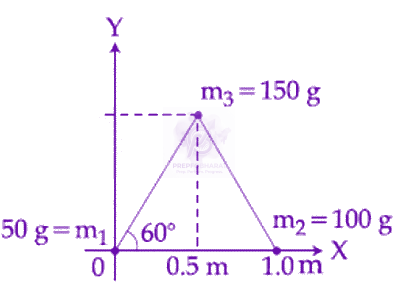
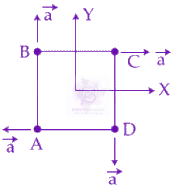
Four particles $A, B, C$ and $D$ with masses ${m}_{A}=m,{m}_{B}=2m,{m}_{C}=3m$ and ${m}_{D}=4m$ are at the corners of a square. They have accelerations of equal magnitude with directions as shown. The acceleration of the centre of mass of the particles is: