JEE Main Physics — Mechanics previous year questions with solutions.
Two identical spherical balls of mass $M$ and radius $R$ each are stuck on two ends of a rod of length $2R$ and mass $M$(see figure). The moment of inertia of the system about the axis passing perpendicularly through the centre of the rod is 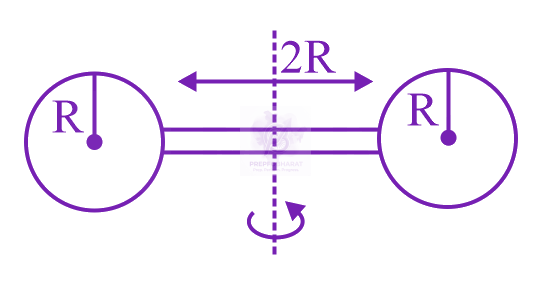
The position of a particle as a function of time $t,$ is given by $x(t)=at+b{t}^{2}-c{t}^{3}$ where $a, b$ and $c$ are constants. When the particles zero acceleration, then its velocity will be:
A uniform rectangular thin sheet $ABCD$ of mass $M$ has length $a$ and breadth $b$, as shown in the figure. If the shaded portion $HBGO$ is cut-off, the coordinates of the centre of mass of the remaining portion will be: 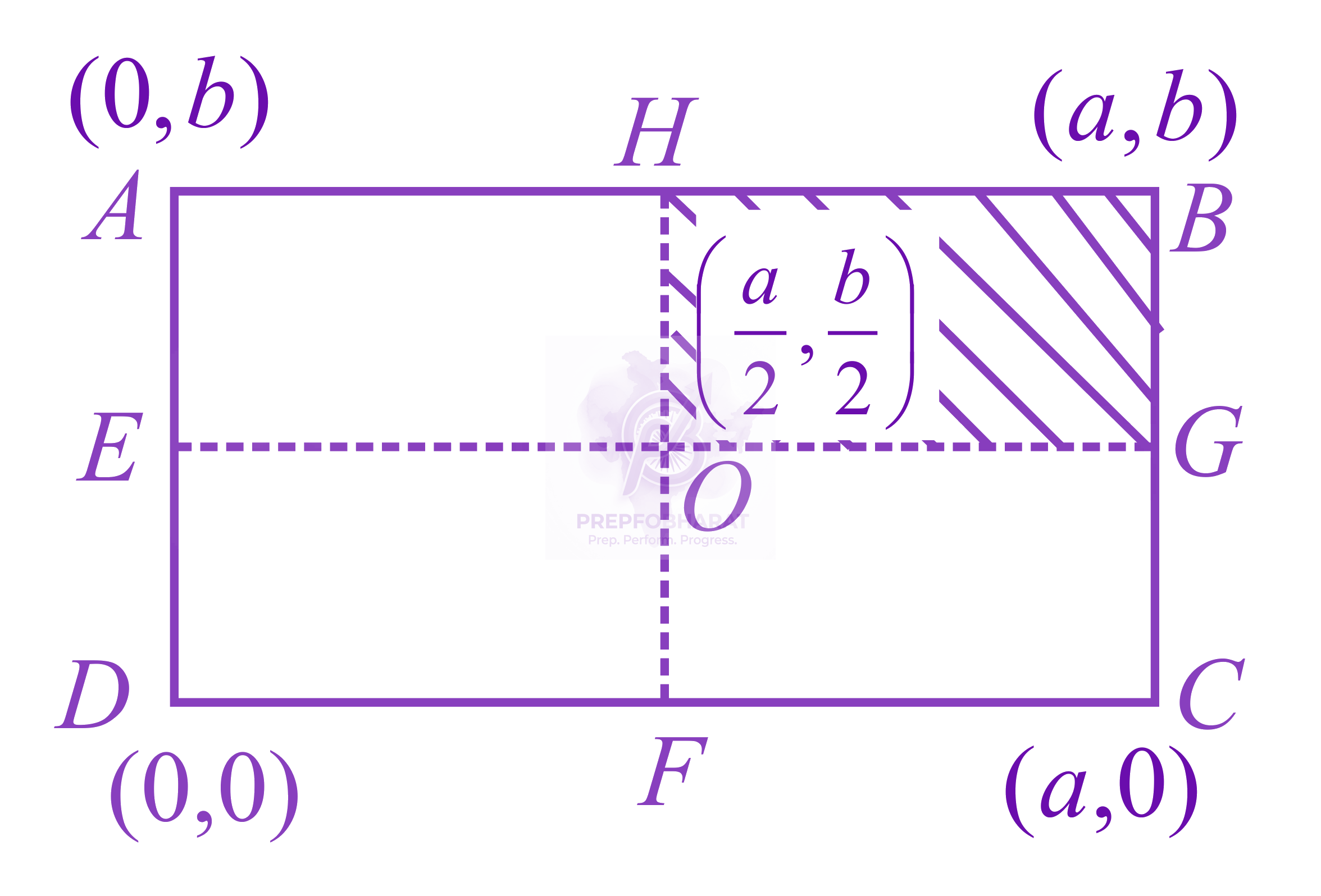
A ball is thrown upward with an initial velocity ${V}_{0}$ from the surface of the earth. The motion of the ball is affected by a drag force equal to $m\gamma {v}^{2}$ (where $m$ is mass of the ball, $v$ is its instantaneous velocity and $\gamma$ is a constant). Time taken by the ball to rise to its zenith is:
A wedge of mass $M=4m$ lies on a frictionless plane. A particle of mass $m$ approaches the wedge with speed $v.$ There is no friction between the particle and the plane or between the particle and the wedge. The maximum height climbed by the particle on the wedge is given by:
Let the moment of inertia of a hollow cylinder of length $30 cm$ (inner radius $10 cm$ and outer radius $20 cm$ ), about its axis be $\text{I}$ . The radius of a thin cylinder of the same mass such that its moment of inertia about its axis is also $\text{I},$ is:
If $'M'$ is the mass of water that rises in a capillary tube of radius $'r'$ , then mass of water which will rise in a capillary tube of radius $'2r'$ is:
Two blocks $A$ and $B$ of masses ${m}_{A}=1 kg$ and ${m}_{B}=3 kg$ are kept on the table as shown in figure. The coefficients of friction between $A$ and $B$ is $0.2$ and between $B$ and the surface of the table is also $0.2.$ The maximum force $F$ that can be applied on $B$ horizontally, so that the block $A$ does not slide over the block $B$ is : [Take $g=10 m/{s}^{2}$ ] 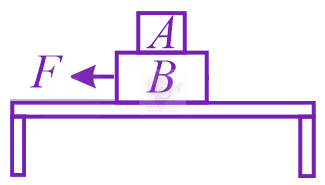
A body of mass 2 kg is moving with velocity 3 m/s. The force required to stop it in 2 seconds is:
A thin circular plate of mass $M$ and radius $R$ has its density varying as $\text{ρ}(r){\text{=ρ}}_{\text{0}}\text{r}$ with ${\rho }_{0}$ as constant and $r$ is the distance from its centre. The moment of Inertia of the circular plate about an axis perpendicular to the plate and passing through its edge is $I=aM{R}^{2}$. The value of the coefficient $a$ is:
A shell is fired from a fixed artillery gun with an initial speed u such that it hits the target on the ground at a distance $R$ from it. If ${t}_{1}$ and ${t}_{2}$ are the values of the time taken by it to hit the target in two possible ways, the product ${t}_{1}{t}_{2}$ is:
If speed (V), acceleration (A) and force (F) are considered as fundamental units, the dimension of Young's modulus will be :
The ratio of surface tensions of mercury and water is given to be $7.5$, while the ratio of their densities is $13.6$. Their contact angles, with glass, are close to $135^{\circ}$ and $0^{\circ}$, respectively. If it is observed that mercury gets depressed by an amount $h$ in a capillary tube of radius ${r}_{1}$, while water rises by the same amount $h$ in a capillary tube of radius ${r}_{2}$, then the ratio $\frac{{r}_{1}}{{r}_{2}}$ is close to
A metal coin of mass $5 g$ and radius $1 cm$ is fixed to a thin stick $AB$ of negligible mass as shown in the figure. The system is initially at rest. The constant torque, that will make the system rotate about $AB$ at $25$ rotations per second in $5 s$ , is close to: 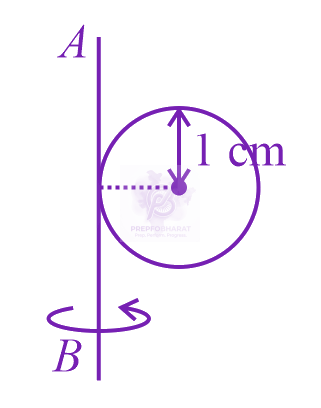
A homogeneous solid cylindrical roller of radius $R$ and mass $M$ is pulled on a cricket pitch by a horizontal force. Assuming rolling without slipping, angular acceleration of the cylinder is:
Two particles of masses $M$ and $2M are$moving with speeds of $10 m{s}^{-1}$ and $5 m{s}^{-1}$, as shown in the figure. They collide at the origin and after that they move along the indicated directions with speeds ${v}_{1}$ and ${v}_{2}$, respectively. The values of ${v}_{1}$ and ${v}_{2}$ are, nearly 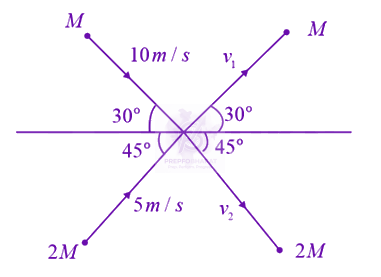
A particle starts from origin $O$ from rest and moves with a uniform acceleration along the positive $x-axis$ . Identify all figures that correctly represent the motion qualitatively. ( $a=$ acceleration, $v=$ velocity, $x=$ dispalcement, $t=$ time) $(A)$ 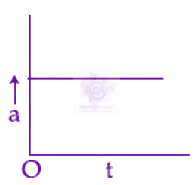 $(B)$ 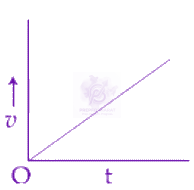 $(C)$ 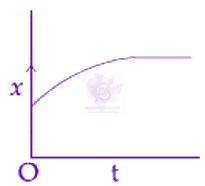 $(D)$ 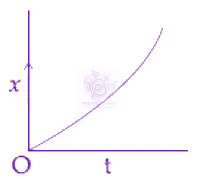
Three blocks $A, B$ and $C$ are lying on a smooth horizontal surface, as shown in the figure. $A$ and $B$ have equal masses, $m$ while $C$ has mass $M.$ Block $A$ is given an initial speed $v$ towards $B$ due to which it collides with $B$ perfectly inelastically. The combined mass collides with $C,$ also perfectly inelastically . $\frac{5}{6}\text{t}\text{h}$ of the initial kinetic energy is lost in the whole process. What is the value of $M/m$? 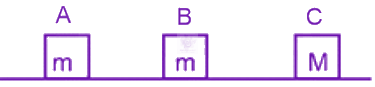
A simple pendulum, made of a string of length $l$ and $a$ bob of mass $m,$ is released from a small angle ${\theta }_{0}.$ It strikes a block of mass $M,$ kept on horizontal surface at its lowest point of oscillations, elastically. It bounces back and goes up to an angle ${\theta }_{1}.$ Then $M$ is given by:
A potentiometer wire $\mathrm{AB}$ having length $L$ and resistance $12r$ is joined to a cell $D$ of emf $\epsilon$ and internal resistance $r$. A cell $C$ having EMF $\epsilon /2$ and internal resistance $3r$ is connected. The length $\mathrm{AJ}$, at which the galvanometer, as shown in the figure, shows no deflection is 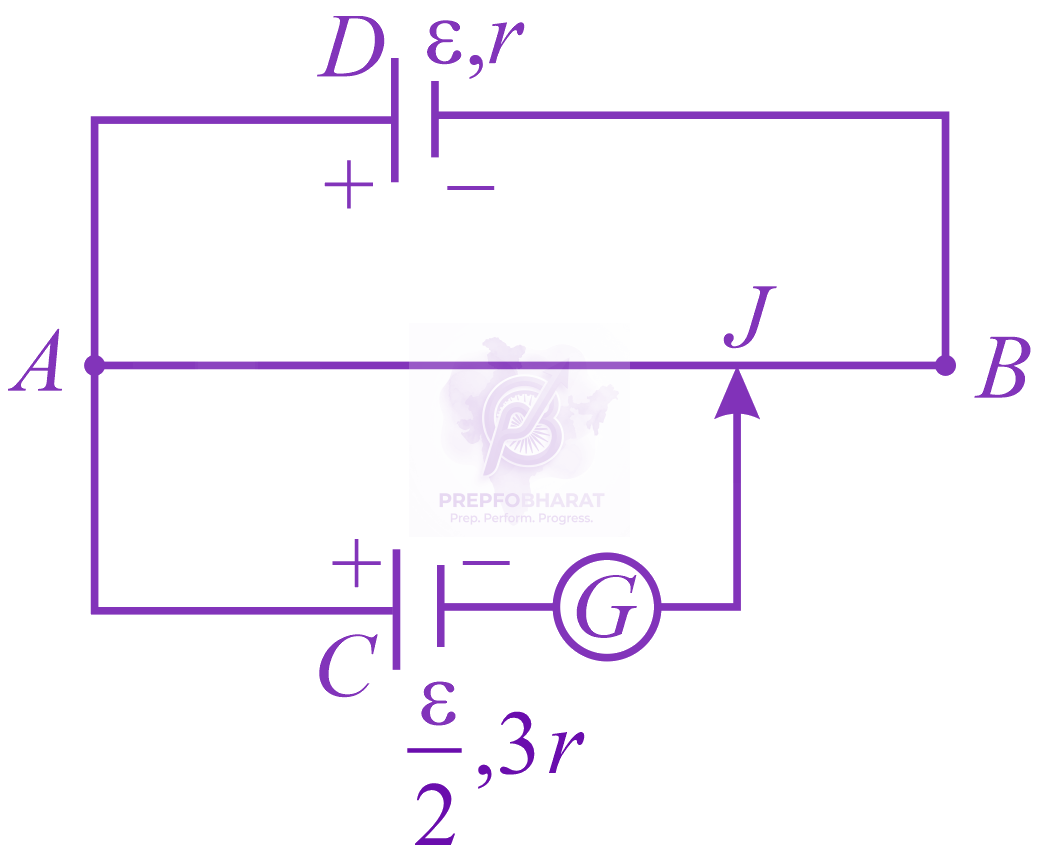
A thin disc of mass $M$ and radius $R$ has mass per unit area $\sigma (r)=k{r}^{2}$ where $r$ is the distance from its centre. Its moment inertia about an axis going through its centre of mass and perpendicular to its plane is:
In the experimental set up of metre bridge shown in the figure, the null point is obtaine data distance of $40 \mathrm{~cm}$ from A. If a $10 \Omega$ resistor is connected in series with $\mathrm{R}_{1},$ the null point shifts by $10 \mathrm{~cm}$. The resistance that should be connected in parallel with $\left(\mathrm{R}_{1}+10\right) \Omega$ such that the null point shifts back to its initial position is 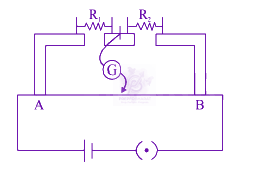
A particle is moving along a circular path with a constant speed of $10 \mathrm{~ms}^{-1}$. What is the magnitude of the change in velocity of the particle, when it moves through an angle of $60^{\circ}$ around the centre of the circle?
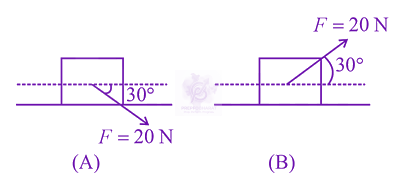
A block of mass $5 kg$ is (i) pushed in case $(A)$ and (ii) pulled in case $(B),$ by a force $F=20 N,$ making an angle of ${30}^{o}$ with the horizontal, as shown in the figures. The coefficient of friction between the block and floor is $\mu =0.2.$ The difference between the accelerations of the block, in case $(B)$ and case $(A)$ will be: $(g=10 m {s}^{-2})$