JEE Main Physics — Mechanics previous year questions with solutions.
The distance $x$ covered by a paritcle in one dimensional motion varies with time $t$ as ${x}^{2}=a{t}^{2}+2bt+c$ . If the acceleration of the particle depends on $x$ as ${x}^{-n}$ , where $n$ is an integer, the value of $n$ is _________
Pressure inside two soap bubbles are $1.01$ and $1.02$ atmosphere, respectively. The ratio of their volumes is :
The coordinates of the centre of mass of a uniform flag-shaped lamina (thin flat plate) of mass $4kg$. (The coordinates of the same are shown in the figure) are: 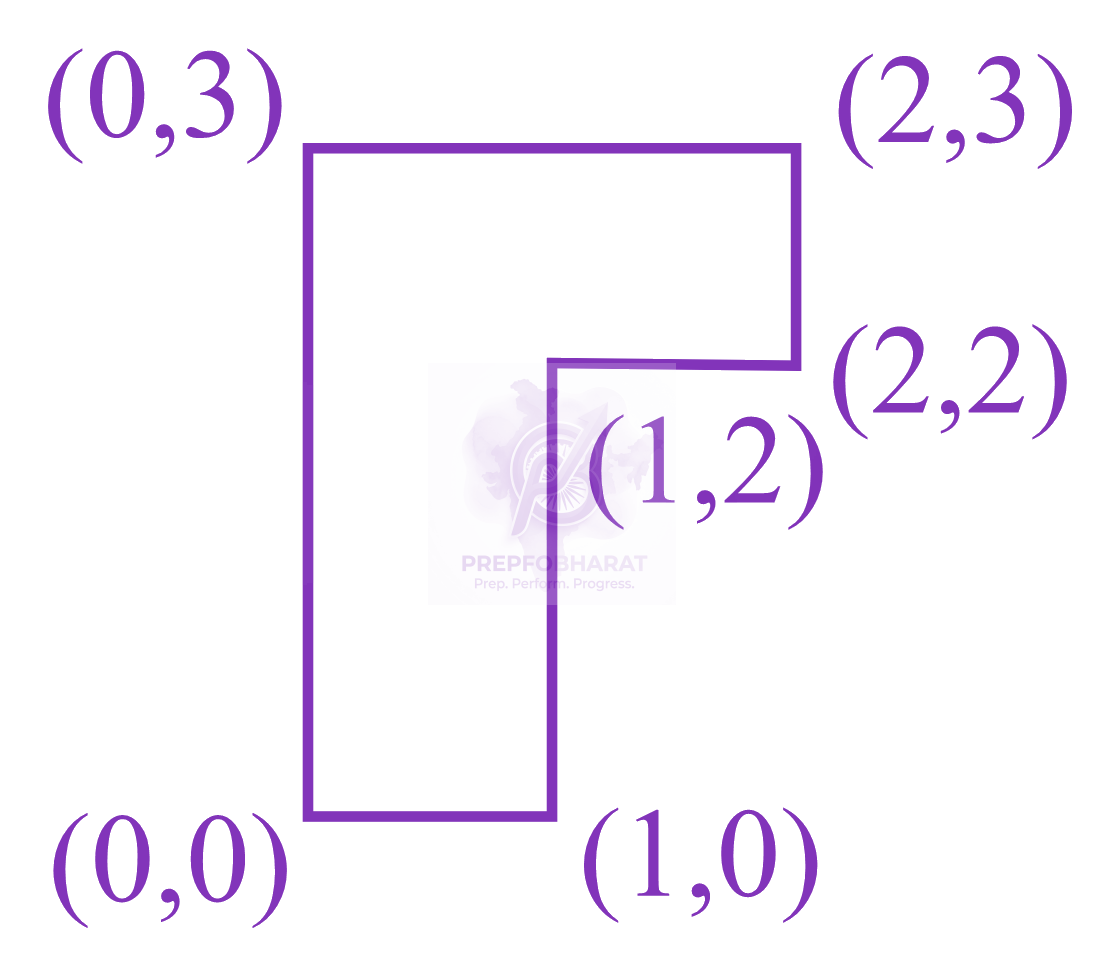
The mass density of a planet of radius R varies with the distance r from its centre as $\rho (r)={\rho }_{0}(1-\frac{{r}^{2}}{{R}^{2}})$ Then the gravitational field is maximum at:
A cube of metal is subjected to a hydrostatic pressure $4GPa$. The percentage change in the length of the side of the cube is close to : (Given bulk modulus of metal, $B=8\times {10}^{10}Pa$)
A capillary tube made of glass of radius $0.15\mathrm{mm}$ is dipped vertically in a beaker filled with methylene iodide (surface tension $=0.05N{m}^{-1}$, density $=667\mathrm{kg}{m}^{-3}$) which rises to height $h$ in the tube. It is observed that the two tangents drawn from observed that the two tangents drawn from liquid-glass interfaces (from opp. sides of the capillary) make an angle of $60º$ with one another. Then $h$ is close to ($g=10m{s}^{-2}$)
The value of the acceleration due to gravity is ${g}_{1}$ at a height $h=\frac{R}{2}$ ($R=$ radius of the earth) from the surface of the earth. It is again equal to ${g}_{1}$ at a depth $d$ below the surface the earth. The ratio $(\frac{d}{R})$ equals:
Using screw gauge of pitch $0.1\mathrm{cm}$ and $50$ divisions on its circular scale, the thickness of an object is measured. It should correctly be recorded as,
The radius of gyration of a uniform rod of length $l,$ about an axis passing through a point $\frac{l}{4}$ away from the centre of the rod, and perpendicular to it, is:
A quantity $x$ is given by $(1F{v}^{2}/W{L}^{4})$ in terms of moment of inertia $I$, force $F$, velocity $v$, work $W$ and length $L$. The dimensional formula for $x$ is same as that of :
Two identical cylindrical vessels are kept on the ground and each contain the same liquid of density $d$. The area of the base of both vessels is $S$ but the height of liquid in one vessel is ${x}_{1}$ and in the other ${x}_{2}$. When both cylinders are connected through a pipe of negligible volume very close to the bottom, the liquid flows from one vessel to the other until it comes to equilibrium at a new height. The change in energy of the system in the process is :
The sum of two forces $\vec{P}$ and $\vec{Q}$ is $\vec{R}$ such that $|\vec{R}|=|\vec{P}|$. Find the angle between resultant of $2\vec{P}$ and $\vec{Q}$ and $\vec{Q}$ , ________
A particle of mass $m$ is moving along the $x$-axis with initial velocity $u\hat{i}$. It collides elastically with a particle of mass $10m$ at rest and then moves with half its initial kinetic energy (see figure). If $\mathrm{sin}{\theta }_{1}=\sqrt{n}\mathrm{sin}{\theta }_{2}$ then value of n is ________. 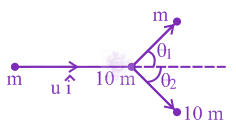
Consider a force $\vec{F}=-x\hat{i}+y\hat{j}$ . The work done by this force in moving a particle from point $A(1,0)$ to $B(0,1)$ along the line segment is : (all quantities are in SI units)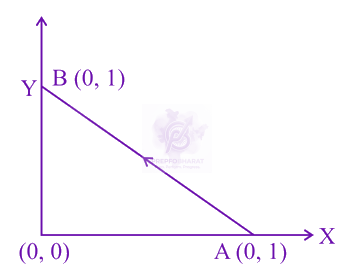
In a reactor, $2\mathrm{kg}$ of $U23592$ fuel is fully used up in $30$ days. The energy released fission is $200\mathrm{MeV}$. Given that the Avogadro number, $N=6.023\times {10}^{26}$ per kilo mole and $1\mathrm{eV}=1.6\times {10}^{-19}J$. The power output of the reactor is close to:
Two uniform circular discs are rotating independently in the same direction around their common axis passing through their centres. The moment of inertia and angular velocity of the first disc are $0.1\mathrm{kg}-{m}^{2}$ and $10\text{ rad }{s}^{-1}$ respectively while those for the second one are $0.2\mathrm{kg}-{m}^{2}$and $5\mathrm{rad}{s}^{-1}$ respectively. At some instant they get stuck together and start rotating as a single system about their common axis with some angular speed. The kinetic energy of the combined system is :
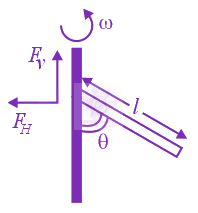 A uniform rod of length ' ${\ell }^{'}$ is pivoted at one of its ends on a vertical shaft of negligible radius. When the shaft rotates at angular speed $\omega$ the rod makes an angle $\theta$with it (see figure). To find $\theta$ equate the rate of change of angular momentum (direction going into the paper) $\frac{m{\ell }^{2}}{12}{\omega }^{2}\mathrm{sin}\theta$ about the centre of mass (CM) to the torque provided by the horizontal and vertical forces ${F}_{H}$and ${F}_{v}$ about the CM. The value of $\theta$ is then such that:
An alpha- particle of mass $m$ suffers $1-$ dimensional elastic collision with a nucleus at rest of unknown mass. It is scattered directly backwards losing $64%$ of its initial kinetic energy. The mass of the nucleus is
A slab is subjected to two forces $\overrightarrow{\mathrm{F}_{1}}$ and $\overrightarrow{\mathrm{F}_{2}}$ of same magnitude $F$ as shown in the figure. Force $\overrightarrow{\mathrm{F}_{2}}$ is in XY- plane while force $\mathrm{F}_{1}$ acts along $z$ -axis at the point $(2 \vec{i}+3 \vec{j})$. The moment of these forces about point $\mathrm{O}$ will be: 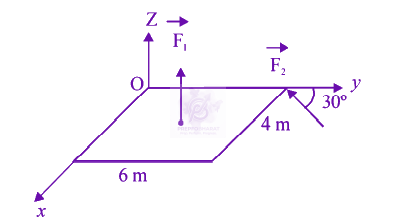
A test particle is moving in a circular orbit in the gravitational field produced by a mass density $\rho (r)=\frac{K}{{r}^{2}}.$ Identify the current relation between the radius $R$ of the particle’s orbit and its period $T:$
In a meter bridge experiment, the circuit diagram and the corresponding observation table are shown in figure. 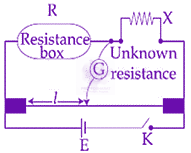<table class="pyq-table"><tbody><tr><th>S. No.</th><th>$R(\Omega )$</th><th>$l(cm)$</th></tr><tr><td>$_{1.}$ $_{2.}$ $_{3.}$ $_{4.}$</td><td>$1000$ $100$ $10$ $1$</td><td>$60$ $13$ $1.5$ $1.0$</td></tr></tbody></table> Which of the reading is inconsistent?
The least count of the main scale of a screw gauge is $1 \mathrm{mm}.$ The minimum number of divisions on its circular scale required to measure $5 \mu m$ diameter of a wire is:
The density of a material in $SI$ units is $128 kg {m}^{-3}.$ In certain units in which the unit of length is $25 cm$ and the unit of mass is $50g,$ the numerical value of density of the material is:
Two guns $A$ and $B$ can fire bullets at speeds $1 km/s$ and $2 km/s$ respectively. From a point on a horizontal ground, they are fired in all possible directions. The ratio of maximum areas covered by the bullets fired by the two guns, on the ground is: