JEE Main Physics — Mechanics previous year questions with solutions.
A particle of mass m is projected with a speed u from the ground at an angle $\theta =\frac{\pi }{3}$ w.r.t. horizontal (x-axis). When it has reached its maximum height, it collides completely inelastically with another particle of the same mass and velocity $u\hat{i}.$ The horizontal distance covered by the combined mass before reaching the ground is:
A uniformly thick wheel with moment of inertia $I$ and radius $R$ is free to rotate about its centre of mass (see fig). A massless string is wrapped over its rim and two blocks of masses ${m}_{1}$ and ${m}_{2}({m}_{1}>{m}_{2})$ are attached to the ends of the string. The system Is released from rest. The angular speed of the wheel when ${m}_{1}$ descends by a distance $h$ is: 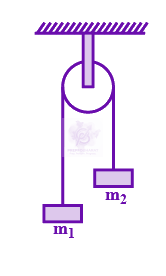
Two planets have masses $M$ and $16M$ and their radii are a and $2a$, respectively. The separation between the centres of the planets is $10a$. A body of mass $m$ is fired from the surface of the larger planet towards the smaller planet along the line joining their centres. For the body to be able to reach at the surface of smaller planet, the minimum firing speed needed is :
Two bodies of the same mass are moving with the same speed, but in different directions in a plane. They have a completely inelastic collision and move together thereafter with a final speed which is half of their initial velocities of the two bodies (in degree) is -
For the four sets of three measured physical quantities as given below. Which of the following options is correct? $(i)$ ${A}_{1}=24.36,{B}_{1}=0.0724,{C}_{1}=256.2$ $(ii)$ ${A}_{2}=24.44,{B}_{2}=16.082,{C}_{2}=240.2$ $(iii)$ ${A}_{3}=25.2,{B}_{3}=19.2812,{C}_{3}=236.183$ $(iv)$ ${A}_{4}=25,{B}_{4}=236.191,{C}_{4}=19.5$
A satellite is moving in a low nearly circular orbit around the earth. Its radius is roughly equal to that of the earth's radius ${R}_{e}.$ By firing rockets attached to it, its speed is instantaneously increased in the direction of its motion so that it become $\sqrt{\frac{3}{2}}$ times larger. Due to this the farthest distance from the centre of the earth that the satellite reaches is $R$. Value of $R$ is :
Consider two uniform discs of the same thickness and different radii ${R}_{1}=R$ and ${R}_{2}=\alpha R$ made of the same material. If the ratio of their moments of inertia ${I}_{1}$ and ${I}_{2}$, respectively, about their axes is ${I}_{1}:{I}_{2}=1:16$ then the value of $\alpha$ is :
Moment of inertia of a cylinder of mass $m,$ length $L$ and radius $R$ about an axis passing through its centre and perpendicular to the axis of the cylinder is $I=M(\frac{{R}^{2}}{4}+\frac{{L}^{2}}{12}).$ If such a cylinder is to be made for a given mass of a material, the ratio $\frac{L}{R}$ for it to have minimum possible $I$ is:
Water flows m a horizontal tube (see figure). The pressure of water changes by $700N{m}^{-2}$ between $A$ and $B$ where the area of cross section are $40c{m}^{2}$ and $20c{m}^{2},$ respectively. Find the rate of flow of water through the tube. (density of water $=1000kg{m}^{-3}$ ) 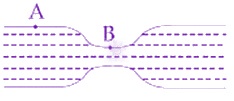
A particle of mass $200\mathrm{MeV}{c}^{-2}$ collides with a hydrogen atom at rest. Soon after the collision, the particle comes to rest, and the atom recoils and goes to its first excited state. The initial kinetic energy of the particle (in $\mathrm{eV}$) is $\frac{N}{4}.$ The value of $N$ is: (Given the mass of the hydrogen atom to be $1\mathrm{GeV}{c}^{-2}$).........
A uniform cylinder of mass $M$ and radius $R$ is to be pulled over a step of height a $(a<R)$ by applying a force $F$ at its centre $'O'$ perpendicular to the plane through the axes of the cylinder on the edge of the step (see figure). The minimum value of $F$ required is : 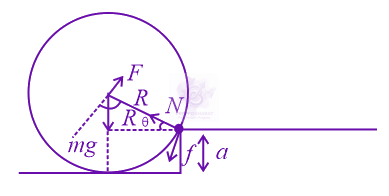
A helicopter rises from rest on the ground vertically upwards with a constant acceleration g. A food packet is dropped from the helicopter when it is at a height h. The time taken by the packet to reach the ground is close to [$g$ is the acceleration due to gravity]:
A body of mass $2\mathrm{kg}$ is driven by an engine delivering a constant power of $1J{s}^{-1}$. the body starts from rest and moves in a straight line. After $9s$, the body has moved a distance (in $m$)….
A hollow spherical shell at outer radius $R$ floats just submerged under the water surface. The inner radius of the shell is $r.$ If the specific gravity of the shell material is $\frac{27}{8}$ with respect to water, the value of $r$ is:
The sum of two forces $\vec{P}$ and $\vec{Q}$ is $\vec{R}$ such that $|\vec{R}|=|\vec{P}|$. Find the angle between resultant of $2\vec{P}$ and $\vec{Q}$ and $\vec{Q}$ , ________
A particle $(m=1kg)$ slides down a frictionless track $(AOC)$ starting from rest at a point $A$ (height $2m$ ). After reaching $C,$ the particle continues to move freely in air as a projectile. When it reaching its highest point $P$ (height $1m$ ), the kinetic energy of the particle (in $J$ ) is: (Figure drawn is schematic and not to scale; take $g=10m{s}^{-2}$ ) ______________. 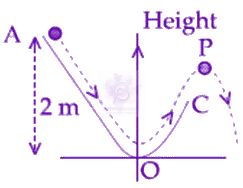
One end of a straight uniform $1m$ long bar is pivoted on horizontal table. It is released from rest when it makes an angle ${30}^{o}$ from the horizontal (see figure). Its angular speed when it hits the table is given as $\sqrt{n}rad{s}^{-1}$ , where $n$ is an integer. The value of $n$ is ____________ 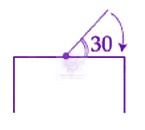
Given, $B$ is magnetic field induction, and ${\mu }_{0}$ is the magnetic permeability of vacuum. The dimension of $\frac{{B}^{2}}{2{\mu }_{0}}$ is:
An ideal fluid flows (laminar flow) through a pipe of non-uniform diameter. The maximum and minimum diameters of the pipes are $6.4cm$ and $4.8cm$ , respectively. The ratio of the minimum and the maximum velocities of fluid in this pipe is:
A satellite is in an elliptical orbit around a planet $P.$ It is observed that the velocity of the satellite when it is farthest from the planet is 6 times less than that when it is closest to the planet. The ratio of distances between the satellite and the planet at closest and farthest points is :
A balloon is moving up in air vertically above a point $A$ on the ground. When it is a height ${h}_{1},$ a girl standing at a distance d (point B) from A (see figure) sees it at an angle $45^{\circ}$ with respect to the vertical. When the balloon climbs up a further height ${h}_{2}$, it is seen at an angle $60^{\circ}$ with respect to the vertical if the girl moves further by a distance $2.464d$ (point C). Then the height ${h}_{2}$ is (given $\mathrm{tan}30^{\circ}=0.5774$): 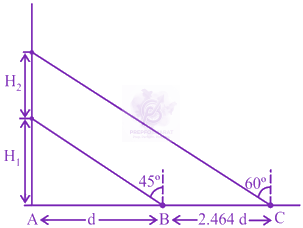
A ball is dropped from the top of a $100m$ high tower on a planet. In the last $\frac{1}{2}s$ before hitting the ground, it covers a distance of $19m.$ Acceleration due to gravity (in $m{s}^{-2}$ ) near the surface on that planet is______
A $60HP$ electric motor lifts an elevator having a maximum total load capacity of $2000kg.$ If the frictional force on the elevator is $4000N,$ the speed of the elevator at full load is close to : $(1\mathrm{HP}=746W,g=10m{s}^{-2})$
A person of $80\mathrm{kg}$ mass is standing on the rim of a circular platform of mass $200\mathrm{kg}$ rotating about its axis at $5$ revolutions per minute (rpm). The person now starts moving towards the centre of the platform. What will be the rotational speed (in $\mathrm{rpm}$ ) of the platform when the person reaches its centre....