JEE Main Physics — Mechanics previous year questions with solutions.
Two steel wires having same length are suspended from a ceiling under the same load. If the ratio of their energy stored per unit volume is $1:4,$ the ratio of their diameters is:
A circular disc of mass $\text{M}$ and radius $\text{R}$ is rotating about its axis with angular speed ${\omega }_{1}$. If another stationary disc having radius $\frac{\text{R}}{2}$ and same mass $\text{M}$ is dropped co-axially on to the rotating disc. Gradually both discs attain constant angular speed ${\omega }_{2}$. The energy lost in the process is $\text{p%}$ of the initial energy. Value of $p$ is ______
The least count of the main scale of a vernier calipers is $1\mathrm{mm}$. Its vernier scale is divided into $10$ divisions and coincide with $9$ divisions of the main scale. When jaws are touching each other, the ${7}^{\mathrm{th}}$ division of the vernier scale coincides with a division of the main scale and the zero of vernier scale is lying right side of the zero of the main scale. When this vernier is used to measure the length of the cylinder the zero of the vernier scale between $3.1\mathrm{cm}$ and $3.2\mathrm{cm}$ and ${4}^{\mathrm{th}}$ VSD coincides with the main scale division. The length of the cylinder is (VSD is vernier scale division)
A small spherical droplet of density $d$ is floating exactly half immersed in a liquid of density $\rho$ and surface tension $T.$ The radius of the droplet is (take note that the surface tension applies an upward force on the droplet):
The acceleration due to gravity on the earth's surface at the poles is $g$ and angular velocity of the earth about the axis passing through the pole is $\omega$. An object is weighed at the equator and at a height $h$ above the poles by using a spring balance. If the weights are found to be same, then $h$ is: ($h\ll R$, where $R$ is the radius of the earth)
A fluid is flowing through a horizontal pipe of varying cross-section, with $v {\mathrm{ms}}^{-1}$ at a point where the pressure is $P$ Pascal. At another point where pressure $\frac{P}{2}$ Pascal its speed is $V{\mathrm{ms}}^{-1}$. If the density of the fluid is $\rho \mathrm{kg}-{m}^{-3}$ and the flow is streamline, then $V$ is equal to
A small block starts slipping down from a point $B$ on an inclined plane $AB$, which is making an angle $\theta$ with the horizontal section $BC$ is smooth and the remaining section $CA$ is rough with a coefficient of friction $\mu$. It is found that the block comes to rest as it reaches the bottom (point A) of the inclined plane. If $BC=2AC$, the coefficient of friction is given by $\mu =ktan\theta$. The value of $k$ is ....... 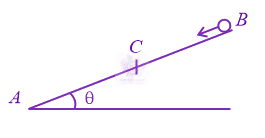
A particle starts from the origin at $t=0$ with an initial velocity of $3.0\hat{i}m/s$ and moves in the $x-y$ plane with a constant acceleration $(6.0\hat{i}+4.0\hat{j})m/{s}^{2}.$ The $x-$ coordinate of the particle at the instant when its $y-$ coordinate is $32m$ is $D$ meters. The value of $D$ is:
Consider a uniform rod of mass $M=4m$ and length $l$ pivoted about its centre. A mass $m$ moving with velocity $v$ making angle $\theta =\frac{\pi }{4}$ to the rod’s long axis collides with one end of the rod and sticks to it. The angular speed of the rod-mass system just after the collision is:
A student measuring the diameter of a pencil of circular cross-section with the help of a vernier scale records the following four readings $5.50\mathrm{mm}$, $5.55\mathrm{mm}$, $5.34\mathrm{mm}$, $5.65\mathrm{mm}$. The average of these four reading is $5.5375\mathrm{mm}$ and the standard deviation of the data is $0.07395\mathrm{mm}$. The average diameter of the pencil should therefore be recorded as :
Consider two solid spheres of radii ${R}_{1}=1m$,${R}_{2}=2m$ and masses ${M}_{1}$ and ${M}_{2},$ respectively. The gravitational field due to sphere $(1)$ and $(2)$ are shown. The value of $\frac{{M}_{1}}{{M}_{2}}$ is: 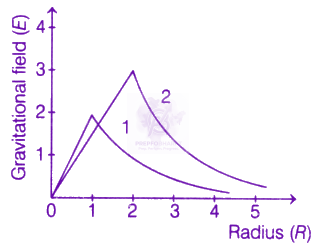
A block of mass $m=1\mathrm{kg}$ slides with velocity $v=6m{s}^{-1}$ on a frictionless horizontal surface and collides with a uniform vertical rod and sticks to it as shown. The rod is pivoted about $O$ and swings as a result of the collision making angle $\theta$ before momentarily coming to rest. if the rod has mass $M=2\mathrm{kg},$ and length $\ell =1m,$ the value of $\theta$ is approximately$(\mathrm{take}g=10m{s}^{-2})$ 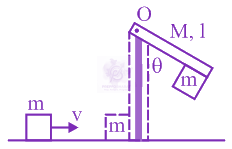
The height ‘$h$’ at which the weight of a body will be the same as that at the same depth ‘h’ from the surface of the earth is (Radius of the earth is $R$ and effect of the rotation of the earth is neglected)
A cylindrical vessel containing a liquid is rotated about its axis so that the liquid rises at its sides as shown in the figure. The radius of vessel is $5\mathrm{cm}$ and the angular speed of rotation is $\omega \mathrm{rad}{s}^{-1}$. The difference in the height, $h(\mathrm{in}\mathrm{cm})$ of liquid at the Centre of vessel and at the sides of the vessel will be : 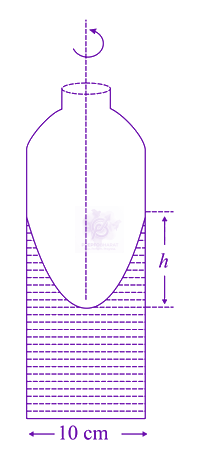
A physical quantity z depends on four observables $a,b,c$ and $d$, as $z=\frac{{a}^{2}{b}^{2/3}}{\sqrt{c}{d}^{3}}.$ The percentage of error in the measurement of $a,b,c$ and $d$ are $2%,1.5%,4%$ and $2.5%$ respectively. The percentage of error in $z$ is :
A wire of density $9\times {10}^{–3}\mathrm{kg}{\mathrm{cm}}^{–3}$ is stretched between two clamps $1m$ apart. The resulting strain in the wire is $4.9\times {10}^{–4}$. The lowest frequency of the transverse vibrations in the wire (Young's modulus of wire $Y=9\times {10}^{10}{\mathrm{Nm}}^{–2}$ ), (to the nearest integer),_______
If the screw on a screw-gauge is given six rotations, it moves by $3mm$ on the main scale. If there are $50$ divisions on the circular scale the least count of the screw gauge is:
A tennis ball is released from a height $\text{h}$ and after freely falling on a wooden floor it rebounds and reaches height $\text{h}/2$. The velocity versus height of the ball during its motion may be represented graphically by: (graphs are drawn schematically and on not to scale)
A wheel is rotating freely with an angular speed $\omega$ on a shaft. The moment of inertia of the wheel is $I$ and the moment of inertia of the shaft is negligible. Another wheel of moment of inertia $3I$ initially at rest is suddenly coupled to the same shaft. The resultant fractional loss in the kinetic energy of the system is:
A spring mass system (mass $m,$ spring constant $k$ and natural length $l$ ) rests in equilibrium on a horizontal disc. The free end of the spring is fixed at the centre of the disc. If the disc together with spring mass system rotates about it's axis with an angular velocity $\omega ,(k>>m{\omega }^{2})$ the relative change in the length of the spring is best given by the option:
A particle is moving unidirectional on a horizontal plane under the action of a constant power supplying energy source. The displacement (s) – time (t) graph that describes the motion of the particle is (graphs are drawn schematically and are not to scale):
Mass per unit area of a circular disc of radius a depends on the distance $r$ from its centre as $\sigma (r)=A+Br$ . The moment of inertia of the disc about the axis, perpendicular to the plane and passing through its centre is:
A simple pendulum is being used to determine the value of gravitational acceleration $g$ at a certain place. The length of the pendulum is $25.0cm$ and a stopwatch with $1s$ resolution measures the time taken for $40$ oscillations to be $50s$. The accuracy in $g$ is:
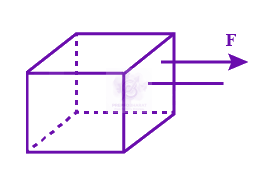 Consider a uniform cubical box of side a on a rough floor that is to be moved by applying minimum possible force $F$ at a point $b$ above its centre of mass (see figure). If the coefficient of friction is $\mu =0.4$ , the maximum possible value of $100\times \frac{b}{a}$ for a box not to topple before moving is ________