JEE Main Physics — Mechanics previous year questions with solutions.
An elevator in a building can carry a maximum of $10$ persons, with the average mass of each person being $68kg$ . The mass of the elevator itself is $920kg$ and it moves with a constant speed of $3m/s$ . The frictional force opposing the motion is $6000N$ . If the elevator is moving up with its full capacity, the power delivered by the motor to the elevator $(g=10m/{s}^{2})$ must be at least:
A body of mass $m=10kg$ is attached to one end of a wire of length $0.3m$. What is the maximum angular speed (in $rad{s}^{-1}$) with which it can be rotated about its other end in a space station without breaking the wire? [Breaking stress of wire $(\sigma )$$=4.8\times {10}^{7}N{m}^{-2}$ and area of cross-section of the wire$={10}^{-2}c{m}^{2}$]
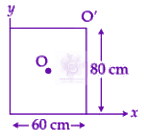 For a uniform rectangular sheet shown in the figure, the ratio of moments of inertia about the axes perpendicular to the sheet and passing through $O$ (the centre of mass) and $O$' (corner point) is:
A force $\vec{F}=(\hat{i}+2\hat{j}+3\hat{k})N$ acts at a point $(4\hat{i}+3\hat{j}-\hat{k})m$. Then the magnitude of torque about the point $(\hat{i}+2\hat{j}+\hat{k})m$ will be $\sqrt{x}N-m.$The value of $x$ is..........
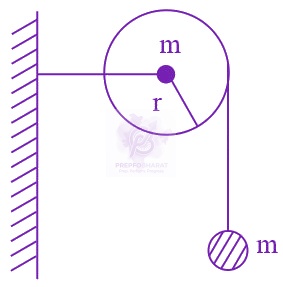 As shown in the figure, a bob of mass $m$ is tied to a massless string whose other end portion is wound on a fly wheel (disc) of radius $r$ and mass $m.$ When released from rest the bob starts falling vertically. When it has covered a distance of $h,$ the angular speed of the wheel will be:
A simple pendulum is being used to determine the value of gravitational acceleration $g$ at a certain place. The length of the pendulum is $25.0cm$ and a stopwatch with $1s$ resolution measures the time taken for $40$ oscillations to be $50s$. The accuracy in $g$ is:
On the $x$-axis and at a distance $x$ from the origin, the gravitational field due to a mass distribution is given by $\frac{Ax}{{({x}^{2}+{a}^{2})}^{3/2}}$ in the $x$-direction. The magnitude of the gravitational potential on the $x$-axis at a distance $x$, taking its value to be zero at infinity is:
A bead of mass $m$ stays at point $P(a,b)$ on a wire bent in the shape of a parabola $y=4C{x}^{2}$ and rotating with angular speed $\omega$ (see figure). The value of $\omega$ is (neglect friction) 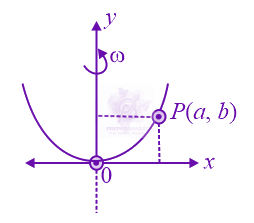
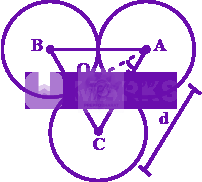 Three solid spheres each of mass $m$ and diameter $d$ are stuck together such that the lines connecting the centres form an equilateral triangle of side of length $d$ . The ratio $\frac{{I}_{0}}{{I}_{A}}$ of moment of inertia ${I}_{0}$ of the system about an axis passing the centroid and about center of any of the spheres ${I}_{A}$ and perpendicular to the plane of the triangle is:
As shown in figure. When a spherical cavity (centred at $O$ ) of radius $1$ is cut out of a uniform sphere of radius $R$ (centred at $C$ ), the centre of mass of remaining (shaded part of sphere is at $G,$ i.e., on the surface of the cavity. $R$ can be determined by the equation: 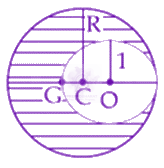
The linear mass density of a thin rod $\mathrm{AB}$ of length $L$ varies from $A$ to $B$ as $\lambda (x)={\lambda }_{0}(1+\frac{x}{L})$, where $x$ is the distance from $A$. If $M$ is the mass of the rod then its moment of inertia about an axis passing through $A$ and perpendicular to the rod :
A particle is moving along the $x$ -axis with its coordinate with time $t$ given by $x(t)=10+8t-3{t}^{2}.$ Another particle is moving along the $y$ -axis with its coordinate as a function of time given by $y(t)=5-8{t}^{3}.$ At $t=1s,$ the speed of the second particle as measured in the frame of the first particle is given as $\sqrt{v}.$ Then $v(inm{s}^{-1})$ is ___________.
A box weighs $196N$ on a spring balance at the north pole. Its weight recorded on the same balance if it is shifted to the equator is close to (Take $g=10{ms}^{-2}$ at the north pole and the radius of the earth $=6400km$ ):
A rod of length $l$ has non-uniform linear mass density given by $\rho (x)=a+b{(\frac{x}{l})}^{2},$ where $a$ and $b$ are constants and $0\leq x\leq l$ The value of $x$ for the centre of mass of the rod is at:
A particle moving in the $\mathrm{xy}$-plane experiences a velocity dependent force $\vec{F}=k({\upsilon }_{y}\hat{i}+{\upsilon }_{x}\hat{j})$, where ${\upsilon }_{x}$ and ${\upsilon }_{y}$ are the $x$ and $y$ components of its velocity $\vec{\upsilon }$. If $\vec{a}$ is the acceleration of the particle, then which of the following statements is true for the particle ?
If the potential energy between two molecules is given by $U=\frac{A}{{r}^{6}}+\frac{B}{{r}^{12}},$ then at equilibrium, separation between molecules, and the potential energy are:
The density of a solid metal sphere is diameter. The maximum error in the density of the sphere is $(\frac{x}{100})%.$ If the relative errors in measuring the mass and the diameter are $6.0%$ and $1.5%$ respectively, the value of $x$ is $-$
Dimensional formula for thermal conductivity is (here $\text{K}$ denotes the temperature):
The dimension of stopping potential ${V}_{0}$ in photoelectric effect in units of Planck’s constant ‘ $h$ ’, speed of light ‘ $c$ ’ and Gravitational constant ‘ $G$ ’ and ampere $A$ is:
The centre of mass of a solid hemisphere of radius $8\mathrm{cm}$ is $x\mathrm{cm}$ from the centre of the flat surface. Then value of $x$ is
In an experiment to verify Stokes law, a small spherical ball of radius $r$ and density $\rho$ falls under gravity through a distance $h$ in air before entering a tank of water. If the terminal velocity of the ball inside water is same as its velocity just before entering the water surface, then the value of $h$ is proportional to: (ignore viscosity of air)
A air bubble of radius $1\text{ cm}$ in water has an upward acceleration of $9.8{\text{ cms}}^{–2}$. The density of water is $1{\text{ gm cm}}^{–3}$ and water offers negligible drag force on the bubble. The mass of the bubble is $(g=980\text{cm}/{\text{s}}^{2})$.
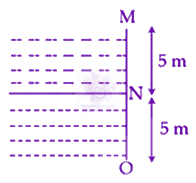 Two liquids of densities ${\rho }_{1}$ and ${\rho }_{2}({\rho }_{2}=2{\rho }_{1})$ are filled up behind a square wall of side $10m$ as shown in figure. Each liquid has a height of $5m.$ The ratio of the forces due to these liquids exerted on upper part MN to that at the lower part NO is (Assume that the liquids are not mixing):
A leak proof cylinder of length $1m,$ made of a metal which has very low coefficient of expansion is floating vertically in water at ${0}^{o}C$ such that its height above the water surface is $20cm.$ When the temperature of water is increased to ${4}^{o}C,$ the height of the cylinder above the water surface becomes $21cm.$ The density of water at $T={4}^{o}C,$ relative to the density at $T={0}^{o}C$ is close to: