JEE Main Physics — Mechanics previous year questions with solutions.
A particle moves such that its position vector $\vec{r}(t)=\mathrm{cos}\omega t\hat{i}+\mathrm{sin}\omega t\hat{j}$ where $\omega$ is a constant and $t$ is time. Then which of the following statements is true for the velocity $\vec{v}(t)$ and acceleration $\vec{a}(t)$ of the particle:
The density of a solid metal sphere is diameter. The maximum error in the density of the sphere is $(\frac{x}{100})%.$ If the relative errors in measuring the mass and the diameter are $6.0%$ and $1.5%$ respectively, the value of $x$ is $-$
If speed $V$, area $A$ and force $F$ are chosen as fundamental units, then the dimension of Young's modulus will be :
If momentum$(P)$, area $(A)$ and time $(T)$ are taken to be the fundamental quantities then the dimensional formula for energy is :
The velocity $(v)$ and time $(t)$ graph of a body in a straight line motion is shown in the figure. The point $S$ is at $4.333$ seconds. The total distance covered by the body in $6s$ is : 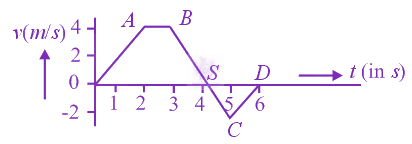
A particle of charge $q$ and mass $m$ is subjected to an electric field $E={E}_{0}(1–a{x}^{2})$ in the $x-$direction, where a and ${E}_{0}$ are constants. Initially the particle was at rest at $x=0$. Other than the initial position the kinetic energy of the particle becomes zero when the distance of the particle from the origin is :
A particle of mass $m$ and charge $q$ is released from rest in a uniform electric field. If there is no other force on the particle, the dependence of its speed $v$ on the distance $x$ travelled by it is correctly given by (graphs are schematic and not drawn to scale)
A body is moving in a low circular orbit about a planet of mass $M$ and radius $R$. The radius of the orbit can be taken to be $R$ itself. Then the ratio of the speed of this body in the orbit to the escape velocity from the planet is:
The mass density of a spherical galaxy varies as $\frac{K}{r}$ over a large distance $r$ from its center. In that region, a small star is in a circular orbit of radius $R$. Then the period of revolution,$T$ depends on $R$ as:
When a car is at rest, its driver sees rain drops falling on it vertically. When driving the car with speed $v$, he sees that rain drops coming at an angle ${60}^{\circ }$ from the horizontal. On further increasing the speed of the car to $(1+\beta )v$, this angle changes to ${45}^{\circ }$. The value of $\beta$ is close to :
A body $A$ of mass $m=0.1kg$ has an initial velocity of $3\hat{i}m{s}^{-1}$. It collides elastically with another body $B$ of the same mass which has an initial velocity of $5\hat{j}m{s}^{-1}$. After the collision, $A$ moves with a velocity $\vec{v}=4(\hat{i}+\hat{j})m{s}^{-1}$. The energy of $B$ after the collision is written as $\frac{x}{10}J$. The value of $x$ is
A spaceship in space sweeps stationary interplanetary dust. As a result, its mass increases at a rate $\frac{dM(t)}{dt}=b{v}^{2}(t),$ where $v(t)$ is its instantaneous velocity. The instantaneous acceleration of the satellite is:
An insect is at the bottom of a hemispherical ditch of radius $1m$. It crawls up the ditch but starts slipping after it is at height h from the bottom. If the coefficient of friction between the ground and the insect is $0.75,$ then $h$is $:(g=10m{s}^{-2})$
A mass of $10kg$ is suspended by a rope of length $4m$, from the ceiling. A force $F$ is applied horizontally at the mid-point of the rope such that the top half of the rope makes an angle of $45^{\circ}$ with the vertical. Then $F$ equals: (Take $g=10m{s}^{-2}$ and the rope to be massless)
A particle of mass $m$ is fixed to one end of a light spring having force constant $k$ and unstretched length $l.$ The other end is fixed. The system is given an angular speed $\omega$ about the fixed end of the spring such that it rotates in a circle in gravity free space. Then the stretch in the spring is:
A thin rod of mass $0.9\mathrm{kg}$ and length $1m$ is suspended, at rest, from one end so that it can freely oscillate in the vertical plane. A particle of move $0.1\mathrm{kg}$ moving in a straight line with velocity $80m{s}^{-1}$ hits the rod at its bottom most point and sticks to it (see figure). The angular speed (in $\mathrm{rad}{s}^{-1}$) of the rod immediately after the collision will be ………… 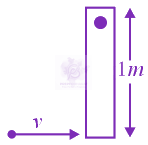
Two particles of equal mass $m$ have respective initial velocities $u\hat{i}$ and $u(\frac{\hat{i}+\hat{j}}{2})$ . They collide completely inelastically. The energy lost in the process is:
Three point particles of masses $1.0kg,1.5\mathrm{kg}$ and $2.5kg$ are placed at three corners of a right angle triangle of sides $4.0cm,3.0cm$ and $5.0cm$ as shown in the figure. The centre of mass of the system is at a point: 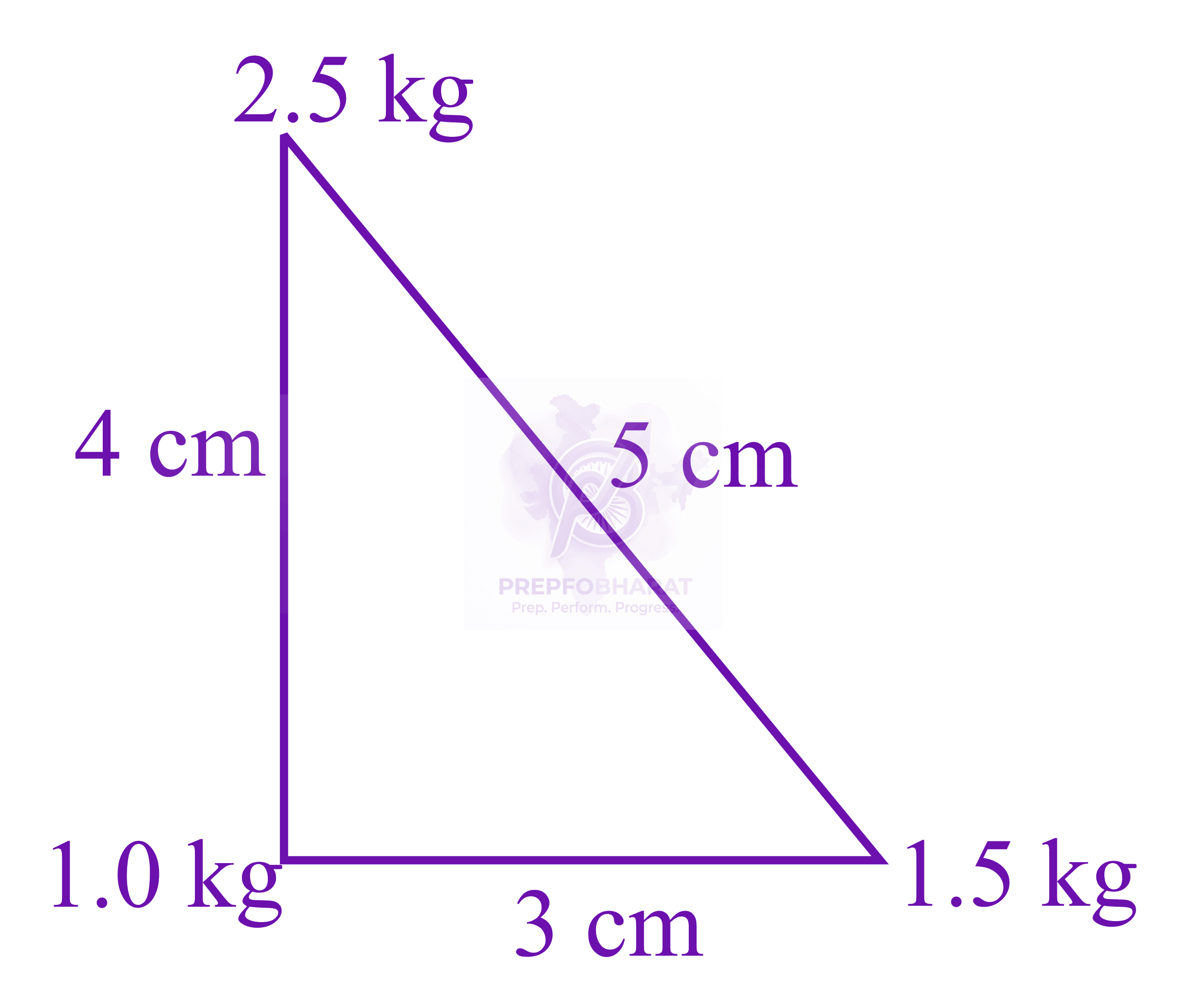
For the four sets of three measured physical quantities as given below. Which of the following options is correct?<br>$(i)$ ${A}_{1}=24.36,{B}_{1}=0.0724,{C}_{1}=256.2$<br>$(ii)$ ${A}_{2}=24.44,{B}_{2}=16.082,{C}_{2}=240.2$<br>$(iii)$ ${A}_{3}=25.2,{B}_{3}=19.2812,{C}_{3}=236.183$<br>$(iv)$ ${A}_{4}=25,{B}_{4}=236.191,{C}_{4}=19.5$
Shown in the figure is a hollow ice-cream cone (it is open at top). If its mass is $M$, radius of its top is $R$ and height, $H$, then its moment of inertia about its axis is 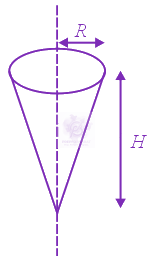
Hydrogen ion and singly ionized helium atom are accelerated, from rest, through the same potential difference. The ratio of final speeds of hydrogen and helium ions is close to:
Blocks of masses $\text{m}, 2\text{m}, 4\text{m}$ and $8\text{m}$ are arranged in a line of a frictionless floor. Another block of mass $m$ , moving with speed $\upsilon$ along the same line (see figure) collides with mass $m$ in perfectly inelastic manner. All the subsequent collisions are also perfectly inelastic. By the time the last block of mass $8\text{m}$ starts moving the total energy loss is $\text{p%}$ of the original energy. Value of ‘$\text{p}$ ’ is close to: 
A quantity $f$ is given by $f=\sqrt{\frac{h{c}^{5}}{G}}$ where $c$ is speed of light, $G$ univasal gravitational constant and $h$ is the Planck’s constant. Dimension of $f$ is that of:
A body A of mass $m$ is moving in a circular orbit of radius $R$ about a planet. Another body B of mass $\frac{m}{2}$ collides with A with a velocity which is half $(\frac{\vec{v}}{2})$ the instantaneous velocity $\vec{v}$ of A. The collision is completely inelastic. Then, the combined body: