JEE Main Physics — Mechanics previous year questions with solutions.
The speed verses time graph for a particle is shown in the figure. The distance travelled (in $m$) by the particle during the time interval $t=0$ to $t=5$ $s$ will be __________ 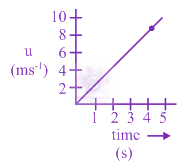
The moment of inertia of a uniform circular disc of radius R and mass M about an axis touching the disc at its diameter and normal to the disc is:
Train $A$ and train $B$ are running on parallel tracks in the opposite directions with speed of $36\mathrm{km}{\mathrm{hour}}^{-1}$ and $72\mathrm{km}{\mathrm{hour}}^{-1}$, respectively. A person is walking in train $A$ in the direction opposite to its motion with a speed of $1.8\mathrm{km}{\mathrm{hour}}^{-1}$. Speed $(\mathrm{in}m{s}^{-1})$ of this person as observed from train $B$ will be close to: (take the distance between the tracks as negligible)
A person pushes a box on a rough horizontal plateform surface. He applies a force of $200N$ over a distance of $15m$. Thereafter, he gets progressively tired and his applied force reduces linearly with distance to $100N$. The total distance through which the box has been moved is $30m$. What is the work done by the person during the total movement of the box?
A clock has a continuously moving second's hand of $0.1m$ length. The average acceleration of the tip of the hand (in units of ${\mathrm{ms}}^{-2}$ ]) is of the order of :
A block starts moving up an inclined plane of inclination $30^{\circ}$ with an initial velocity of${v}_{0}$. It comes back to its initial position with velocity $\frac{{v}_{0}}{2}.$ The value of the coefficient of kinetic friction between the block and the inclined plane is close to $\frac{1}{1000},$ The nearest integer to $I$ is :
A uniform sphere of mass $500 g$ rolls without slipping on a plane horizontal surface with its centre moving at a speed of $5.00\mathrm{cm}{s}^{-1}$. Its kinetic energy is:
$ABC$ is a plane lamina of the shape of an equilateral triangle. $D,E$ are mid-points of $AB,AC$ and $G$ is the centroid of the lamina. Moment of inertia of the lamina about an axis passing through $G$ and perpendicular to the plane $ABC$ is ${I}_{0}$. If part $ADE$ is removed, the moment of inertia of the remaining part about the same axis is $\frac{N{I}_{0}}{16}$ where $N$ is an integer. Value of $N$ is: 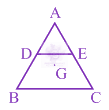
When a long glass capillary tube of radius $0.015\mathrm{cm}$ is dipped in a liquid, the liquid rises to a height of $15\mathrm{cm}$ within it. If the contact angle between the liquid and glass to close to $0^{\circ}$, the surface tension of the liquid, in milliNewton ${m}^{-1},$ is $[{\rho }_{\text{(liqued) }}=900\mathrm{kg}{m}^{-3},g=10m{s}^{-2}]$ (Given answer in closed integer)
An asteroid is moving directly towards the centre of the earth. When at a distance of $10R$ ($R$ is the radius of the earth) from the centre of the earth, it has a speed of $12\mathrm{km}{s}^{-1}.$ Neglecting the effect of earth's atmosphere, what will be the speed of the asteroid when it hits the surface of the earth (escape velocity from the earth is $11.2km{s}^{-1})$ ? Give your answer to the nearest integer in $\mathrm{km}{s}^{-1}$__________.
A cricket ball of mass $0.15\mathrm{kg}$ is thrown vertically up by a bowling machine so that it rises to a maximum height of $20m$ after leaving the machine. If the part pushing the ball applies a constant force $F$ on the ball applies a constant force $F$ on the ball and moves horizontally a distance of $0.2m$ while launching the ball, the value of $F(\mathrm{in}N)$ is $(g=10m{s}^{-2})$
A screw gauge has 50 divisions on its circular scale. The circular scale is 4 units ahead of the pitch scale marking, prior to use. Upon one complete rotation of the circular scale, a displacement of $0.5\mathrm{mm}$ is noticed on the pitch scale. The nature of zero error involved and the lest count of the screw gauge, are respectively:
A square shaped hole of side$l=\frac{a}{2}$ is carved out at a distance $d=\frac{a}{2}$ from the centre '$O$' of a uniform circular disk of radius a. If the distance of the centre of mass of the remaining portion from $O$ is $-\frac{a}{x}$, value of $X$ (to the nearest integer) is : 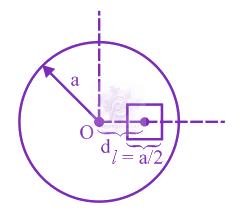
Planet $A$ has mass $M$ and radius $R.$ Planet $B$ has half the mass and half the radius of Planet $A.$ If the escape velocities from the Planets $A$ and $B$ are ${v}_{A}$ and ${v}_{B},$ respectively, then $\frac{{v}_{A}}{{v}_{B}}=\frac{n}{4}.$ The value of $n$ is:
A small ball of mass $m$ is thrown upward with velocity $u$ from the ground. The ball experiences a resistive force $mk{v}^{2}$ where $v$ is it speed. The maximum height attained by the ball is :
Consider a solid sphere of radius $R$ and mass density $\rho (r)={\rho }_{0}(1-\frac{{r}^{2}}{{R}^{2}}),0<r\leq R.$ The minimum density of a liquid in which it will float is:
The quantities $x=\frac{1}{\sqrt{{\mu }_{0}{\in }_{0}}},y=\frac{E}{B}$ and $z=\frac{l}{CR}$ are defined where C-capacitance, R-Resistance, $\ell -$length, E-Electric field, B-magnetic field and$\in 0,\mu 0,-$free space permittivity and permeability respectively. Then:
An massless equilateral triangle EFG of side 'a' (As shown in figure) has three particles of mass $m$ situated at its vertices. The moment of inertia of the system about the line EX perpendicular to EG in the plane of EFG is $\frac{N}{20}{\mathrm{ma}}^{2}$ where $N$ is an integer. The value of $N$ is ___________ . 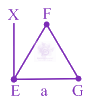
Shown in the figure is rigid and uniform one meter long rod $\mathrm{AB}$ held in horizontal position by two strings tied to its ends and attached to the ceiling. The rod is off mass $'m'$ and has another weight of mass $2m$ hung at a distance of $75\mathrm{cm}$ from $A$. The tension in the string at $A$ is: 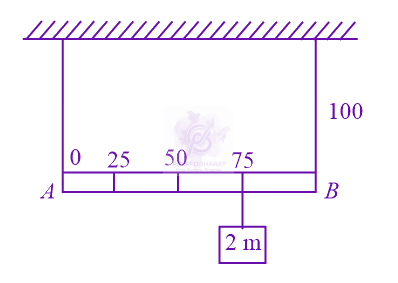
Amount of solar energy received on the earth's surface per unit area per unit time is defined a solar constant. Dimension of solar constant is:
Starting from the origin at time $\text{t}=0$, with initial velocity $5\overset{⏜}{j}{\text{ms}}^{-1}$, a particle moves in the $x$ -$y$ plane with a constant acceleration of $(10\overset{⏜}{i}+4\overset{⏜}{j}){\text{ms}}^{-2}$. At time $\text{t}$, its coordinates are $(20{\text{m, y}}_{0}\text{ m})$. The values of $\text{t}$ and ${\text{y}}_{0}$ are, respectively:
A satellite of mass$M$ is launched vertically upwards with an initial speed $u$ from the surface of the earth. After it reaches height $R$ ( $R=$ radius of the earth), it ejects a rocket of mass $\frac{M}{10}$ so that subsequently the satellite moves in a circular orbit. The kinetic energy of the rocket is ( $G$ is the gravitational constant; ${M}_{e}$ is the mass of the earth):
A particle of mass $m$ is dropped from a height $h$ above the ground. At the same time another particle of the same mass is thrown vertically upwards from the ground with a speed of $\sqrt{2gh}.$ If they collide head-on completely inelastically, the time taken for the combined mass to reach the ground, in units of $\sqrt{\frac{h}{g}}$ is:
Speed of a transverse wave on a straight wire (mass $6.0g,$ length $60cm$ and area of cross-section $1.0m{m}^{2}$ is $90{ms}^{-1}$. If the Young's modulus of wire is $16\times {10}^{11}N{m}^{-2}$, the extension of wire over its natural length is: