JEE Main Physics — Mechanics previous year questions with solutions.
A sphere of mass $2\mathrm{kg}$ and radius $0.5m$ is rolling with an initial speed of $1{ms}^{-1}$ goes up an inclined plane which makes an angle of $30^{\circ}$ with the horizontal plane, without slipping. How low will the sphere take to return to the starting point $A$? 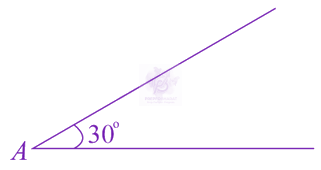
Two vectors $\vec{X}$ and $\vec{Y}$ have equal magnitude. The magnitude of $(\vec{X}-\vec{Y})$ is $n$ times the magnitude of $(\vec{X}+\vec{Y})$. The angle between $\vec{X}$ and $\vec{Y}$ is :
The diameter of a spherical bob is measured using a vernier callipers. $9$ divisions of the main scale, in the vernier callipers, are equal to $10$ divisions of vernier scale. One main scale division is $1\mathrm{mm}.$ The main scale reading is $10\mathrm{mm}$ and ${8}^{\mathrm{th}}$ division of vernier scale was found to coincide exactly with one of the main scale division. If the given vernier callipers has positive zero error of $0.04\mathrm{cm},$ then the radius of the bob is _____________ $\times {10}^{-2}\mathrm{cm}.$
The vernier scale used for measurement has a positive zero error of $0.2\mathrm{mm}.$ If while taking a measurement it was noted that $0$ on the vernier scale lies between $8.5\mathrm{cm}$ and $8.6\mathrm{cm}$. Vernier coincidence is $6,$ then the correct value of measurement is $\mathrm{cm}.$ (least count$=0.01\mathrm{cm}$)
A body of mass $m$ is launched up on a rough inclined plane making an angle of $30^{\circ}$ with the horizontal. The coefficient of friction between the body and plane is $\frac{\sqrt{x}}{5}$ if the time of ascent is half of the time of descent. The value of $x$ is
An inclined plane is bent in such a way that the vertical cross-section is given by $y=\frac{{x}^{2}}{4}$ where $y$ is in vertical and $x$ in horizontal direction. If the upper surface of this curved plane is rough with coefficient of friction $\mu =0.5,$ the maximum height in $\mathrm{cm}$ at which a stationary block will not slip downward is________$\mathrm{cm}.$
An inclined plane making an angle of $30^{\circ}$ with the horizontal is placed in a uniform horizontal electric field $200\frac{N}{C}$ as shown in the figure. A body of mass $1\mathrm{kg}$ and charge $5\mathrm{mC}$ is allowed to slide down from rest at a height of $1m$. If the coefficient of friction is $0.2,$ find the time taken by the body to reach the bottom. $[g=9.8m{s}^{-2};\mathrm{sin}30^{\circ}=\frac{1}{2};\mathrm{cos}30^{\circ}=\frac{\sqrt{3}}{2}]$ 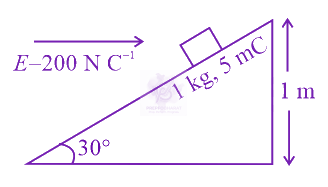
A helicopter is flying horizontally with a speed $v$ at an altitude $h$ has to drop a food packet for a man on the ground. What is the distance of helicopter from the man when the food packet is dropped ?
A system consists of two identical spheres each of mass $1.5\mathrm{kg}$ and radius $50\mathrm{cm}$ at the ends of a light rod. The distance between the centres of the two spheres is $5m.$ What will be the moment of inertia of the system about an axis perpendicular to the rod passing through its midpoint?
An engine is attached to a wagon through a shock absorber of length $1.5m.$ The system with a total mass of $40,000\mathrm{kg}$ is moving with a speed of $72\mathrm{km}{h}^{-1}$ when the brakes are applied to bring it to rest. In the process of the system being brought to rest, the spring of the shock absorber gets compressed by $1.0m$. If $90%$ of energy of the wagon is lost due to friction, the spring constant is $_________\times {10}^{5}N{m}^{-1}.$
A body of mass $m$ dropped from a height $h$ reaches the ground with a speed of $0.8\sqrt{gh}.$ The value of work done by the air-friction is:
An automobile of mass $m$ accelerates starting from the origin and initially at rest, while the engine supplies constant power $P$. The position is given as a function of time by:
Two solids $A$ and $B$ of mass $1\mathrm{kg}$ and $2\mathrm{kg}$ respectively are moving with equal linear momentum. The ratio of their kinetic energies ${(K.E.)}_{A}:{(K.E.)}_{B}$ will be $\frac{A}{1},$ so the value of $A$ will be _________.
A constant power delivering machine has towed a box, which was initially at rest, along a horizontal straight line. The distance moved by the box in time $t$ is proportional to :-
A rubber ball is released from a height of $5m$ above the floor. It bounces back repeatedly, always rising to $\frac{81}{100}$ of the height through which it falls. Find the average speed of the ball. (Take $g=10{ms}^{-2}$)
$\mathrm{Assertion}A:$ If $A,B,C,D$ are four points on a semi-circular arc with a centre at $O$ such that $|\vec{AB}|=|\vec{BC}|=|\vec{CD}|.$ Then, $\vec{AB}+\vec{AC}+\vec{AD}=4\vec{AO}+\vec{OB}+\vec{OC}$<br>$\mathrm{Reason}R:$ Polygon law of vector addition yields $\vec{AB}+\vec{BC}+\vec{CD}+\vec{AD}=2\vec{AO}$<br><img src="https://prepforbharat.s3.ap-south-1.amazonaws.com/exam/615f0e999476412f48314daf/Physics/images/Mathematics_in_Physics/648b5a6b417cc3fb48d675d5/question_1__q_648b5a6b417cc3fb48d675d5__cdn-question-pool.getmarks.app__ca64fd8d-ea77-4c07-93d2-d3ab941483f5-image__17d06709a1_final_ppt_sync.png" alt="JEE Main 2021 Physics, Mathematics in Physics — question figure"><br>In the light of the above statements, choose the most appropriate answer from the options given below.
Consider a water tank as shown in the figure. It's cross-sectional area is $0.4{m}^{2}$. The tank has an opening $B$ near the bottom whose cross-section area is $1{\mathrm{cm}}^{2}$. A load of $24\mathrm{kg}$ is applied on the water at the top when the height of the water level is $40\mathrm{cm}$ above the bottom, the velocity of water coming out the opening $B$ is $vm{s}^{-1}$. The value of $v$, to the nearest integer, is ___ .[Take the value of $g$ to be $10{ms}^{-2}$] 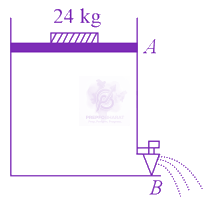
Find the gravitational force of attraction between the ring and sphere as shown in the diagram, where the plane of the ring is perpendicular to the line joining the centres. If $\sqrt{8}R$ is the distance between the centres of a ring (of mass $m$) and a sphere (mass $M$) where both have equal radius $R$ 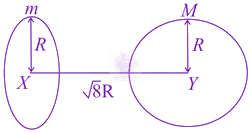
Four particles each of mass $M,$ move along a circle of radius $R$ under the action of their mutual gravitational attraction as shown in figure. The speed of each particle is : 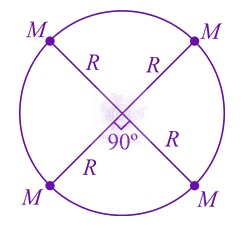
Particle $A$ of mass ${m}_{1}$ moving with velocity $(\sqrt{3}\hat{i}+\hat{j}){\mathrm{ms}}^{-1}$ collides with another particle $B$ of mass ${m}_{2}$ which is at rest initially. Let ${\vec{v}}_{1}$ and ${\vec{v}}_{2}$ be the velocities of particles $A$ and $B$ after collision respectively. If ${m}_{1}=2{m}_{2}$ and after collision ${\vec{v}}_{1}-(\hat{i}+\sqrt{3}\hat{j}){\mathrm{ms}}^{-1}$, the angle between ${\vec{v}}_{1}$ and ${\vec{v}}_{2}$ is :
Four point masses, each of mass $m$, are fixed at the corners of a square of side I. The square is rotating with angular frequency $\omega ,$ about an axis passing through one of the corners of the square and parallel to tis diagonal, as shown in the figure. The angular momentum of the square about the axis is 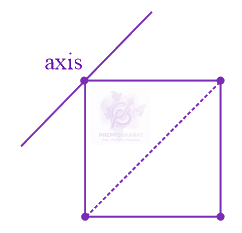
A physical quantity z depends on four observables $a,b,c$ and $d$, as $z=\frac{{a}^{2}{b}^{2/3}}{\sqrt{c}{d}^{3}}.$ The percentage of error in the measurement of $a,b,c$ and $d$ are $2%,1.5%,4%$ and $2.5%$ respectively. The percentage of error in $z$ is :
A block of mass $1.9\mathrm{kg}$ is at rest at the edge of a table, of height 1 m. A bullet of mass $0.1\mathrm{kg}$ collides with the block and sticks to it. If the velocity of the bullet is $20m{s}^{-1}$ in the horizontal direction just before the collision then the kinetic energy just before the combined system strikes the floor, is [Take $g=10m{s}^{-2}$. Assume there is no rotational motion and loss of energy after the collision is negligible.]
A particle of mass $m$ with an initial velocity $u\hat{i}$ collides perfectly elastically with a mass $3m$ at rest. It moves with a velocity $v\hat{j}$ after collision, then, $v$ is given by