JEE Main Physics — Mechanics previous year questions with solutions.
Two blocks of masses $3\mathrm{kg}$ and $5\mathrm{kg}$ are connected by a metal wire going over a smooth pulley. The breaking stress of the metal is $\frac{24}{\pi }\times {10}^{2}N{m}^{-2}$. What is the minimum radius of the wire ? ( take $g=10{ms}^{-2})$ 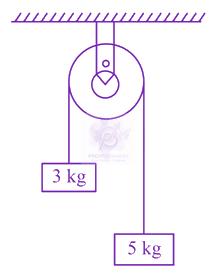
The time period of a simple pendulum is given by $T=2\pi \sqrt{\frac{l}{g}}.$ The measured value of the length of the pendulum is $10\mathrm{cm}$ known to a $1\mathrm{mm}$ accuracy. The time for $200$ oscillations of the pendulum is found to be $100$ second using a clock of $1s$ resolution. The percentage accuracy in the determination of $g$ using this pendulum is $x.$ The value of $x$ to the nearest integer is:-
In order to determine the Young's Modulus of a wire of radius $0.2\mathrm{cm}$ (measured using a scale of least count $=0.001\mathrm{cm}$) and length $1m$ (measured using a scale of least count $=1\mathrm{mm}$), a weight of mass $1\mathrm{kg}$ (measured using a scale of least count $=1g$ ) was hanged to get the elongation of $0.5\mathrm{cm}$ (measured using a scale of least count $0.001\mathrm{cm}$). What will be the fractional error in the value of Young's Modulus determined by this experiment?
If $C$ and $V$ represent capacity and voltage respectively then what are the dimensions of $\lambda$ where $C/V=\lambda$ ?
Match List - I with List - II : <table class="pyq-table"><tbody><tr><td></td><td>$\mathrm{List}-I$</td><td></td><td>$\mathrm{List}-\mathrm{II}$</td></tr><tr><td>$(a)$</td><td>$h$ (Planck's constant)</td><td>$(i)$</td><td>$[{\mathrm{MLT}}^{-1}]$</td></tr><tr><td>$(b)$</td><td>$E$ (kinetic energy)</td><td>$(\mathrm{ii})$</td><td>$[{\mathrm{ML}}^{2}{T}^{-1}]$</td></tr><tr><td>$(c)$</td><td>$V$ (electric potential)</td><td>$(\mathrm{iii})$</td><td>$[{\mathrm{ML}}^{2}{T}^{-2}]$</td></tr><tr><td>$(d)$</td><td>$P$ (linear momentum)</td><td>$(\mathrm{iv})$</td><td>$[{\mathrm{ML}}^{2}{I}^{-1}{T}^{-3}]$</td></tr></tbody></table>Choose the correct answer from the options given below:
The work done by a gas molecule in an isolated system is given by, $W=\alpha {\beta }^{2}{e}^{-\frac{{x}^{2}}{\alpha kT}},$ where $x$ is the displacement, $k$ is the Boltzmann constant and $T$ is the temperature. $\alpha$ and $\beta$ are constants. Then the dimensions of $\beta$ will be:
A uniform heavy rod of weight $10\mathrm{kg}{ms}^{-2},$ cross-sectional area $100{\mathrm{cm}}^{2}$ and length $20\mathrm{cm}$ is hanging from a fixed support. Young modulus of the material of the rod is $2\times {10}^{11}N{m}^{-2}.$ Neglecting the lateral contraction, find the elongation of rod due to its own weight:
A particle is moving with constant acceleration $a.$ Following graph shows ${v}^{2}$ versus $x$ (displacement) plot. The acceleration of the particle is _________ $m{s}^{-2}.$ 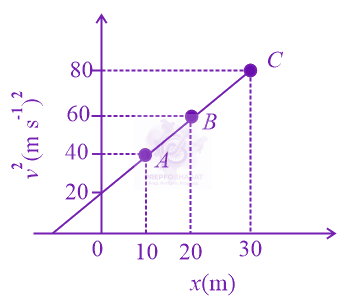
If the velocity of a body related to displacement $x$ is given by $v=\sqrt{5000+24x}m{s}^{-1},$ then the acceleration of the body is _________ $m{s}^{-2}.$
Two spherical balls having equal masses with radius of $5\mathrm{cm}$ each are thrown upwards along the same vertical direction at an interval of $3s$ with the same initial velocity of $35m{s}^{-1}$, then these balls collide at a height of _____$m$, (take $g=10m{s}^{-2}$)
The relation between time $t$ and distance $x$ for a moving body is given as $t=m{x}^{2}+nx$, where $m$ and $n$ are constants. The retardation of the motion is: (When $v$ stands for velocity)
A body at rest is moved along a horizontal straight line by a machine delivering a constant power. The distance moved by the body in time $t$ is proportional to:
The velocity of a particle is $v=({v}_{0}+gt+F{t}^{2})m{s}^{-1}$. Its position is $x=0$ at $t=0;$ then its displacement after time $(t=1s)$ is :
A mosquito is moving with a velocity $\vec{v}=0.5{t}^{2}\hat{i}+3t\hat{j}+9\hat{k}m{s}^{-1}$ and accelerating in uniform conditions. What will be the direction of mosquitoes after $2s$ ?
A person standing on a spring balance inside a stationary lift measures $60\mathrm{kg}$. The weight of that person if the lift descends with uniform downward acceleration of $1.8m{s}^{-2}$ will be $N$. $[g=10m{s}^{-2}]$
A block of $200g$ mass moves with a uniform speed in a horizontal circular groove, with vertical side walls of radius $20\mathrm{cm}$. If the block takes $40s$ to complete one round, the normal force by the side walls of the groove is:
A small block slides down from the top of hemisphere of radius $R=3m$ as shown in the figure. The height $h$ at which the block will lose contact with the surface of the sphere is $m$. (Assume there is no friction between the block and the hemisphere) 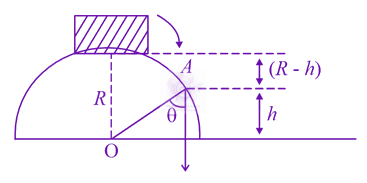
In a spring gun having spring constant $100N{m}^{-1}$ a small ball $B$ of mass $100g$ is put in its barrel (as shown in figure) by compressing the spring through $0.05m$. There should be a box placed at a distance $d$ on the ground so that the ball falls in it. If the ball leaves the gun horizontally at a height of $2m$ above the ground. The value of $d$ is $m$. $(g=10m{s}^{-2})$ 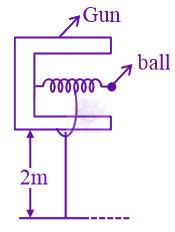
A modern grand-prix racing car of mass $m$ is travelling on a flat track in a circular arc of radius $R$ with a speed $v.$ If the coefficient of static friction between the tyres and the track is ${\mu }_{s},$ then the magnitude of negative lift ${F}_{L}$ acting downwards on the car is: 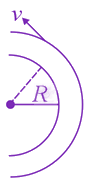
The length of a metal wire is ${\ell }_{1},$ when the tension in it is ${T}_{1}$ and is ${\ell }_{2}$ when the tension is ${T}_{2}.$ The natural length of the wire is:
A huge circular arc of length $4.4\mathrm{ly}$ subtends an angle $4s$ at the centre of the circle. How long it would take for a body to complete $4$ revolution if its speed is $8\mathrm{AU}$ per second? Given : $1\mathrm{ly}=9.46\times {10}^{15}m$ $1\mathrm{AU}=1.5\times {10}^{11}m$
A wire of $1\Omega$ has a length of $1m$. It is stretched till its length increases by $25%$. The percentage change in resistance to the nearest integer is :
A ball with a speed of $9m{s}^{-1}$ collides with another identical ball at rest. After the collision, the direction of each ball makes an angle of $30^{\circ}$ with the original direction. If the ratio of velocities of the balls after the collision is $x:y$, then what is the value of $x$?
If the angular velocity of earth's spin is increased such that the bodies at the equator start floating, the duration of the day would be approximately : (Take : $g=10{\mathrm{ms}}^{-2}$, the radius of earth, $R=6400\times {10}^{3}m$, Take $\pi =3.14$)