JEE Main Physics — Mechanics previous year questions with solutions.
Given below are two statements: one is labelled as Assertion A and the other is labelled as Reason R. Assertion A: Moment of inertia of a circular disc of mass $M$ and radius $R$ about $X,Y$ axes (passing through its plane) and Z-axis which is perpendicular to its plane were found to be ${I}_{x},{I}_{y}$ and ${I}_{z}$, respectively. The respective radii of gyration about all the three axes will be the same. Reason R: A rigid body making rotational motion has fixed mass and shape. In the light of the above statements, choose the most appropriate answer from the options given below:
A block moving horizontally on a smooth surface with a speed of $40{ms}^{-1}$ splits into two equal parts. If one of the parts moves at $60{ms}^{-1}$ in the same direction, then the fractional change in the kinetic energy will be $x:4$ where $x=$ ________.
In an octagon $ABCDEFGH$ of equal side, what is the sum of $\vec{AB}+\vec{AC}+\vec{AD}+\vec{AE}+\vec{AF}+\vec{AG}+\vec{AH},$ if, $\vec{\mathrm{AO}}=2\hat{i}+3\hat{j}-4\hat{k}$<br><img src="https://prepforbharat.s3.ap-south-1.amazonaws.com/exam/615f0e999476412f48314daf/Physics/images/Mathematics_in_Physics/648b5a6a417cc3fb48d6724d/question_1__q_648b5a6a417cc3fb48d6724d__cdn-question-pool.getmarks.app__6d57eb30-500d-4e69-80b2-34a8f26821c1-image__2302001706_final_ppt_sync.png" alt="JEE Main 2021 Physics, Mathematics in Physics — question figure">
What will be the projection of vector $\vec{A}=\hat{i}+\hat{j}+\hat{k}$ on vector $\vec{B}=\hat{i}+\hat{j}?$
A mass $M$ hangs on a massless rod of length $l$ which rotates at a constant angular frequency. The mass $M$ moves with steady speed in a circular path of constant radius. Assume that the system is in steady circular motion with constant angular velocity $\omega .$ The angular momentum of $M$ about point $A$ is ${L}_{A}$ which lies in the positive $z$ direction and the angular momentum of $M$ about $B$ is ${L}_{B}.$ The correct statement for this system is: 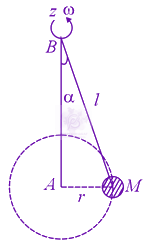
The following bodies, $(1)$ a ring $(2)$ a disc $(3)$ a solid cylinder $(4)$ a solid sphere, of same mass $m$ and radius $R$ are allowed to roll down without slipping simultaneously from the top of the inclined plane. The body which will reach first at the bottom of the inclined plane is [Mark the body as per their respective numbering given in the question] 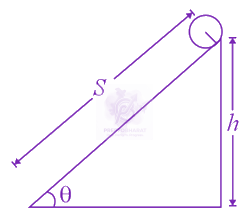
An object is located at $2\mathrm{km}$ beneath the surface of the water. If the fractional compression $\frac{\Delta V}{V}$ is $1.36%$, the ratio of hydraulic stress to the corresponding hydraulic strain will be ______[Given: density of water is $1000\mathrm{kg}{m}^{-3}$ and $g=9.8{ms}^{-2}.$
A person whose mass is $100\mathrm{kg}$ travels from Earth to Mars in a spaceship. Neglect all other objects in sky and take acceleration due to gravity on the surface of the Earth and Mars as $10m{s}^{-2}$ and $4m{s}^{-2}$, respectively. Identify from the below figures, the curve that fits best for the weight of the passenger as a function of time. 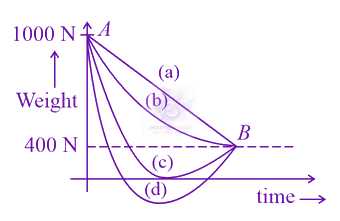
A bomb is dropped by a fighter plane flying horizontally. To an observer sitting in the plane, the trajectory of the bomb is a :
The radius of a sphere is measured to be $(7.50\pm 0.85)\mathrm{cm}$. Suppose the percentage error in its volume is $x$. The value of $x$, to the nearest $x$, is ___ .
A wire of $1\Omega$ has a length of $1m$. It is stretched till its length increases by $25%$. The percentage change in resistance to the nearest integer is :
Statement I: A cyclist is moving on an unbanked road with a speed of $7\mathrm{km}{h}^{-1}$ and takes a sharp circular turn along a path of the radius of $2m$ without reducing the speed. The static friction coefficient is $0.2$. The cyclist will not slip and pass the curve $(g=9.8m{s}^{-2})$ Statement II : If the road is banked at an angle of $45^{\circ}$, cyclist can cross the curve of $2m$ radius with the speed of $18.5\mathrm{km}{h}^{-1}$ without slipping. In the light of the above statements, choose the correct answer from the options given below.
A rod of mass $M$ and length $L$ is lying on a horizontal frictionless surface. A particle of mass $m$ travelling along the surface hits at one end of the rod with a velocity $u$ in a direction perpendicular to the rod. The collision is completely elastic. After collision, particle comes to rest. The ratio of masses $(\frac{m}{M})$ is $\frac{1}{x}.$ The value of $x$ will be
A boy is rolling a $0.5\mathrm{kg}$ ball on the frictionless floor with the speed of $20{ms}^{-1}.$ The ball gets deflected by an obstacle on the way. After deflection it moves with $5%$ of its initial kinetic energy. What is the speed of the ball now?
A body of mass $M$ moving at speed ${V}_{0}$ collides elastically with a mass $m$ at rest. After the collision, the two masses move at angles ${\theta }_{1}$ and ${\theta }_{2}$ with respect to the initial direction of motion of the body of mass $M.$. The largest possible value of the ratio $\frac{M}{m},$ for which the angles ${\theta }_{1}$ and ${\theta }_{2}$ will be equal, is :
Match List - I with List - II : <table class="pyq-table"><tbody><tr><td></td><td>List - I</td><td></td><td>List - II</td></tr><tr><td>a</td><td>Magnetic induction</td><td>i</td><td>${\mathrm{ML}}^{2}{T}^{-2}{A}^{-1}$</td></tr><tr><td>b</td><td>Magnetic flux</td><td>ii</td><td>${M}^{0}{L}^{-1}A$</td></tr><tr><td>c</td><td>Magnetic permeability</td><td>iii</td><td>${\mathrm{MT}}^{-2}{A}^{-1}$</td></tr><tr><td>d</td><td>Magnetization</td><td>iv</td><td>${\mathrm{MLT}}^{-2}{A}^{-2}$</td></tr></tbody></table>Choose the most appropriate answer from the options given below :
A body having specific charge $8\mu C{g}^{-1}$ is resting on a frictionless plane at a distance $10\mathrm{cm}$ from the wall (as shown in the figure). It starts moving towards the wall when a uniform electric field of $100V{m}^{-1}$ is applied horizontally towards the wall. If the collision of the body with the wall is perfectly elastic, then the time period of the motion will be $____s.$ 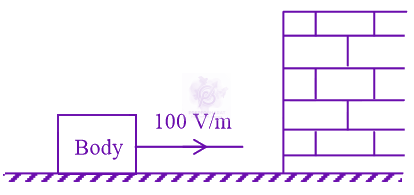
Three students ${S}_{1},{S}_{2}$ and ${S}_{3}$ perform an experiment for determining the acceleration due to gravity $(g)$ using a simple pendulum. They use different lengths of pendulum and record time for different number of oscillations. The observations are as shown in the table.<br><table class="pyq-table"><tbody><tr><td>Student No.</td><td>Length of pendulum $(\mathrm{cm})$</td><td>Number of oscillations $(n)$</td><td>Total time for $n$ oscillations</td><td>Time period $(s)$</td></tr><tr><td>$1.$</td><td>$64.0$</td><td>$8$</td><td>$128.0$</td><td>$16.0$</td></tr><tr><td>$2.$</td><td>$64.0$</td><td>$4$</td><td>$64.0$</td><td>$16.0$</td></tr><tr><td>$3.$</td><td>$20.0$</td><td>$4$</td><td>$36.0$</td><td>$9.0$</td></tr></tbody></table>(Least count of length $=0.1m$, least count for time $=0.1s$)<br>If ${E}_{1},{E}_{2}$ and ${E}_{3}$ are the percentage errors in $g$ for students $1,2$ and $3$, respectively, then the minimum percentage error is obtained by student no $.$
The trajectory of a projectile in a vertical plane is $y=\alpha x-\beta {x}^{2},$ where $\alpha$ and $\beta$ are constants and $x&y$ are respectively the horizontal and vertical distances of the projectile from the point of projection. The angle of projection $\theta$ and the maximum height attained $H$ are respectively given by
A solid sphere of radius $R$ gravitationally attracts a particle placed at $3R$ from its centre with a force ${F}_{1}.$ Now a spherical cavity of radius $(\frac{R}{2})$ is made in the sphere (as shown in figure) and the force becomes ${F}_{2}$. The value of ${F}_{1}:{F}_{2}$ is: 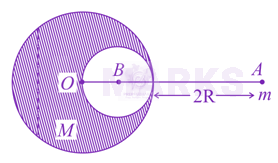
The time period of a simple pendulum is given by $T=2\pi \sqrt{\frac{l}{g}}.$ The measured value of the length of the pendulum is $10\mathrm{cm}$ known to a $1\mathrm{mm}$ accuracy. The time for $200$ oscillations of the pendulum is found to be $100$ second using a clock of $1s$ resolution. The percentage accuracy in the determination of $g$ using this pendulum is $x.$ The value of $x$ to the nearest integer is:-
Consider a $20\mathrm{kg}$ uniform circular disk of radius $0.2m$. It is pin supported at its center and is at rest initially. The disk is acted upon by a constant force $F=20N$ through a massless string wrapped around its periphery as shown in the figure. 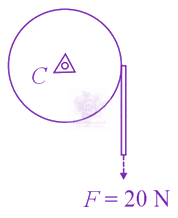 Suppose the disk makes $n$ number of revolutions to attain an angular speed of $50\mathrm{rad}{s}^{-1}$. The value of $n$, to the nearest integer, is _______ . [Given : In one complete revolution, the disk rotates by $6.28\mathrm{rad}$]
Four equal masses, $m$ each are placed at the corners of a square of length $(l)$ as shown in the figure. The moment of inertia of the system about an axis passing through $A$ and parallel to $DB$ would be : 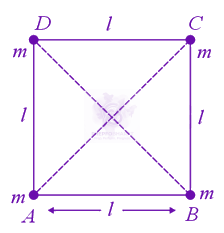
The masses and radii of the earth and moon are $({M}_{1},{R}_{1})$ and $({M}_{2},{R}_{2})$ respectively. Their centres are at a distance $r$ apart. Find the minimum escape velocity for a particle of mass $m$ to be projected from the middle of these two masses :