JEE Main Physics — Mechanics previous year questions with solutions.
A glass tumbler having inner depth of $17.5\mathrm{cm}$ is kept on a table. A student starts pouring water $(\mu =\frac{4}{3})$ into it while looking at the surface of water from the above. When he feels that the tumbler is half filled, he stops pouring water. Up to what height, the tumbler is actually filled ?
If $E$ and $H$ represents the intensity of electric field and magnetizing field respectively, then the unit of $\frac{E}{H}$ will be:
One main scale division of a vernier callipers is $a$ $\mathrm{cm}$ and ${n}^{\mathrm{th}}$ division of the vernier scale coincide with ${(n-1)}^{\mathrm{th}}$ division of the main scale. The least count of the callipers in $\mathrm{mm}$ is :
A body is projected vertically upwards from the surface of earth with a velocity sufficient enough to carry it to infinity. The time taken by it to reach height $h$ is $S.$
A ball of mass $4\mathrm{kg}$, moving with a velocity of $10{ms}^{-1}$, collides with a spring of length $8m$ and force constant $100N{m}^{-1}$. The length of the compressed spring is $xm$. The value of $x$, to the nearest integer, is ___ .
A raindrop with radius $R=0.2\mathrm{mm}$ falls from a cloud at a height $h=2000m$ above the ground. Assume that the drop is spherical throughout its fall and the force of buoyance may be neglected, then the terminal speed attained by the raindrop is : [Density of water ${f}_{w}=1000\mathrm{kg}{m}^{-3}$ and Density of air ${f}_{a}=1.2\mathrm{kg}{m}^{-3},g=10m/{s}^{2}$ Coefficient of viscosity of air $=1.8\times {10}^{-5}Ns{m}^{-2}]$
The motion of a mass on a spring, with spring constant $K$ is as shown in figure. 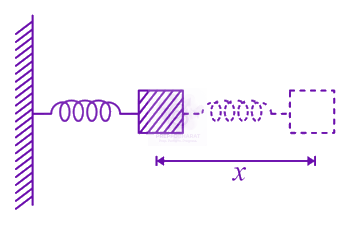 The equation of motion is given by, $x(t)=A\mathrm{sin}\omega t+$$B\mathrm{cos}\omega t$ with $\omega =\sqrt{\frac{K}{m}}$. Suppose that at time $t=0,$the position of mass is $x(0)$ and velocity $v(0),$ then its displacement can also be represented as $x(t)=C\mathrm{cos}(\omega t-\phi ),$ where $C$ and $\phi$ are
Three objects $A,B$ and $C$ are kept in a straight line on a frictionless horizontal surface. The masses of $A,B$ and $C$ are $m,2m$ and $2m$ respectively. $A$ moves towards $B$ with a speed of $9m{s}^{-1}$ and makes an elastic collision with it. Thereafter $B$ makes a completely inelastic collision with $C.$ All motions occur along the same straight line. The final speed of $C$ is : 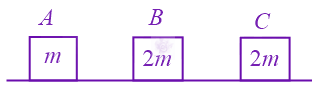
When a body slides down from rest along a smooth inclined plane making an angle of $30^{\circ}$ with the horizontal, it takes time $T.$ When the same body slides down from the rest along a rough inclined plane making the same angle and through the same distance, it takes time $\alpha T,$ where $\alpha$ is a constant greater than $1.$ The co-efficient of friction between the body and the rough plane is $\frac{1}{\sqrt{x}}(\frac{{\alpha }^{2}-1}{{\alpha }^{2}})$ where $x=__________.$
A bullet of $4g$ mass is fired from a gun of mass $4\mathrm{kg}.$ If the bullet moves with the muzzle speed of $50{\mathrm{ms}}^{1},$ the impulse imparted to the gun and velocity of recoil of gun are
The figure shows two solid discs with radius $R$ and $r$ respectively. If mass per unit area is the same for both, what is the ratio of $MI$ of bigger disc around axis $AB$ (Which is $\perp$ to the plane of the disc and passing through its centre) of $MI$ of smaller disc around one of its diameters lying on its plane? Given $M$ is the mass of the larger disc. ($MI$ stands for a moment of inertia) 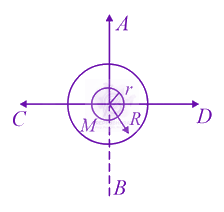
Two small drops of mercury each of radius $R$ coalesce to form a single large drop. The ratio of total surface energy before and after the change is
If the velocity-time graph has the shape $\mathrm{AMB},$ what would be the shape of the corresponding acceleration-time graph? 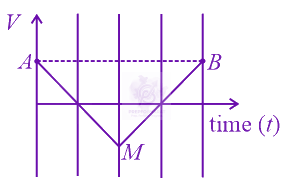
Consider a badminton racket with length scales as shown in the figure. 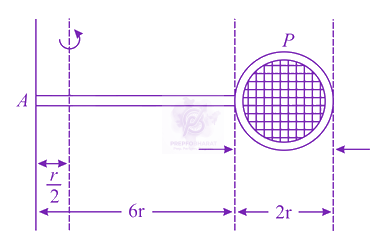 If the mass of the linear and circular portions of the badminton racket are same ($M$) and the mass of the threads are negligible, the moment of inertia of the racket about an axis perpendicular to the handle and in the plane of the ring at, $\frac{r}{2}$ distance from the end $A$ of the handle will be ______$M{r}^{2}$.
In the given figure, two wheels $P$ and $Q$ are connected by a belt $B$. The radius of $P$ is three times that of $Q$. In the case of the same rotational kinetic energy, the ratio of rotational inertias $(\frac{{I}_{1}}{{I}_{2}})$ will be $x:1.$ The value of $x$ will be ______. 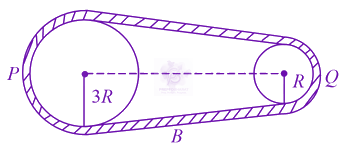
A body of mass $2\mathrm{kg}$ moves under a force of $(2\hat{i}+3\hat{j}+5\hat{k})N$ It starts from rest and was at the origin initially. After $4s$, its new coordinates are $(8,b,20)$. The value of $b$ is ______. (Round off to the Nearest Integer)
A circular disc reaches from top to bottom of an inclined plane of length $L.$ When it slips down the plane, it takes time ${t}_{1}$. When it rolls down the plane, it takes time ${t}_{2}$. The value of $\frac{{t}_{2}}{{t}_{1}}$ is $\sqrt{\frac{3}{x}}$. The value of $x$ will be
Two satellites $A$ and $B$ of masses $200\mathrm{kg}$ and $400\mathrm{kg}$ are revolving round the earth at height of $600\mathrm{km}$ and $1600\mathrm{km}$ respectively. If ${T}_{A}$ and ${T}_{B}$ are the time periods of $A$ and $B$ respectively then the value of ${T}_{B}-{T}_{A}$ :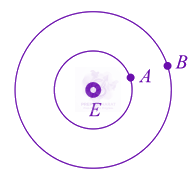 [ Given : radius of earth $=6400\mathrm{km},$ mass of earth $=6\times {10}^{24}\mathrm{kg}$ ]
In an octagon $ABCDEFGH$ of equal side, what is the sum of $\vec{AB}+\vec{AC}+\vec{AD}+\vec{AE}+\vec{AF}+\vec{AG}+\vec{AH},$ if, $\vec{\mathrm{AO}}=2\hat{i}+3\hat{j}-4\hat{k}$ 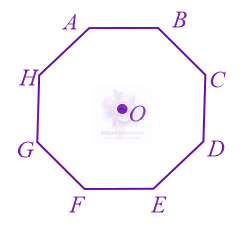
If ${R}_{E}$ be the radius of Earth, then the ratio between the acceleration due to gravity at a depth $r$ below and a height $r$ above the earth surface is: (Given : $r<{R}_{E}$)
In a typical combustion engine the workdone by a gas molecule is given by $W={\alpha }^{2}\beta {e}^{\frac{-\beta {x}^{2}}{kT}}$, where $x$ is the displacement, $k$ is the Boltzmann constant and $T$ is the temperature. If $\alpha$ and $\beta$ are constants, dimensions of $\alpha$ will be:
If $e$ is the electronic charge, $c$ is the speed of light in free space and $h$ is Planck's constant, the quantity $\frac{1}{4\pi {\epsilon }_{0}}\frac{{|e|}^{2}}{hc}$ has dimensions of :
The initial velocity ${v}_{i}$ required to project a body vertically upward from the surface of the earth to reach a height of $10R$, where $R$ is the radius of the earth, may be described in terms of escape velocity ${v}_{e}$ such that ${v}_{i}=\sqrt{\frac{x}{y}}\times {v}_{e}$. The value of $x$ will be
The instantaneous velocity of a particle moving in a straight line is given as $v=\alpha t+\beta {t}^{2}$, where $\alpha$ and $\beta$ are constants. The distance travelled by the particle between $1s$ and $2s$ is: